
Imagine shooting a scene on a soundstage, but instead of green screens and guesswork, you’re standing inside a glowing, living landscape-mountains outside the window, clouds drifting across the sky, sunlight hitting your actor’s face exactly as it would on location. No post-production magic. No blue spill. No waiting weeks to see if the background looks real. This isn’t science fiction. It’s virtual production, and it’s changing how movies and TV shows are made today.
What Is Virtual Production?
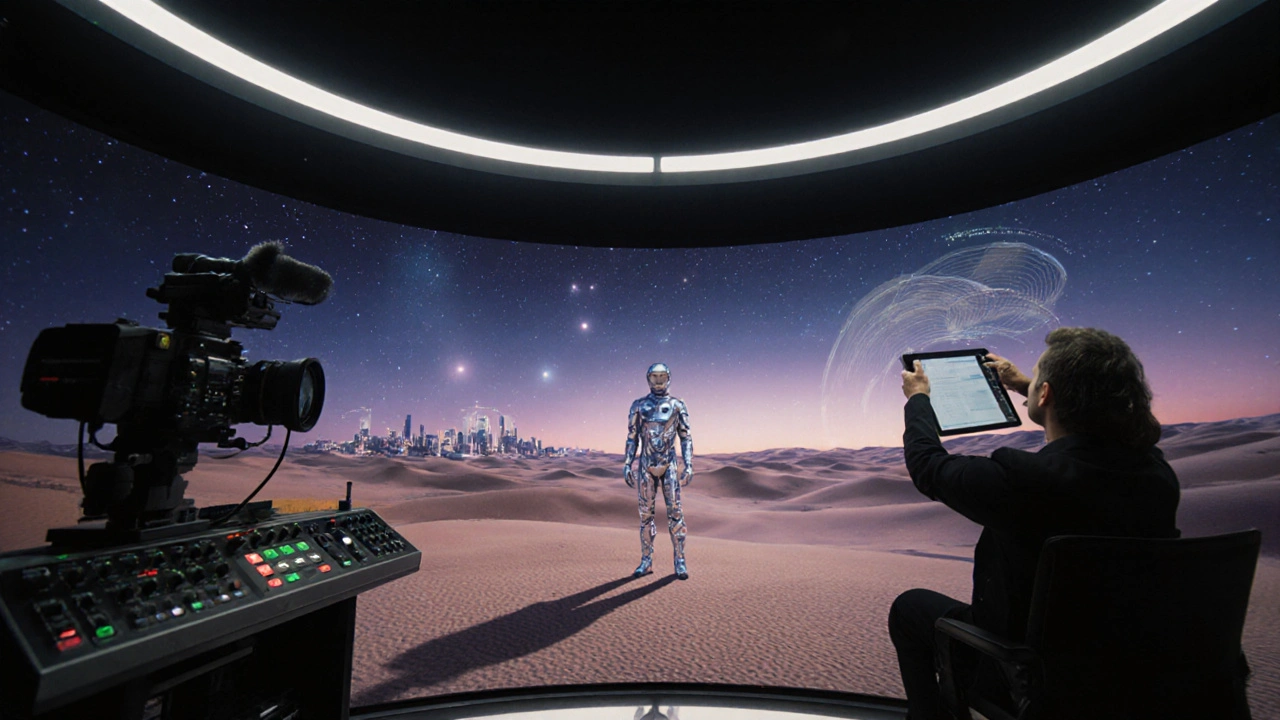
Virtual production is a filmmaking method that combines real-time computer graphics with live-action filming. Instead of shooting actors in front of a green screen and adding backgrounds later, you film them inside a giant LED wall that displays dynamic, photorealistic environments while the camera rolls. The camera’s movement is tracked, and the background updates in real time to match the perspective-just like looking out a real window.
This isn’t just about pretty visuals. It’s about control. Directors can see exactly what the final shot will look like on set. Actors can react to real light and reflections. Cinematographers can use natural lighting techniques-no more trying to fake sunlight with 20K tungsten lamps. And because everything is rendered live, changes happen instantly. Want to move the sun lower in the sky? Change the weather? Switch from a desert to a city skyline? Done. In seconds.
How LED Volume Walls Work
The heart of modern virtual production is the LED volume wall. Think of it as a massive, curved screen made of thousands of high-resolution LED panels. These aren’t your average TV screens. They’re professional-grade, ultra-bright, and designed for film use-capable of hitting 1,000 nits of brightness or more, so they can realistically mimic sunlight, neon signs, or twilight glows.
These walls can form a full 180-degree or even 360-degree environment around the set. Some setups include a ceiling of LEDs, turning the whole space into a dome. The walls are typically made of modules from companies like Sony Crystal LED, Samsung The Wall, or Nanolux. Each panel is calibrated to match color and brightness across the entire surface, so there are no visible seams or flickers under camera.
But here’s the key: the LED walls aren’t just playing back a video. They’re rendering graphics live, frame by frame, based on where the camera is pointing. This is what makes it different from traditional backdrops or pre-rendered loops. The environment reacts to camera motion. If you pan left, the horizon shifts. If you tilt up, clouds roll into view. If you move closer to a wall, the texture becomes sharper. It’s all calculated in real time.
Real-Time Rendering: The Engine Behind the Magic
What powers those dynamic backgrounds? Real-time rendering engines-primarily Unreal Engine, developed by Epic Games. Originally built for video games, Unreal Engine was adapted for film because it handles complex lighting, physics, and textures at 60+ frames per second with incredible accuracy.
Unreal Engine doesn’t just display images. It simulates light. It calculates how sunlight bounces off a car’s hood, how reflections appear on wet pavement, how shadows fall based on the sun’s angle. This means the lighting on your actor’s face comes from the same source as the light in the background. No more matching lights in post. The scene is lit correctly from the start.
Artists create the environments ahead of time using 3D modeling tools like Maya or Blender. These assets are imported into Unreal Engine, where they’re optimized for performance. Then, during filming, a camera tracking system-usually infrared sensors or optical markers-feeds the camera’s position and rotation into the engine. The engine updates the background instantly. The result? Perfect camera-to-background alignment, every time.
Why This Beats Green Screen
Green screen has been the industry standard for decades. But it has serious flaws. Light spills onto actors’ hair and clothes. Shadows don’t match the background. Reflections on glasses or wet surfaces look fake. And actors have to imagine the world around them-often leading to flat, unconvincing performances.
Virtual production fixes all of that. Because the environment is real light, not a flat image, reflections appear naturally. A character wearing a shiny coat will reflect the sky or a neon sign. A puddle on the ground mirrors the LED wall above it. Even the color of light bouncing off a wall affects skin tones-something green screens can’t replicate.
Take The Mandalorian. The show’s creators used an LED volume called StageCraft, built with Unreal Engine, to film entire seasons. In one scene, the character rides a creature through a forest at dusk. The trees sway, the sky dims, and the creature’s scales reflect the orange glow of the setting sun-all captured live. The crew didn’t need to add any CGI in post. What you see on screen is what the camera recorded.
Other productions like Obi-Wan Kenobi, Avatar: The Way of Water, and The Batman have followed suit. Even commercials and music videos now use LED volumes. The tech is no longer reserved for blockbusters-it’s becoming standard.
Costs, Challenges, and Accessibility
Setting up a full LED volume isn’t cheap. A small 20x30-foot stage can cost $1 million to $3 million. Larger ones, like the ones at Industrial Light & Magic or Pinewood Studios, run over $10 million. You need high-end computers, motion tracking systems, specialized LED panels, and a team of real-time artists and engineers.
But costs are dropping. Companies like NVIDIA and Red Giant now offer cloud-based rendering tools that let smaller studios simulate virtual sets without physical walls. Some filmmakers are using large flat LED screens-just one wall instead of a full volume-to get 80% of the benefit at a fraction of the cost. And software like Unreal Engine is free for film projects under $1 million in revenue.
The biggest challenge isn’t money-it’s skill. Not every DP or director knows how to work with real-time engines. Lighting for LED volumes is different than lighting for green screen. You can’t just throw up a softbox. You have to think like a 3D artist, adjusting light intensity and color in the engine, not on set. Training is still limited. But schools like USC and NYU are adding virtual production courses. Studios are hiring real-time artists as part of the core crew.
What’s Next for Virtual Production?
The next leap is AI-driven environments. Imagine typing: “Create a cyberpunk city in 2045 with rain, flying cars, and holographic ads.” The AI generates the scene in minutes, and you start shooting the same day. Tools like NVIDIA’s Omniverse and Adobe’s Project Aero are already experimenting with this.
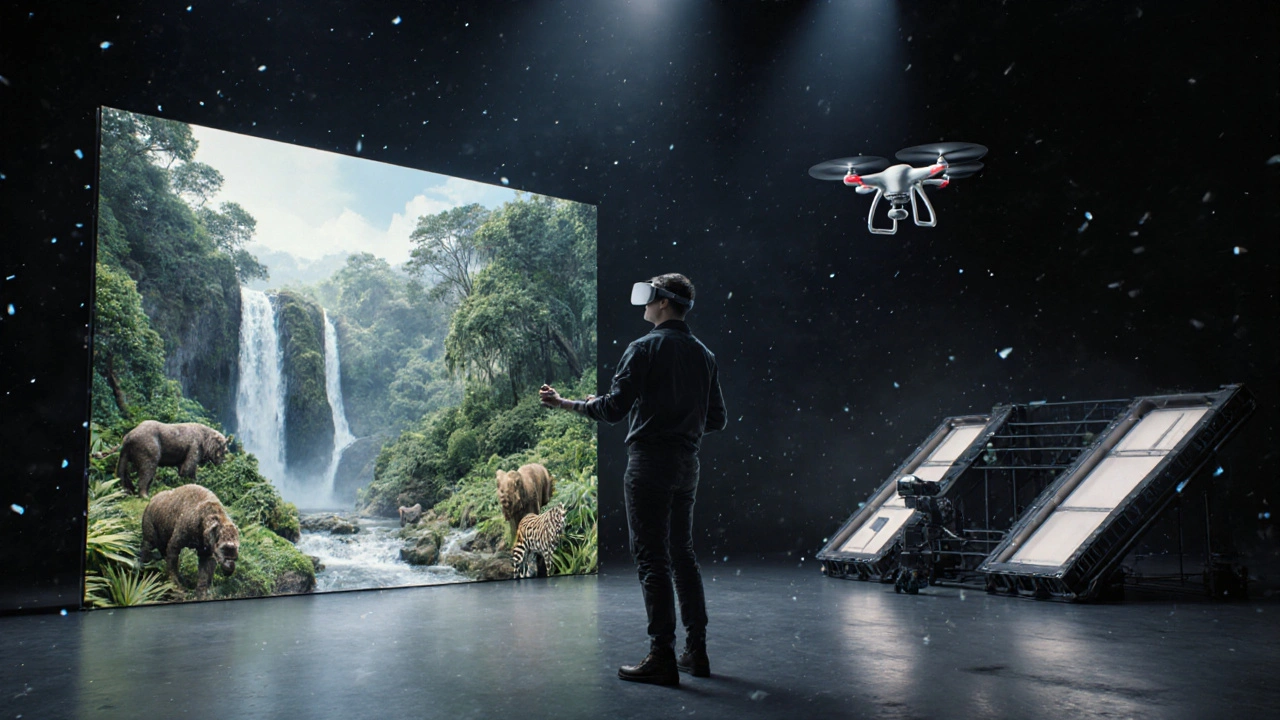
Another trend: portable volumes. Smaller, modular LED walls that can be shipped to remote locations. Imagine shooting a jungle scene in Georgia, but the LED walls show the Amazon rainforest. No travel. No permits. No weather delays.
And soon, you won’t need a physical volume at all. Virtual cameras on set-using AR glasses or head-mounted displays-could let directors see the digital environment overlaid on the real world. You’d walk around a blank stage and see your entire scene in real time, adjusting lighting and camera angles before you even turn on the camera.
Real-World Impact on Filmmaking
This isn’t just a fancy tool. It’s reshaping the entire production pipeline. Pre-visualization is now part of the shoot. Storyboards are replaced by real-time previews. Editing starts on day one because you’re seeing the final image. Post-production time drops by 30-50%. Budgets become more predictable. You’re not paying for weeks of VFX fixes-you’re paying for one solid take.
For indie filmmakers, this means more creative freedom. You’re not limited by location budgets or weather. You can film a space station in your garage. A medieval castle in a warehouse. A Martian landscape in a parking lot. The only limit is your imagination-and your render budget.
And for audiences? They’re getting more immersive, believable worlds. No more awkward green edges. No more floating trees. Just stories that feel real-because they were shot that way.
Is virtual production only for big-budget films?
No. While full LED volumes are expensive, many indie filmmakers are using single-wall LED setups or cloud-based rendering tools to simulate virtual environments. Unreal Engine is free for low-revenue projects, and affordable LED panels are now available for under $50,000. You don’t need a studio the size of a football field to get started.
Do actors need special training for virtual production?
Not necessarily. But they do benefit from seeing the environment they’re in. Actors respond better when they can see where they are-whether it’s a burning building or a distant planet. Directors often show them concept art or short clips of the environment before shooting. Some even use AR headsets during rehearsals to help them visualize the scene.
Can virtual production replace location shooting entirely?
Not yet. While LED volumes can simulate almost any environment, some scenes still need real elements-wind, rain, smoke, or interactions with physical props. Many productions combine virtual backgrounds with practical sets. For example, you might shoot a car chase with real vehicles on a soundstage, while the city behind them is rendered in real time. The goal isn’t to replace location work-it’s to expand it.
What software is used for real-time rendering in virtual production?
Unreal Engine is the dominant platform, used by over 90% of virtual production sets today. It’s favored because of its high-quality lighting, easy integration with camera tracking, and strong artist tools. Some studios use Unity or proprietary engines, but Unreal remains the industry standard. Tools like Nuke and Maya are still used for asset creation, but the live rendering happens in Unreal.
How does camera tracking work in virtual production?
Camera tracking systems use infrared markers or optical sensors to detect the exact position and rotation of the camera in 3D space. These sensors send data to the rendering engine, which adjusts the background in real time to match the camera’s perspective. Systems like Vicon or Mo-Sys are commonly used. Some newer setups use the camera’s own lens data-focal length, focus distance, and zoom-to calculate position without external sensors.


Comments(6)