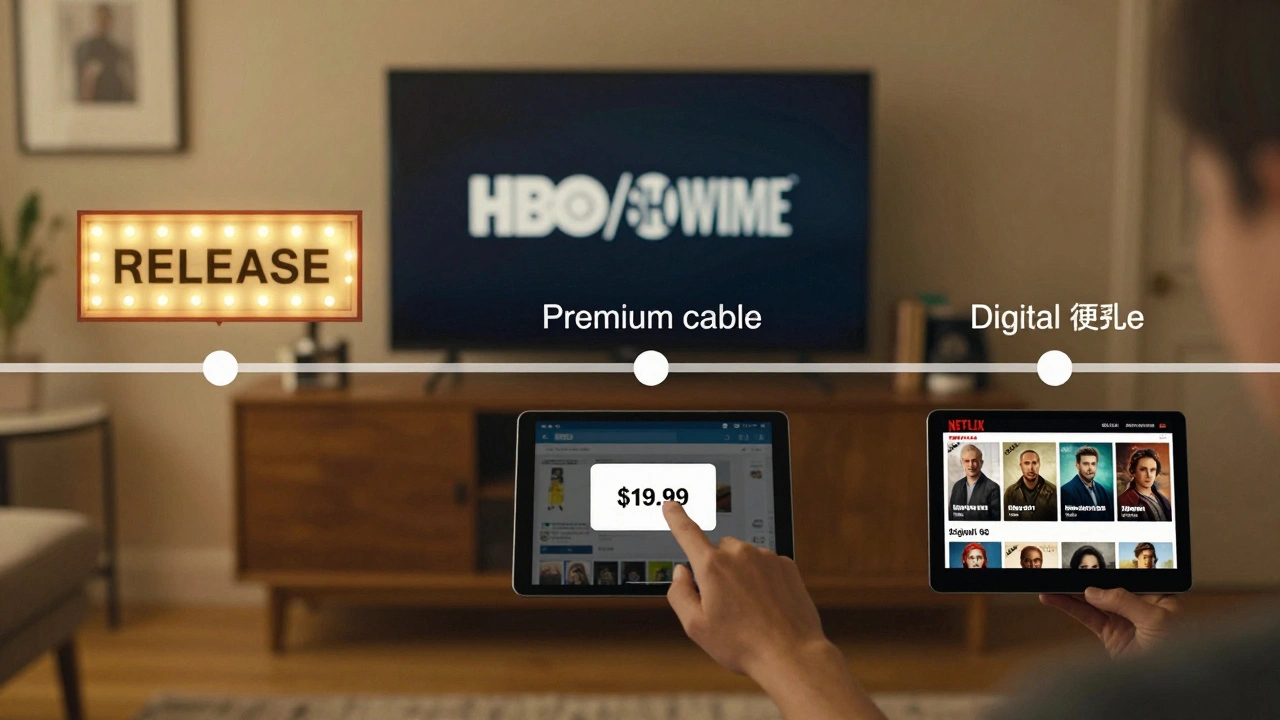
When you stream a movie on Netflix, Hulu, or Apple TV+, you’re not watching it because the studio gave it away for free. You’re watching it because someone paid a lot of money for the right to show it - and that right comes with a strict timeline. These timelines are called licensing windows, and they’re the hidden engine behind what you see on your screen. The most common ones are Pay-2, Pay-3, and Library windows. If you’ve ever wondered why a new movie disappears from theaters, pops up on premium channels, then vanishes again before landing on Netflix, this is why.
What Is a Licensing Window?
A licensing window is a time period during which a streaming service or TV network has the exclusive right to show a movie. Studios don’t sell movies outright. They rent them out in stages, like a theater releasing a film in phases: first to theaters, then to premium cable, then to digital rentals, and finally to subscription services. Each stage has its own rules, prices, and audiences.
Think of it like this: a studio owns the movie. But they don’t want to give it to everyone at once. They want to squeeze every dollar out of it, one audience at a time. That’s where Pay-2, Pay-3, and Library windows come in - they’re not random. They’re a carefully timed money machine.
Pay-2 Window: The First Stop After Theaters
Right after a movie leaves theaters - usually 45 to 90 days later - it enters the Pay-2 window. This is where premium cable networks like HBO, Showtime, or Starz step in. These services pay big money for exclusivity. They don’t just show the movie. They run ads around it. They make it part of their brand. You’ll see it promoted as "HBO Original," even though it came from Universal or Sony.
In 2025, the average Pay-2 deal for a mid-budget film was around $15 million to $25 million. For a hit like Dune: Part Two, it was closer to $40 million. That’s not pocket change. That’s enough to fund three smaller films.
Why does this matter? Because during this window, you can’t stream it on Netflix or Max. You need a cable subscription. If you cut the cord, you’re locked out. Studios count on this. They know cable subscribers are loyal. And they know people will pay extra for premium channels.
Pay-3 Window: The Digital Rental Phase
After Pay-2 ends - usually 6 to 9 months after theatrical release - the movie enters the Pay-3 window. This is where digital storefronts like Apple TV, Amazon Prime Video, and Google Play take over. You can’t stream it for free. But you can rent or buy it.
Here’s how it works: a new release might cost $19.99 to rent for 48 hours. Or $29.99 to own forever. That’s not a one-time sale. Studios get a cut every time someone hits "Rent." In 2025, the average Pay-3 rental revenue for a successful film was $8 million to $12 million over a 3-month window. Some films, like Oppenheimer, made over $20 million just from digital rentals.
This window is also where studios test the market. If a movie sells well as a rental, they know it has long-term value. If it flops, they might push it into the library window faster. Pay-3 is a filter. It tells studios which movies are worth keeping around.
Library Window: The Streaming Graveyard - Or Treasure Trove?
Finally, after 12 to 18 months, the movie enters the Library window. This is where it lands on subscription services like Netflix, Hulu, or Disney+. This is the part you see most often. The movie is no longer exclusive. It’s part of the catalog. You don’t pay extra. It’s just there.
But here’s the twist: studios don’t just hand over the movie for free. They sell the rights for a fixed fee - often between $5 million and $15 million - and the deal lasts 3 to 7 years. After that, the rights expire. The movie disappears. And the studio can sell it again.
That’s why you’ll see the same movie on Netflix, then vanish, then pop up on Hulu a year later. It’s not a glitch. It’s the contract. Netflix paid for the rights from 2023 to 2026. Now they’re done. Hulu picked it up for 2026 to 2030. You’re not getting it for free. You’re getting it because someone else paid for the privilege.
Why Do These Windows Still Exist?
You might think: "Why not just put everything on streaming right away?" That’s what everyone thought in 2020. But the math didn’t work.
When Universal tried releasing movies on Peacock the same day as theaters in 2021, box office revenue dropped 30%. Theater chains threatened to boycott. Studios lost leverage. Revenue dropped across the board.
So they went back to the old system - but with new rules. Today’s windows are shorter than they used to be. Pay-2 used to last 18 months. Now it’s 6 to 9 months. Library windows used to be 10 years. Now they’re 5.
Why? Because streamers are hungry. They need content. And they’re willing to pay more - but only if they get it sooner. Studios learned: shorten the window, increase the price.
What This Means for You
If you’re a casual viewer, this system is frustrating. You want to watch a movie. You can’t. It’s on another service. Or it’s gone. Or it costs $20 to rent.
But if you’re trying to understand why your favorite movie vanished from Netflix, or why new releases never show up on Hulu, now you know. It’s not about algorithms. It’s about contracts. It’s about money.
Here’s a rule of thumb: If a movie came out in theaters in January 2025, you’ll see it on premium cable by April. You can rent it in September. And it’ll land on a subscription service by January 2026. That’s the new normal.
And if you want to watch something before it hits streaming? Go to theaters. Or pay for premium cable. Or rent it. There’s no free pass. The system is designed to make you pay - at every stage.
Who Benefits the Most?
Studios. They get paid three times - once for Pay-2, once for Pay-3, once for the Library. And they still own the movie. They can resell it later. Or license it internationally. Or turn it into a sequel.
Streamers? They get content. But they’re paying more per title than ever. Netflix spent over $1.2 billion on film licensing in 2025. That’s up 40% from 2023. They’re not making money on these movies. They’re using them to keep subscribers.
And you? You’re the one paying for it all - through your subscription fees, your rental fees, your cable bills. The system is built to keep you paying. Again. And again. And again.
What’s Next?
Some studios are experimenting with hybrid models. Warner Bros. tried a 45-day window in 2025. Disney is testing 60-day exclusivity on Hulu before moving films to Disney+. But the core structure isn’t going away.
Why? Because theaters still need to survive. Premium channels still need content. And streamers still need to compete. The windows are shrinking, but they’re not disappearing. They’re just getting more expensive.
The future? More deals. More exclusivity. More confusion. And more money flowing from your wallet into the pockets of studios who still believe the old rules work - even in a streaming world.



Comments(6)