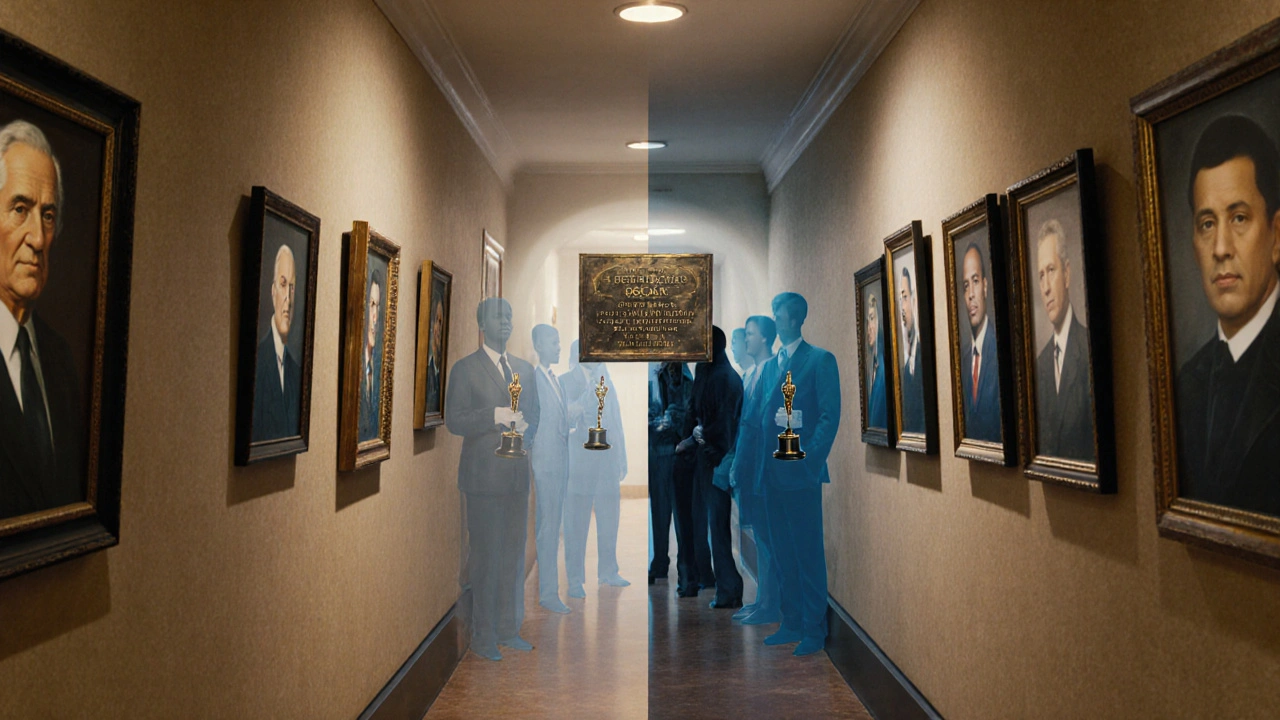
For decades, the Oscars have been more than just a celebration of cinema-they’ve been a mirror. And that mirror? It’s been cracked. The people who vote for the winners don’t look like the audiences watching the movies, and that gap doesn’t just affect who gets nominated-it decides who wins.
Who Actually Votes for the Oscars?
The Academy of Motion Picture Arts and Sciences has around 10,000 voting members. That number sounds big, but it’s not representative. In 2024, 84% of voters were white. Only 14% were Black, Hispanic, Asian, or Indigenous. Over 75% were over the age of 50. More than 70% were men. And nearly half had spent their careers in the same three fields: acting, directing, or producing.
These aren’t random stats. They’re the result of decades of gatekeeping. Membership isn’t open to the public. You get in by invitation, usually after earning an Oscar nomination or having a significant body of work. That means the pool is filled with people who’ve already made it inside the system-and that system has historically favored certain types of stories, performances, and styles.
What Kind of Films Win? It’s Not About Popularity
Think about the last few Best Picture winners. Everything Everywhere All at Once won in 2023. It was bold, weird, and made by a Vietnamese-American director. But it also had a quiet, emotional core about family and loss-themes that resonate with older, more traditional voters. Parasite won in 2020. It was a Korean film with no English dialogue. But it was structured like a classic thriller, with clear moral lines and a devastating class critique-something that appealed to voters who value "serious" cinema.
Compare that to blockbusters like Avengers: Endgame or Barbie. Both made over $1 billion. Both were cultural phenomena. Neither won Best Picture. Why? Because they didn’t fit the mold. The Academy doesn’t vote for what’s popular. It votes for what feels familiar, what feels "important," and what feels like it was made by people who look like them.
The Power of the Branches
The Academy isn’t one group. It’s broken into 19 branches: Actors, Directors, Writers, Cinematographers, and so on. Each branch votes for their own category-Best Actor, Best Cinematography, etc. But for Best Picture, every member gets a ballot. That means a film can win even if most voters didn’t love it, as long as enough of the right people did.
Take Green Book in 2019. It won Best Picture, even though many critics called it outdated and reductive. Why? Because the Actors branch, which makes up the largest voting bloc, loved the lead performances. The Writers branch liked the script’s structure. And the older, predominantly white voters connected with its narrative of racial reconciliation through individual kindness-not systemic change.
That’s the pattern. Films that win often do so because they check boxes that appeal to specific branches, not because they’re universally great. A movie with a powerful lead performance by a white actor? Likely to win Best Actor. A film with a slow-burn drama about trauma or redemption? Likely to win Best Picture. A movie that’s too loud, too funny, or too modern? It might get ignored, even if it’s better made.

How Demographics Shape the Stories We See
The result? The Oscars reward a narrow slice of human experience. Stories about white men overcoming personal demons. Stories about marginalized people being saved by white saviors. Stories that end with quiet tears, not revolution.
Look at the nominations for Best Director over the last 10 years. Only five women have been nominated. Only three Black directors. Only one Asian director. That’s not because there weren’t great films made by them-it’s because the voters didn’t see those films as "worthy."
When voters are mostly older, mostly white, and mostly male, they tend to value films that reflect their own worldview. They don’t always understand stories that come from outside that experience. And when they don’t understand them, they don’t vote for them.
Changes Are Happening-But Slowly
After the #OscarsSoWhite protests in 2015, the Academy made promises. They pledged to double the number of women and people of color in membership by 2020. They did. By 2024, women made up 40% of voters. People of color made up 28%. Those numbers are still low, but they’re rising.
And it’s showing. Minari (2021) got nominated. CODA (2022) won Best Picture. Everything Everywhere All at Once swept the board. These weren’t flukes. They were signs that new voices are finally being heard.
But here’s the catch: older members still hold the most votes. And they’re not going anywhere. The Academy’s voting rules allow lifetime membership. That means someone who voted for Ben-Hur in 1959 can still vote today. And they often do.

What This Means for Filmmakers
If you’re making a film and you want it to win an Oscar, you can’t just make something great. You have to make something that fits the mold.
That means:
- Lead characters who are white, male, or suffering in a quiet, dignified way
- Stories that end with redemption, not revolution
- Themes that feel timeless-not trendy
- Visuals that are polished, not experimental
- Emotional beats that are subtle, not loud
It’s not about lying. It’s about understanding the audience you’re trying to win over. The Academy doesn’t hate innovation. It just doesn’t trust it unless it’s wrapped in something it already recognizes.
Why This Matters Beyond the Oscars
People don’t just watch the Oscars for entertainment. They watch to see what the industry says matters. When the Oscars ignore diverse stories, it sends a message to studios: "Don’t invest in these films. They won’t win."
That affects greenlight decisions. It affects budgets. It affects who gets to tell stories in Hollywood at all.
When a film like The Whale wins Best Actor for a performance that many called problematic, it tells filmmakers that audiences will accept exaggerated, stereotypical portrayals of marginalized people-as long as they’re played by a white actor in heavy prosthetics.
And when a film like A Star Is Born gets snubbed for Best Picture despite massive popularity and critical praise, it tells creators that emotional, mainstream stories don’t count as "art."
What’s Next?
The Academy’s demographics are changing. Slowly. But change takes time. And until the voting body reflects the world outside its doors, the winners will keep reflecting its biases.
For now, the best strategy isn’t to complain. It’s to keep making films. Keep pushing boundaries. Keep telling stories that don’t fit the mold. Because eventually, the voters will have to catch up.
And when they do, the Oscars won’t just be a celebration of film. They’ll be a celebration of everyone who’s ever been told their story doesn’t belong on screen.
Why don’t more diverse films win Oscars?
The voting body is still overwhelmingly white, male, and older. These voters tend to favor films that reflect their own experiences-stories about white protagonists, quiet emotional arcs, and traditional storytelling. Films that are loud, experimental, or center non-white perspectives often get overlooked because they don’t fit that mold-even if they’re critically acclaimed or commercially successful.
Has the Academy become more diverse?
Yes, but slowly. After the #OscarsSoWhite backlash in 2015, the Academy pledged to double membership from underrepresented groups by 2020. By 2024, women made up 40% of voters and people of color made up 28%. That’s progress, but it’s still far from proportional. Older members still hold the most influence because membership is lifelong.
Do box office numbers matter for Oscar wins?
No, not directly. The Oscars don’t reward popularity. Barbie and Avengers: Endgame made billions but didn’t win Best Picture. The Academy values films that feel "important," often those with serious themes, slow pacing, and dramatic performances-even if they’re less commercially successful.
How do the different branches affect Best Picture winners?
Each branch votes for its own category, but all members vote for Best Picture. A film can win if it appeals to key branches-like Actors or Writers-even if others don’t love it. For example, Green Book won because the Actors branch loved the performances and the Writers branch liked the structure, even though many viewers found the story outdated.
Can a film win without a nomination in major categories?
Yes. Parasite won Best Picture in 2020 without a Best Actor or Best Actress nomination. Green Book won in 2019 without a Best Director nomination. The Best Picture vote is a separate process, and films can win based on broad support across the membership, even if they’re not dominant in individual categories.







Comments(9)