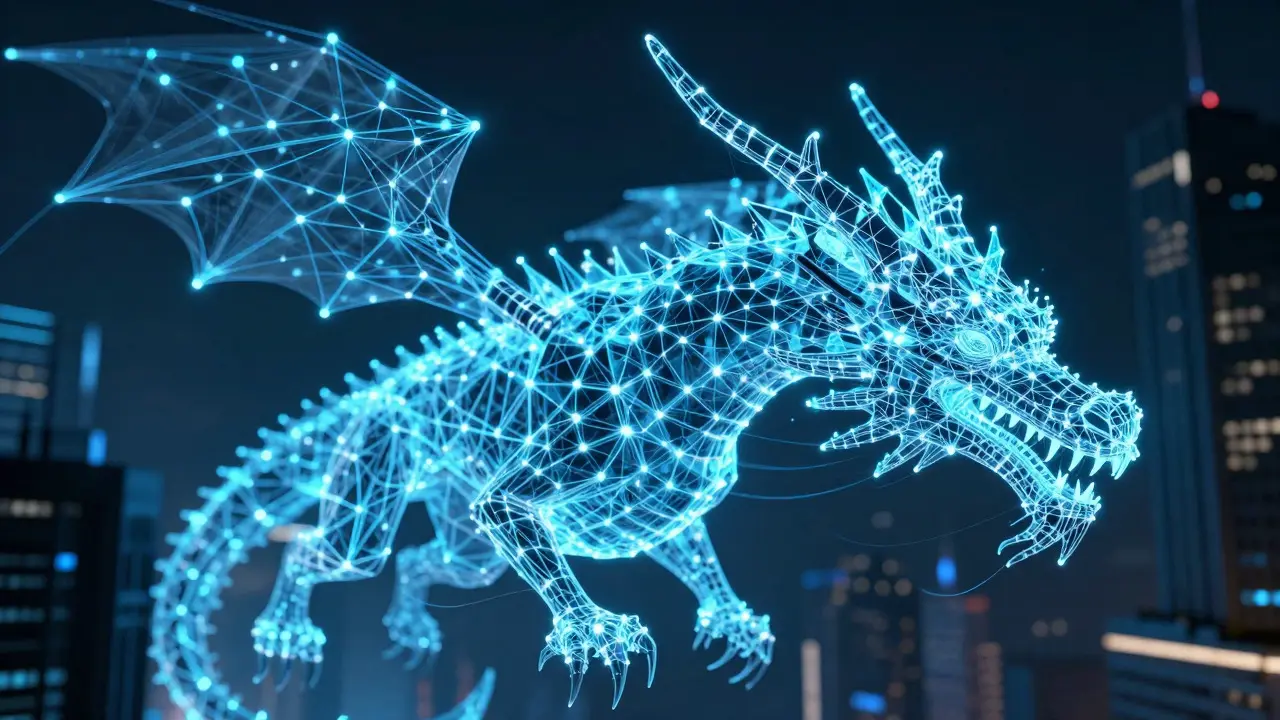
Ever wonder why your favorite blockbuster looks so real? It’s not just magic; it’s math. Specifically, it’s the massive amount of computing power required to turn lines of code into photorealistic pixels. This process is called VFX rendering, and it is the engine room of modern visual effects.
When a director asks for a dragon flying over a city, the computer doesn’t see a dragon. It sees millions of polygons, light rays, and material properties. To make that look convincing on screen, software has to simulate how light interacts with every single surface in the scene. This calculation is incredibly heavy. A single frame of high-quality animation can take hours or even days to compute if done on a standard laptop. That is why studios rely on specialized hardware and distributed systems to get the job done before the release date.
The Core Process: From Scene to Image
Rendering is the final step in the VFX pipeline. Before this stage, artists model characters, rig them, animate their movements, and set up lighting. Once the scene is ready, the renderer takes over. Its job is to calculate the color and brightness of every pixel in the camera view.
This isn't a simple copy-paste operation. The software must determine what is visible, what is hidden behind other objects, and how light bounces around the environment. For example, if you have a glass cup on a table, the renderer needs to calculate refraction (how light bends through the glass), reflection (light bouncing off the surface), and caustics (the focused light patterns cast by the glass). Missing any of these details makes the image look fake immediately.
Ray Tracing vs. Rasterization
There are two main ways computers handle this visual data. You might hear terms like rasterization and ray tracing thrown around. Understanding the difference helps explain why some shots look more realistic than others.
Ray Tracing is a rendering technique that simulates the path of light by tracing rays from the camera through each pixel into the scene. It is considered the gold standard for realism because it handles global illumination, shadows, and reflections physically accurately. However, it is computationally expensive. Early versions were too slow for real-time use, but modern hardware has changed that game entirely.
On the other hand, rasterization is the older method used in most video games. It works by projecting 3D geometry onto a 2D screen and filling in the colors. It is much faster but struggles with complex lighting interactions unless combined with approximations. Today, many engines use a hybrid approach, using rasterization for base geometry and ray tracing for specific effects like reflections and shadows to balance speed and quality.
The Hardware Backbone: CPUs and GPUs
To perform these calculations at scale, you need serious hardware. The two main components are the CPU (Central Processing Unit) and the GPU (Graphics Processing Unit).
- CPU: Traditional rendering engines often rely heavily on multi-core CPUs. These processors are great at handling complex logic and large datasets sequentially. They are stable and predictable, which is crucial for long-running render jobs where stability matters more than raw speed bursts.
- GPU: Modern graphics cards are designed to handle thousands of parallel tasks simultaneously. This makes them perfect for ray tracing, where millions of light rays need to be calculated at once. In recent years, GPU rendering has become the dominant force in the industry due to its sheer speed advantage.
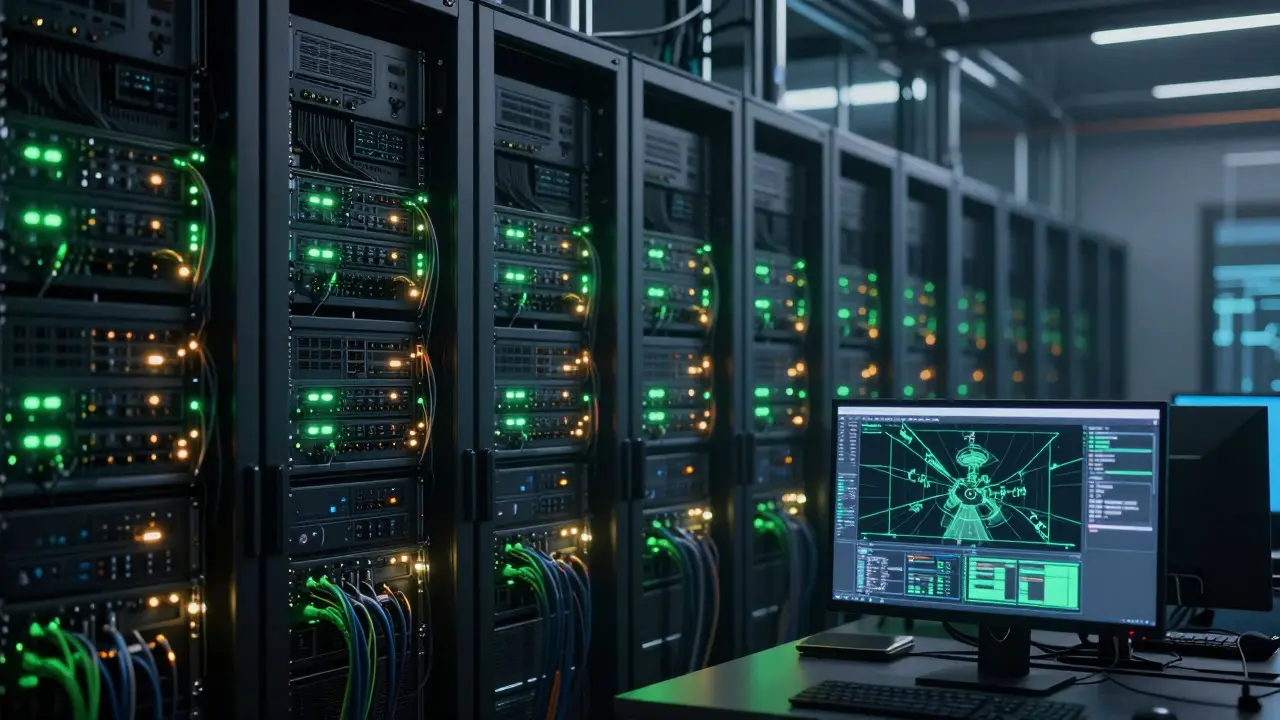
Studios now build entire racks of servers packed with high-end GPUs. A single workstation might have four or eight professional-grade graphics cards. When you multiply that across dozens of machines, you get a system capable of processing teraflops of floating-point operations per second. This raw power allows artists to iterate quickly, seeing changes in near-real-time rather than waiting overnight for a preview.
Distributed Rendering and Render Farms
Even with powerful GPUs, one machine is rarely enough for a feature-length film. A movie contains roughly 140,000 frames (at 24 frames per second for a two-hour film). If each frame takes ten minutes to render, that’s nearly 97,000 hours of work on a single machine. That would take over eleven years to complete alone.
This is where Render Farms come in. A render farm is a collection of interconnected computers that work together to distribute rendering tasks across multiple nodes. Instead of one computer doing all the work, the job is split up. One node renders frame 1, another does frame 2, and so on. By adding more nodes, you reduce the total time linearly. If you double the number of machines, you cut the render time in half.
Many large studios maintain internal render farms in their own facilities. Others outsource to cloud providers or third-party services. Cloud rendering offers flexibility; if a deadline is tight, a studio can spin up hundreds of virtual machines in the cloud for a few weeks and then shut them down. This pay-as-you-go model saves money compared to maintaining idle hardware during slower periods.
Software Ecosystems and Engines
Hardware does the heavy lifting, but software tells it what to do. The industry relies on a few key players in the rendering space.
| Tool | Type | Key Strength | Typical Use Case |
|---|---|---|---|
| Arnold | Path Tracer | Industry standard for realism | Feature films, high-end TV |
| V-Ray | Hybrid Renderer | Speed and versatility | Architecture, product viz, film |
| Redshift | GPU Accelerated | Extreme speed on GPUs | Real-time previews, fast iteration |
| Mantra | Procedural | Integration with Houdini | Complex simulations, procedural art |
Each tool has its strengths. Some are better suited for organic characters, while others excel at hard-surface vehicles or architectural visualization. Artists choose their tools based on the specific requirements of the shot. For instance, if a scene involves heavy smoke or fire simulation, a renderer that handles volumetrics efficiently will be preferred. If the scene is mostly static products, a fast rasterizer might suffice.
Challenges in Modern Rendering
Despite technological leaps, rendering remains one of the most challenging aspects of VFX. Memory is a constant bottleneck. Complex scenes can consume terabytes of RAM. If the data doesn't fit in memory, the system slows down as it swaps data to disk, which is significantly slower. Optimization is an art form. Artists spend hours tweaking settings to balance quality with render time. They might reduce the number of light bounces for background elements that aren't the focus. They might use proxies-low-resolution stand-ins-for detailed assets when they aren't being closely inspected. These techniques keep the render times manageable without sacrificing the final look.
The Future: Real-Time and AI
We are moving toward a future where rendering happens in real-time. Game engines like Unreal Engine are increasingly used for pre-visualization and even final visuals. This shift means that what used to take days to render can now be seen instantly on a monitor. This accelerates the creative process dramatically, allowing directors to change angles or lighting on the fly.
Additionally, artificial intelligence is starting to play a role. Machine learning models can predict how light should behave, reducing the need for exhaustive sampling. Neural radiance fields (NeRFs) allow for photorealistic reconstruction of real-world environments from photos. While these technologies are still maturing, they promise to further reduce the computational load and open new creative possibilities for VFX artists.
Frequently Asked Questions
How long does it take to render a single frame of a movie?
It varies widely. Simple animated frames might take seconds to minutes. Complex photorealistic shots with heavy lighting and particles can take several hours to a full day on a single workstation. On a large render farm, the average time per frame is reduced significantly, often to under an hour for most shots.
What is the difference between offline and real-time rendering?
Offline rendering calculates the final image after the scene is built, often taking hours or days. Real-time rendering calculates the image instantly as the user interacts with the scene, typically seen in video games. Offline rendering prioritizes maximum quality, while real-time rendering prioritizes speed and interactivity.
Do I need a GPU to learn VFX rendering?
Not necessarily. Many educational setups use CPU-based rendering, which is sufficient for learning fundamentals. However, as you move to professional work, a dedicated GPU becomes highly recommended for faster feedback loops and access to modern ray-traced workflows.
Why do some VFX shots look blurry or noisy?
Noise in rendered images usually comes from insufficient sampling. Ray tracing uses random samples to estimate light values. If there aren't enough samples, the result appears grainy. Increasing the sample count reduces noise but increases render time. Denoising algorithms can also clean up images post-render to save time.
Can cloud rendering replace local render farms?
For many studios, yes, especially for peak workload spikes. Cloud rendering offers scalability without the capital expense of buying hardware. However, some large studios prefer local farms for data security, lower latency, and predictable costs for steady, high-volume workloads. Most adopt a hybrid approach.





Comments(9)