
Imagine two directors meeting in a conference room. One is from Berlin, the other from Seoul. They agree on the script and the budget, but when they discuss where to shoot, the conversation gets tricky. The German producer wants to hit a specific carbon footprint target set by local regulators, while the Korean team is focused on waste reduction metrics that align with their domestic industry standards. This isn't just a bureaucratic headache; it’s a fundamental clash of sustainability standards that can make or break a global co-production.
In the world of international filmmaking, "green" doesn’t mean the same thing everywhere. What counts as an eco-friendly practice in one territory might be considered basic compliance in another, or even irrelevant in a third. For producers navigating these waters, understanding how these practices vary across co-production territories is no longer optional-it’s a core part of pre-production planning. Getting this wrong leads to wasted resources, legal friction, and a final product that claims to be sustainable but fails to meet the expectations of its primary audiences.
The Fragmented Landscape of Green Filmmaking
There is no single global rulebook for sustainable cinema. Instead, we are dealing with a patchwork of national regulations, voluntary industry pledges, and regional certification bodies. This fragmentation creates what we might call a "compliance maze." When you combine productions from different countries, you have to decide which rules take precedence. Usually, the answer is: both. You must meet the minimum legal requirements of every jurisdiction where you shoot, plus any contractual obligations tied to funding sources like tax incentives or grant programs.
Take the European Union, for example. The EU has been pushing hard on environmental directives that trickle down to creative industries. In contrast, North American markets often rely more on market-driven incentives, such as tax rebates that require certain green certifications to unlock higher rates. Meanwhile, in parts of Asia and Africa, the focus might be less on carbon accounting and more on community impact and resource conservation. Recognizing these distinct drivers is the first step in harmonizing your production plan.
Key Metrics: Where the Definitions Diverge
To manage this complexity, you need to look at the specific metrics used in different regions. These aren't just numbers; they represent different philosophical approaches to sustainability. Below is a breakdown of how three major territories handle key environmental indicators in film production.
| Metric Category | European Union (e.g., Germany/France) | North America (US/Canada) | East Asia (South Korea/Japan) |
|---|---|---|---|
| Primary Focus | Regulatory Compliance & Carbon Reduction | Market Incentives & Waste Diversion | Community Impact & Resource Efficiency |
| Carbon Accounting | Strict Scope 1 & 2 tracking required for public funding | Voluntary, often linked to tax credit tiers | Increasingly common, but less standardized |
| Waste Management | Mandatory recycling targets in many cities | High diversion rates expected for large sets | Focus on minimizing packaging and single-use plastics |
| Certification Bodies | Green Screen Production, EFG | Green Movie Alliance, Local Film Offices | Korean Green Film Committee, JAFCA |
| Reporting Frequency | Post-production audit required | Real-time tracking for incentive qualification | End-of-project summary report |
Notice the difference in "Reporting Frequency." In Europe, if you want public money, you often have to prove your results after the fact through a rigorous audit. In North America, you might need to show real-time data to keep your tax rebate eligibility active during the shoot. In East Asia, the process is often more retrospective, focusing on a final summary rather than continuous monitoring. If your production manager assumes a one-size-fits-all reporting schedule, you’ll likely miss deadlines in at least one territory.
Navigating Energy and Transportation Discrepancies
Energy use is usually the biggest chunk of a film's carbon footprint, but how it’s calculated varies wildly. In the UK and much of Western Europe, the grid electricity mix is relatively clean due to high renewable penetration. This means that simply plugging in your lighting rigs generates fewer emissions per kilowatt-hour compared to shooting in regions with coal-heavy grids. However, the standard calculation methods differ. Some territories use a simple grid average, while others require you to account for the specific location’s micro-grid composition.
Transportation presents another layer of complexity. Moving cast and crew between co-production locations is inevitable. But does flying count differently depending on where you depart? Under the GHG Protocol, business travel is typically categorized under Scope 3 emissions. Yet, some local film offices only track direct vehicle fuel usage (Scope 1). If you’re coordinating a shoot that moves from London to Los Angeles, you need to know which methodology each partner expects. A mismatch here can lead to double-counting or, worse, missing significant emission sources entirely.

Waste Management: Beyond Recycling Bins
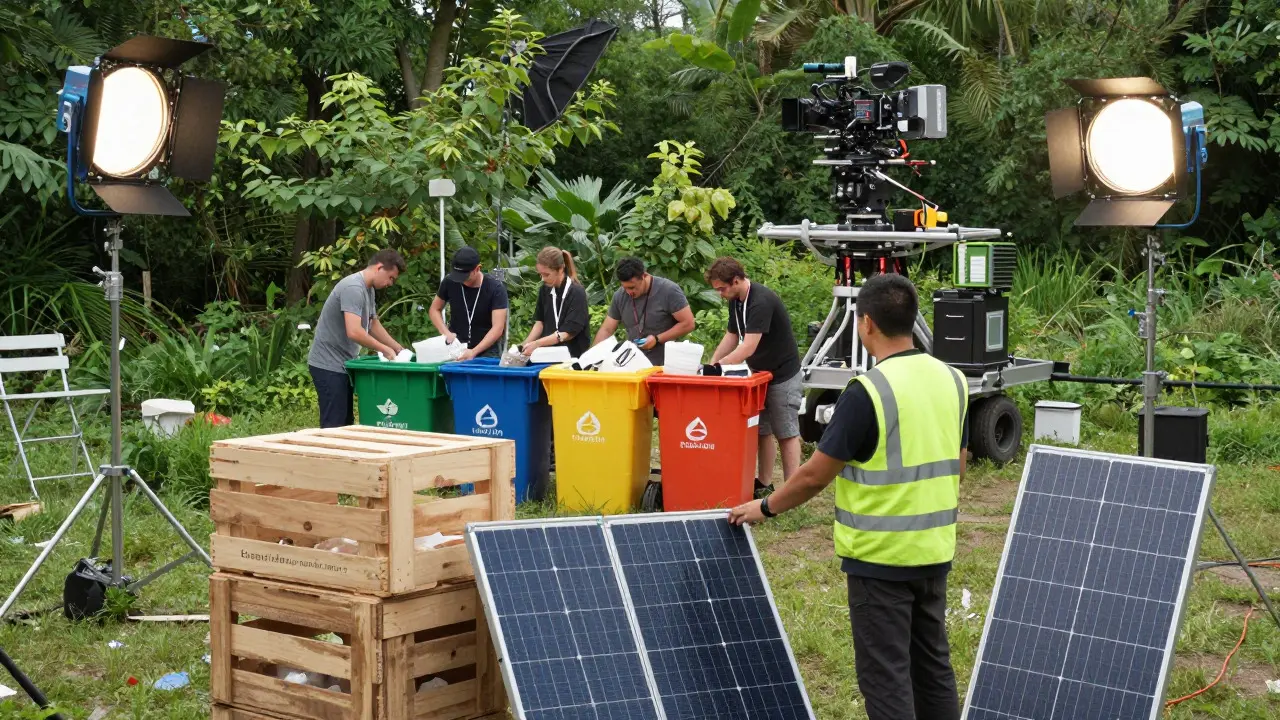
Let’s talk trash. It sounds mundane, but waste management is where cultural differences in sustainability become most visible. In many North American productions, the goal is a high "diversion rate"-the percentage of waste kept out of landfills. Producers often hire specialized waste consultants to sort everything on set, from catering leftovers to set construction debris. The metric is clear: aim for 70% or higher diversion.
In contrast, some European territories focus heavily on the circular economy. It’s not just about keeping things out of the landfill; it’s about reusing materials within the local supply chain. For instance, a set built in France might be required to donate its lumber to local schools or theater groups rather than shipping it back to a central warehouse. In parts of Southeast Asia, where waste infrastructure can be inconsistent, the focus shifts to source reduction-buying less stuff in the first place and using local, biodegradable materials. Understanding these nuances helps you design a waste plan that feels natural to the local crew and meets the contractual requirements of your foreign partners.
Practical Strategies for Harmonizing Standards
So, how do you actually execute this? Here are four actionable steps to keep your co-production on track without drowning in paperwork.
- Establish a Common Baseline Early: During pre-production, sit down with all co-producers and agree on a single set of KPIs (Key Performance Indicators) for the entire project. Even if local laws differ, having an internal standard prevents confusion. Decide whether you will prioritize carbon, waste, or social impact as your headline metric.
- Use Local Experts, Not Just Consultants: Hire a line producer or unit production manager in each territory who understands the local regulatory landscape. They know which permits trigger environmental reviews and which suppliers actually deliver on their green promises.
- Standardize Data Collection Tools: Use a digital platform that allows all teams to input data in the same format. If the US team uses Excel and the German team uses a proprietary software, merging the data later is a nightmare. Cloud-based tools that support multiple currencies and units of measurement are essential.
- Budget for the Gap: Always include a contingency line in your budget for sustainability compliance. Prices for certified materials, electric vehicles, and waste services vary by region. What costs $500 in California might cost $1,200 in rural Bavaria. Don’t let surprise costs eat into your post-production budget.
The Role of Funding and Tax Incentives
You can’t ignore the financial side. Many governments now tie their film incentives to sustainability performance. In Canada, for example, the Canadian Media Fund requires applicants to demonstrate a commitment to environmental stewardship. In the UK, the British Film Institute offers grants specifically for projects that reduce their carbon footprint. If you’re relying on these funds, your sustainability plan isn’t just good PR; it’s a condition of payment. Failing to meet the agreed-upon standards can result in clawbacks or reduced payouts. Therefore, your production design and logistics teams need to work closely with your finance department to ensure that every green decision is documented in a way that satisfies the funder’s audit requirements.
Future-Proofing Your Production Plan
Standards are moving fast. What is considered best practice today might be outdated in two years. To stay ahead, keep an eye on emerging trends like water usage tracking and biodiversity impact assessments. As climate change becomes more pressing, audiences and investors are asking harder questions. By building a flexible framework that can adapt to new regulations, you turn a potential liability into a competitive advantage. A production that is genuinely sustainable across all its territories tells a stronger story, both on screen and in the boardroom.
What is the most common mistake in co-production sustainability planning?
Assuming that one country’s standards apply universally. Producers often export their home-country practices to foreign locations without checking local regulations or available infrastructure, leading to compliance failures or unnecessary costs.
How do I calculate the carbon footprint for a multi-location shoot?
You should use the GHG Protocol as a baseline, breaking down emissions into Scope 1 (direct), Scope 2 (energy), and Scope 3 (supply chain/travel). However, you must adjust for local grid factors and transportation modes specific to each location to get an accurate total.
Are there specific certifications recognized across multiple continents?
While few certifications are legally binding globally, organizations like the Green Screen Production and the Environmental Media Awards are widely respected. Using their frameworks as a common language helps align teams from different regions, even if local laws differ.
How much extra budget should I allocate for green practices?
A general rule of thumb is to add 2-5% to your production budget for sustainability initiatives. This covers efficient equipment, waste management services, and potential premium costs for local, eco-friendly suppliers. The exact percentage depends on the scale of the production and the strictness of the target jurisdictions.
Who is responsible for reporting sustainability data in a co-production?
Typically, the lead producer or the entity holding the main distribution rights is responsible for the final report. However, each co-producer must provide localized data for their segments. Clear contracts should define who compiles the final data and who bears the cost of third-party audits.