Ever read a movie review that gave a film a 9/10, then watched it and thought, ‘This is a 6 at best’? You’re not alone. The problem isn’t your taste-it’s the lack of consistency in how reviewers score films. Without clear rules, a 7 from one critic might mean ‘good’ while another uses it for ‘mediocre’. That confusion hurts audiences, filmmakers, and even platforms trying to rank movies fairly.
Why Film Review Scores Don’t Add Up
Most film critics use a 1-to-10 scale, a 4-star system, or a letter grade. But no one agrees on what those numbers actually mean. One reviewer gives a 9 to a film that’s visually stunning but has a weak script. Another gives a 9 only if the film changes how you think about cinema. Both are valid opinions-but when those scores appear side by side on Rotten Tomatoes or IMDb, they look like they’re measuring the same thing. They’re not.
A 2023 study by the University of Southern California analyzed over 50,000 professional reviews and found that the same film received scores differing by 3 or more points on a 10-point scale from critics who otherwise had similar tastes. Why? Because most critics don’t define their own scoring systems. They wing it.
What a Consistent Scoring System Actually Looks Like
A consistent system isn’t about being rigid-it’s about being transparent. Think of it like a rubric in school. If you’re grading an essay, you don’t just say ‘good job.’ You break it down: thesis, structure, evidence, grammar. The same should happen with films.
Here’s how a real scoring system works in practice:
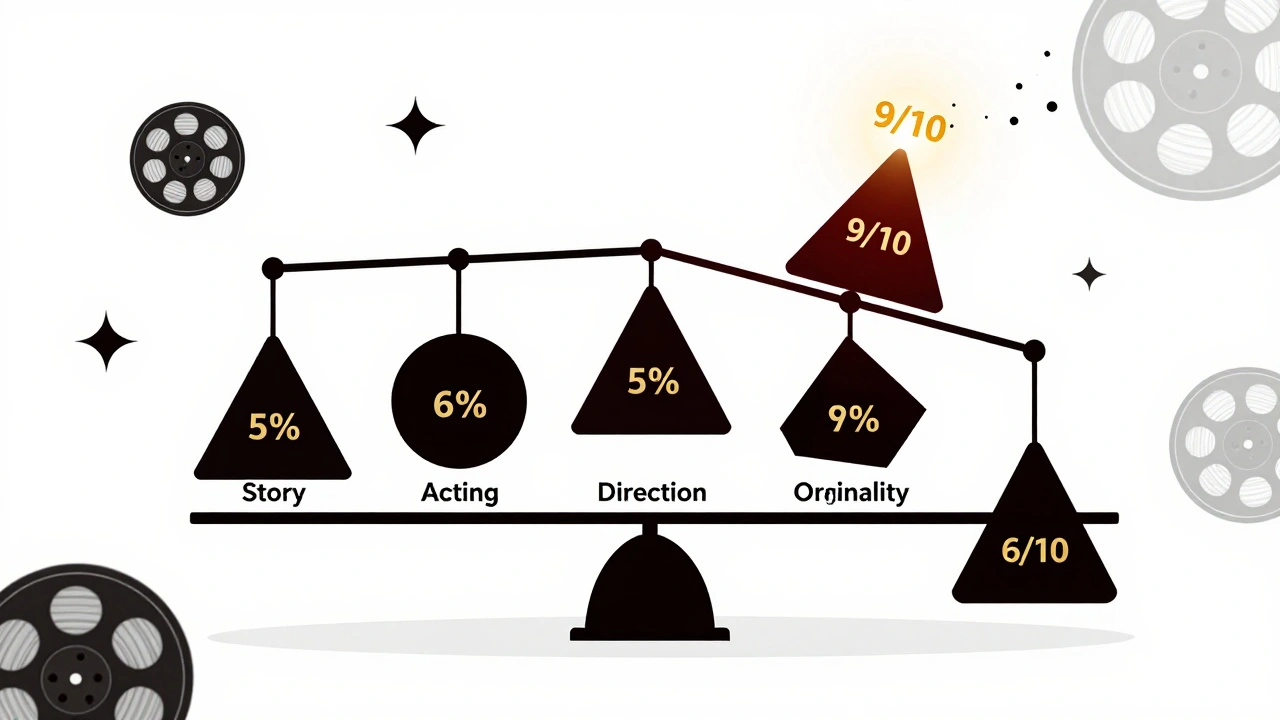
- Story (30%): Is the plot original, well-paced, and emotionally satisfying? A 10 means it’s unforgettable. A 5 means it’s predictable but functional.
- Acting (25%): Do the performances feel real? Are there standout moments? A 9 means every actor elevates the material. A 4 means the lead looks like they’re reading from a teleprompter.
- Direction & Cinematography (20%): Does the camera work serve the story? Is the tone consistent? A 10 means every shot feels intentional. A 3 means it looks like a student film.
- Sound & Score (15%): Does the music enhance the mood? Are sound effects used purposefully? A 7 means the score sticks with you. A 2 means it’s distracting.
- Originality & Impact (10%): Did this film do something new? Will it be remembered? A 10 means it’s a landmark. A 1 means it’s forgettable.
This system forces reviewers to justify their scores. No more ‘I loved it’ or ‘I hated it’ without explanation. It also makes it easier for readers to understand why a film got a 7 instead of an 8.
Real Examples: How the Same Film Scores Differently
Take Oppenheimer (2023). One critic gave it a 9/10. Another gave it a 6/10. Here’s what happened when they broke it down:
| Category | Critic A (9/10) | Critic B (6/10) |
|---|---|---|
| Story | 9 | 5 |
| Acting | 10 | 9 |
| Direction & Cinematography | 10 | 7 |
| Sound & Score | 9 | 6 |
| Originality & Impact | 8 | 4 |
| Total | 9.0 | 6.2 |
Critic A valued the film’s ambition and technical mastery. Critic B felt the story was too dense and emotionally cold. The difference wasn’t about quality-it was about what they prioritized. With a scoring system, readers can see that. They can decide: ‘Do I care more about direction or story?’ and adjust the score accordingly.
How to Build Your Own Scoring System
If you’re a reviewer, blogger, or even just someone who rates movies on Letterboxd, here’s how to build a system that works for you:
- Define your categories. Pick 4-6 elements that matter most to you. Don’t copy someone else’s list. What do you notice when you walk out of a theater? Is it the dialogue? The pacing? The ending? Start there.
- Assign weights. Not everything is equally important. For a superhero movie, visual effects might be 20%. For an indie drama, dialogue might be 35%.
- Create clear anchors. What does a 5 mean? A 7? Write it down. Example: ‘7 = Strong, but has one major flaw that holds it back.’
- Apply it every time. Even if you’re tired. Even if you loved the film. Write the numbers before you write the review.
- Share your system. Put it in your bio, your review footer, or your About page. Let readers know what they’re reading.
One indie critic in Portland started doing this in 2022. Her audience grew 40% in six months-not because she gave higher scores, but because people could trust them. They knew if she gave a 6, it wasn’t a lukewarm thumbs-up. It was a film with great acting but a weak ending.
Why This Matters Beyond Reviews
Consistent scoring isn’t just for readers. It helps filmmakers understand feedback. If 12 critics say the script is weak but the acting is brilliant, the director knows where to focus next time. Studios can use aggregated scores more reliably. Even streaming platforms could use this to recommend films based on what you value-not just what’s popular.
Think about how Netflix recommends movies. Right now, it’s mostly based on what people clicked. What if it also asked: ‘Do you care more about story, visuals, or performances?’ Then it could match you with films that align with your priorities. That’s the future.

Common Mistakes to Avoid
Even when people try to create systems, they mess them up. Here’s what not to do:
- Don’t use vague terms. Avoid ‘great’, ‘amazing’, ‘boring’. These mean nothing without context.
- Don’t change your scale mid-review. If you gave a 9 to a film last month for its visuals, don’t give a 6 to this one for the same reason unless your standards changed.
- Don’t let emotions override logic. If you loved the director’s last film, don’t automatically give this one a 9. Score it on its own.
- Don’t overcomplicate it. Five categories max. If you need more than that, you’re analyzing, not reviewing.
One reviewer I know used 12 categories. He spent 45 minutes writing each review. No one read them. He quit. Simplicity wins.
What Happens When Everyone Does This?
Imagine a world where every review on Rotten Tomatoes had a breakdown like this:
‘7/10 - Story: 6, Acting: 8, Direction: 7, Sound: 5, Originality: 6’
Now imagine you’re looking for a thriller that’s well-paced but doesn’t need a twist ending. You filter by ‘Story: 8+’ and ‘Originality: 5-’. You get a list of films that match your taste-not just the ones with the highest average.
That’s not science fiction. It’s already happening on Letterboxd, where users can tag films with custom criteria. But it needs to move into professional criticism too.
Final Thought: Your Score Is Only as Good as Your System
A film review without a scoring system is just a feeling. A feeling is fine for a friend. But if you’re writing for an audience, you owe them more. You owe them clarity. You owe them consistency. You owe them the chance to understand why you rated it the way you did.
Start small. Pick one film this week. Score it using five categories. Write it down. Share it. See how your readers respond. You might be surprised how much they appreciate the honesty.
Why do different critics give such different scores for the same movie?
Critics often don’t use the same criteria. One might prioritize story, another might focus on visuals or acting. Without a defined scoring system, their scores reflect personal taste, not consistent standards. That’s why a 7 from one critic might mean ‘good’ and from another, ‘mediocre’.
Can a scoring system make film reviews more objective?
No system can remove subjectivity-film is art, not math. But a clear scoring system reduces randomness. It forces reviewers to justify their scores with specific elements, making their opinions more transparent and trustworthy. Readers can then decide whether they agree with the reviewer’s priorities.
Should I use a 10-point scale or a 4-star system?
Use whatever feels natural, but stick to it. A 10-point scale offers more nuance; a 4-star system is simpler. The key isn’t the format-it’s consistency. If you use stars, define what each star means. A 4-star film shouldn’t be ‘great’ one time and ‘okay’ the next.
How many categories should I use in my scoring system?
Four to six is ideal. Too few and you miss important details. Too many and you turn a review into a thesis. Focus on what matters most to you: story, acting, direction, sound, originality. That’s enough to give meaningful insight.
Do professional critics use scoring systems?
Most don’t. Many rely on instinct or reputation. But some outlets, like The Guardian and IndieWire, have started including breakdowns in their reviews. Independent reviewers who use systems often gain more trust and larger audiences because their ratings feel reliable.
Can I adapt this system for TV shows?
Absolutely. For TV, add a category like ‘Episode Structure’ or ‘Character Development Across Seasons’. Weight pacing differently since TV unfolds over time. The same principles apply: define your categories, assign weights, stick to them.







Comments(6)