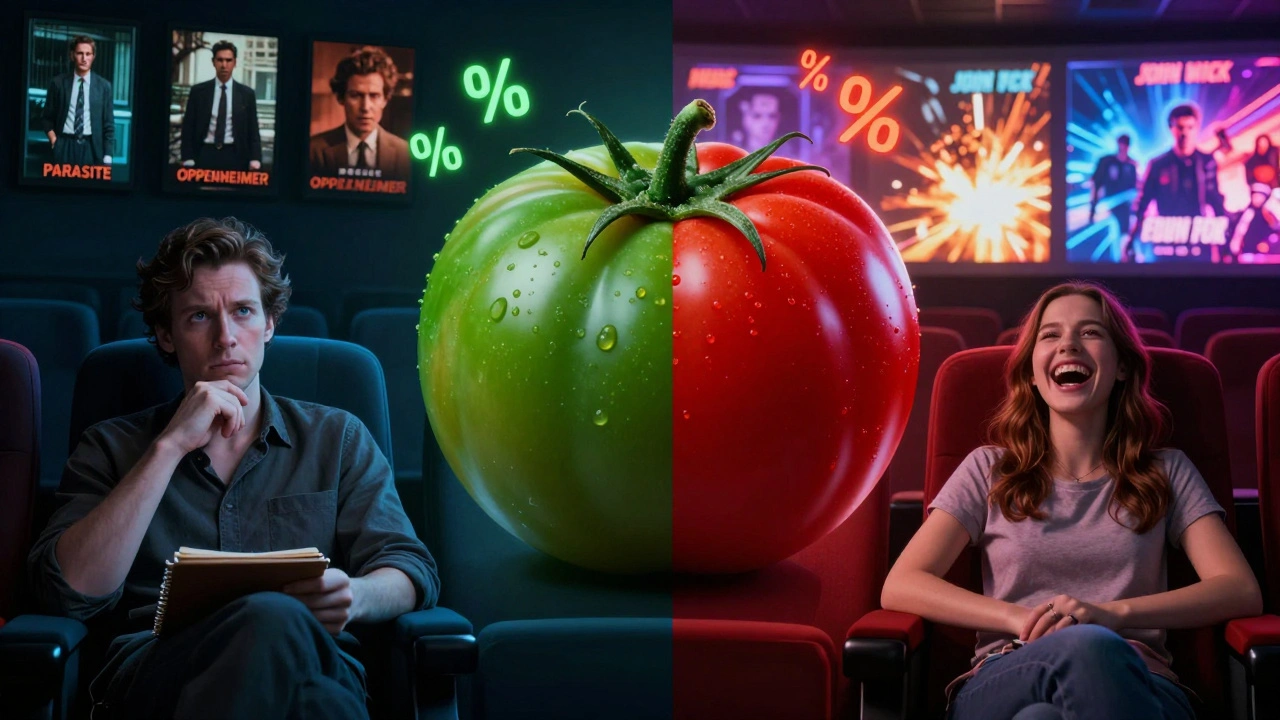
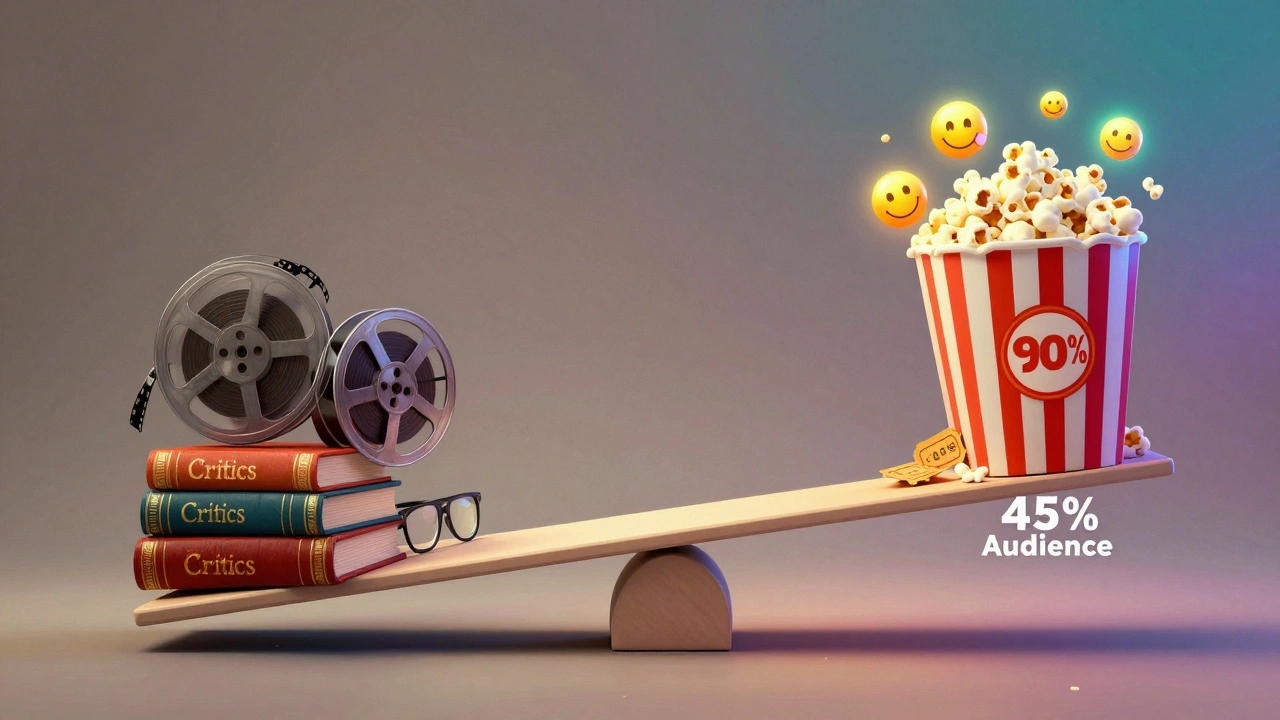
Ever clicked on a movie page on Rotten Tomatoes and seen that green smiley face next to a 90% critics score-only to scroll down and find the audience score sitting at 45%? You’re not alone. That disconnect isn’t a glitch. It’s the system working exactly as designed. And understanding why those two numbers diverge can save you from wasting a night on a movie that feels like a betrayal.
How Rotten Tomatoes Calculates Scores
Rotten Tomatoes doesn’t average ratings. It counts how many reviews are positive. For critics, a score of 6/10 or higher counts as "fresh." Anything below is "rotten." The percentage you see is the share of reviews labeled fresh. So if 85 out of 100 critics gave a movie a 6 or above, it gets an 85% critics score-even if 70 of those critics gave it exactly a 6, and the other 15 gave it a 10.
The audience score works the same way, but with one big difference: anyone with an account can rate. No credentials needed. No editorial oversight. Just a slider from 0 to 10, and a click. That means a movie can get a 90% audience score because 90% of voters gave it a 7 or higher-even if the other 10% gave it a 1.
That’s why you see movies like John Wick with a 93% critics score and a 91% audience score: both groups agree. But then you get Transformers: Age of Extinction with a 17% critics score and a 54% audience score. Critics called it noise and nonsense. Fans showed up for the explosions and gave it a pass.
Why Critics and Audiences Often Disagree
Critics are trained to look at structure, pacing, originality, acting depth, and technical craft. They watch dozens of films a year. They compare new releases to classics. They’re paid to notice what’s missing.
Audiences? They watch for fun. For escape. For nostalgia. For the feeling of being part of something. A movie like Barbie got a 88% critics score and a 78% audience score. Critics praised its satire and visual design. Audiences loved the colors, the humor, the emotional payoff. Both were right. But their metrics were different.
There’s also a cultural gap. Critics tend to be older, more educated, and more urban. Their tastes lean toward indie dramas, foreign films, and slow-burn thrillers. Audiences are younger, more diverse, and more spread out. They’re the ones who make Deadpool a hit even when critics call it crude.
And let’s not forget the hype machine. A studio can push a movie hard to critics with early screenings, press junkets, and emotional appeals. That can inflate a critics score before the public even sees it. Then, when the audience finally gets access, they realize it’s not what they expected-and the audience score drops.
When the Divide Is a Red Flag
Not every gap means something’s wrong. But some patterns are warning signs.
If a movie has a critics score above 80% and an audience score below 50%, it’s often a sign of pretension without payoff. Think The Last Airbender (14% critics, 31% audience) or Star Wars: The Phantom Menace (53% critics, 52% audience-wait, that’s close? But the audience score dropped after years of backlash). The critics saw technical competence. The audience felt cheated.
On the flip side, if the audience score is above 80% and the critics are below 50%, it’s usually a crowd-pleaser that doesn’t meet traditional standards. Bad Boys for Life (70% critics, 89% audience) is a perfect example. Critics called it formulaic. Audiences didn’t care-they showed up for Will Smith and Martin Lawrence, and got exactly what they wanted.
Here’s the real test: look at the number of reviews. A critics score based on 15 reviews and an audience score based on 500? The critics score is a snapshot. The audience score is a trend. If both are based on 500+ reviews and still wildly apart, that’s a cultural rift worth noticing.
What the Numbers Don’t Tell You
Here’s the thing: Rotten Tomatoes doesn’t show you the full story. It hides the distribution. You don’t see how many people gave a 10, how many gave a 5, how many gave a 1. A 70% audience score could mean half the voters gave it a 10 and half gave it a 4. Or it could mean everyone gave it a 7. Same number. Totally different experience.
That’s why the "average rating" is sometimes more useful than the percentage. On Rotten Tomatoes, you can click through to see the average rating. For example, Oppenheimer had a 92% critics score and a 90% audience score. But the average critic rating was 8.6/10. The average audience rating was 8.4/10. That’s a near-perfect alignment. The percentage and the average tell the same story.
But for The Marvels, the critics score was 61% and the audience score was 74%. The average critic rating? 6.7/10. The average audience rating? 7.4/10. The gap in percentages looks bigger than the gap in actual ratings. That’s because the critics were split-some gave it 5, some gave it 9. The audience was more consistent. The average tells you the tone. The percentage tells you the polarization.
How to Use Rotten Tomatoes Wisely
You don’t need to choose between critics and audiences. You need to use both as filters.
- If you like smart, layered films: trust the critics score above 80% and ignore the audience score if it’s below 60%. You’re looking for depth, not just fun.
- If you want to be entertained: trust the audience score above 80% and ignore critics if they’re below 50%. You’re here for the ride, not the analysis.
- If both scores are above 80%: you’ve found a rare gem. Everything Everywhere All At Once is one. Parasite is another. These are the movies that bridge the gap.
- If both scores are below 50%: skip it. Even if your friend swears by it.
- If there’s a big gap: read the top critic and top audience reviews. Look for why they disagree. Is it pacing? Tone? Expectations? That’s the real insight.
Also, pay attention to the date. A movie with a 90% critics score from 2015 might have an audience score that’s dropped over time as people rewatched it and realized it didn’t hold up. The opposite can happen too-Blade Runner 2049 had a lukewarm audience score at release, but over time, viewers came back and raised it to 84%.

What Happens When the System Breaks
Rotten Tomatoes isn’t perfect. Sometimes, it gets gamed. In 2023, a group of fans organized a campaign to inflate the audience score of a low-budget horror film by flooding it with 10/10 ratings. The critics score stayed at 35%. The audience score jumped to 98%. The studio ran ads saying "98% of audiences loved it!"-but the average rating was 7.1. The system didn’t lie. The users just exploited its simplicity.
That’s why Rotten Tomatoes added a "Verified Audience" badge in 2021. Only people who bought tickets through Fandango or another partner can leave a verified review. It’s not perfect, but it filters out some of the noise.
And then there are the outliers: Shrek had a 90% critics score and a 90% audience score. But the average critic rating was 7.8/10. The average audience rating was 8.4/10. The critics called it clever. The audience called it funny. Both were right. And that’s the point.
Aggregation isn’t about finding the truth. It’s about finding the consensus. And sometimes, the consensus is that critics and audiences are speaking different languages.
Final Takeaway: Trust the Pattern, Not the Number
The Rotten Tomatoes score is a map, not a destination. It doesn’t tell you if you’ll like a movie. It tells you whether people who think like you liked it.
Use the critics score to find films that reward attention. Use the audience score to find films that reward emotion. And when they disagree? That’s not a mistake. That’s the movie telling you who it’s for.
Next time you’re scrolling, don’t just look at the percentage. Look at the gap. Ask yourself: Do I want to be challenged? Or do I want to be carried away? The answer is in the numbers-if you know how to read them.





Comments(7)