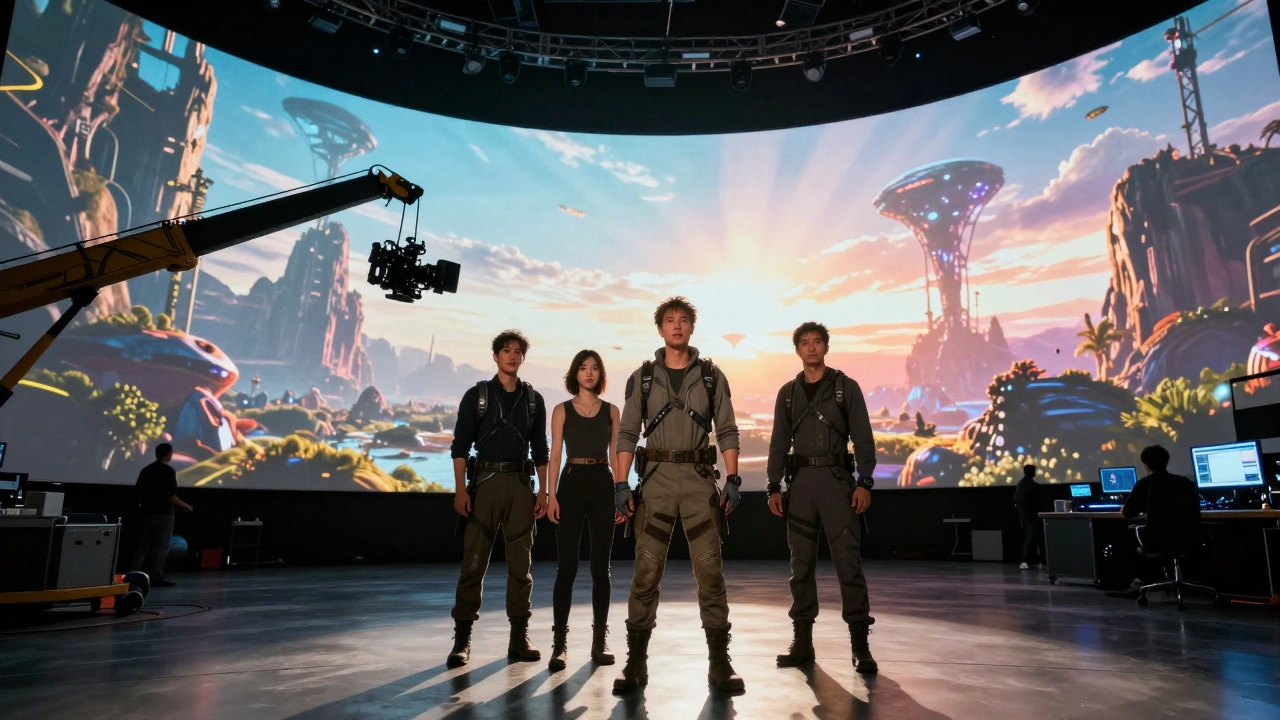
For decades, visual effects in movies were built after the camera stopped rolling. Actors performed in front of green screens, and teams spent months stitching together digital backgrounds, explosions, and alien worlds. But that’s not how it works anymore. Today, directors can see a fully rendered alien planet behind their actors while filming-real time, on set, in the camera. This isn’t sci-fi. It’s virtual production, and it’s rewriting the rules of filmmaking.
What Is Virtual Production?
Virtual production isn’t just one tool. It’s a whole system that combines real-time game engines, LED walls, motion tracking, and camera tracking to create digital environments that respond instantly to the camera’s movement. Think of it like a giant, ultra-high-resolution TV screen wrapped around your set. Instead of green screens, you have photorealistic backgrounds-mountain ranges, cityscapes, or even entire alien planets-projected on massive LED panels. The camera sees them live. The actors see them. And the director can adjust lighting, weather, or time of day on the fly.
This system started gaining real traction after The Mandalorian used it in 2019. The show’s team, led by Industrial Light & Magic, built a 270-degree LED volume in Los Angeles. Actors walked through scenes where the sky changed as they moved, and sunlight cast real shadows on their costumes. No post-production green screen cleanup. No guesswork. What you saw on set was what you got in the final cut.
In-Camera Effects: Seeing It Before You Shoot
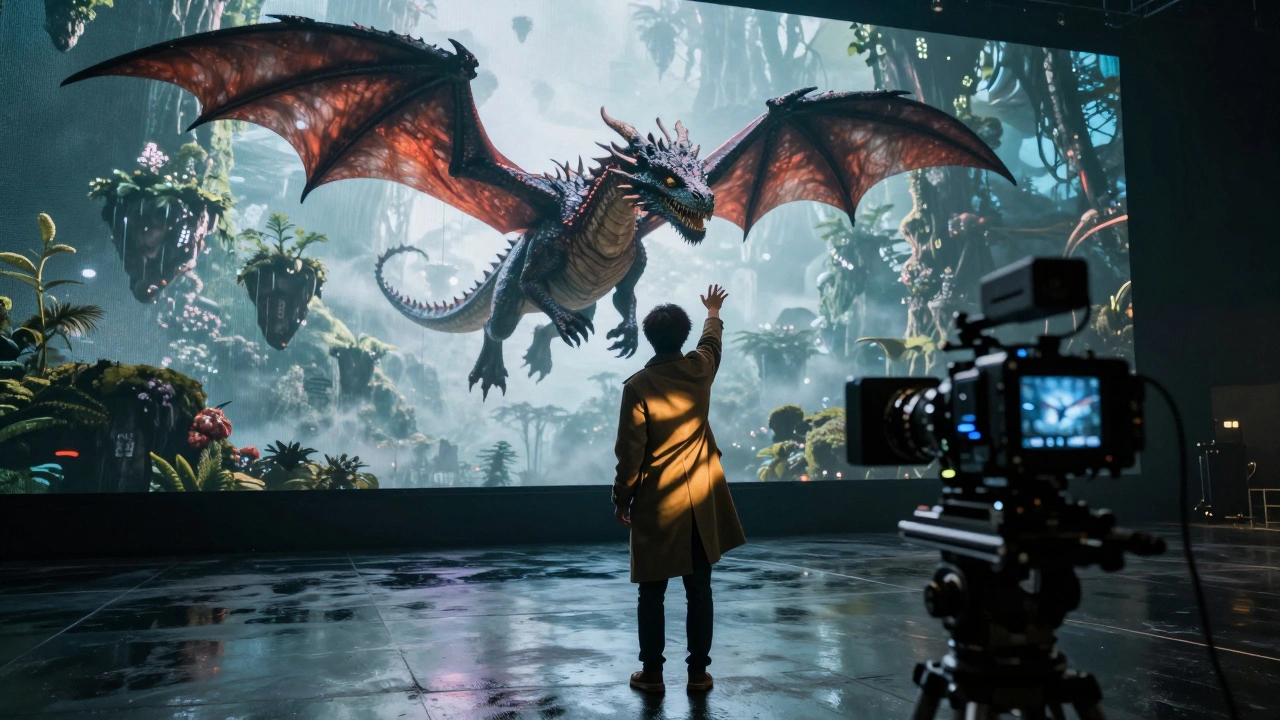
In-camera effects mean the VFX are captured during filming-not added later. That’s the game-changer. When you shoot against a green screen, you’re shooting blind. You don’t know if the CGI dragon will look right next to your actor until months later. With virtual production, you see the dragon right there, in real time, with correct lighting and perspective. The actor can react to it. The cinematographer can frame the shot properly. The director can tweak the dragon’s movement during the take.
One of the biggest benefits? Lighting. In traditional VFX, matching the lighting of a digital background to live-action footage is one of the hardest parts. It takes hours of manual tweaking. In virtual production, the LED walls emit real light. That light hits the actors, their costumes, the props. It reflects off surfaces. It creates natural shadows. You don’t have to fake it in post. The camera captures it all correctly the first time.
For example, in the film Avatar: The Way of Water, the production team used virtual production to shoot underwater scenes. They didn’t just film actors in tanks. They used real-time rendering to simulate the ocean’s movement, light refraction, and coral reefs on LED walls. The actors reacted to the environment as if it were real. The result? A level of realism that would’ve taken years to achieve with traditional methods.
The Tech Behind the Magic
Virtual production relies on three core technologies working together:
- LED Volume Walls - These aren’t just big screens. They’re high-brightness, high-refresh-rate LED panels designed for film. Panels like those from LEDM or Unilumin can hit 1,000 nits of brightness, which is enough to match sunlight. They’re also pixel-accurate, so there’s no moiré or flicker when filmed with high-speed cameras.
- Real-Time Game Engines - Unreal Engine from Epic Games is the industry standard. It renders photorealistic environments at 60+ frames per second, synced to the camera’s movement. Artists build the worlds in 3D software, then import them into Unreal, where they can tweak textures, weather, and lighting instantly.
- Camera Tracking Systems - Sensors on the camera (like those from Mo-Sys or Vicon) track its position and rotation in 3D space. That data tells the engine exactly where to render the background. If the camera pans left, the digital horizon shifts left. If it tilts up, the clouds move accordingly. The effect is seamless.
These systems aren’t just for blockbusters anymore. Independent filmmakers are starting to rent LED volumes in cities like Atlanta, Toronto, and even Asheville. A small studio can now shoot a sci-fi short with the same visual quality as a $200 million movie-without hiring a team of 50 VFX artists.
Why This Changes Everything
Traditional VFX pipelines are slow, expensive, and full of guesswork. A single shot might take weeks to render, then need five rounds of revisions. With virtual production, you fix problems on set. If the lighting looks off? Adjust the LED brightness. If the background doesn’t match the actor’s position? Move the digital asset in real time. You don’t need to reshoot the whole scene.
It also saves money. A single green screen shot might cost $10,000 to clean up and composite. With virtual production, you cut that cost by 70%-because you’re doing the work upfront. Studios like Disney and Netflix are now budgeting for virtual production as a standard, not a luxury.
And it’s better for actors. No more staring at tennis balls on sticks. No more imagining a 100-foot robot. They can react to real light, real movement, real environments. That leads to more authentic performances. Directors like James Cameron and Jon Favreau have said virtual production brought back the joy of filmmaking-because they could finally see the movie as it was meant to be.
Challenges and Limitations
It’s not perfect. LED volumes are expensive to build and run. A full-scale volume can cost $20 million to install. The power usage is massive-some setups draw as much electricity as a small town. And not every scene works well with it. Wide open landscapes, like deserts or oceans, can be hard to replicate without visible seams. The technology also requires skilled technicians who understand both film and game engines.
There’s also a learning curve. Cinematographers used to controlling lenses and lighting in the real world now have to think like game designers. They need to understand how to light a digital scene that’s physically in front of them. It’s a new skill set. Many crews still rely on traditional methods for certain shots.
And while virtual production reduces post-production time, it doesn’t eliminate it. Complex effects like fur, water simulation, or particle systems still need to be added later. But now, those additions are smaller, targeted, and easier to integrate.
What’s Next?
The next wave is even more exciting. Studios are experimenting with AI-driven real-time environments that adapt to actor movement. Imagine a scene where a character walks into a forest-and the trees grow, the wind shifts, and birds fly away based on their speed and direction. That’s already being tested.
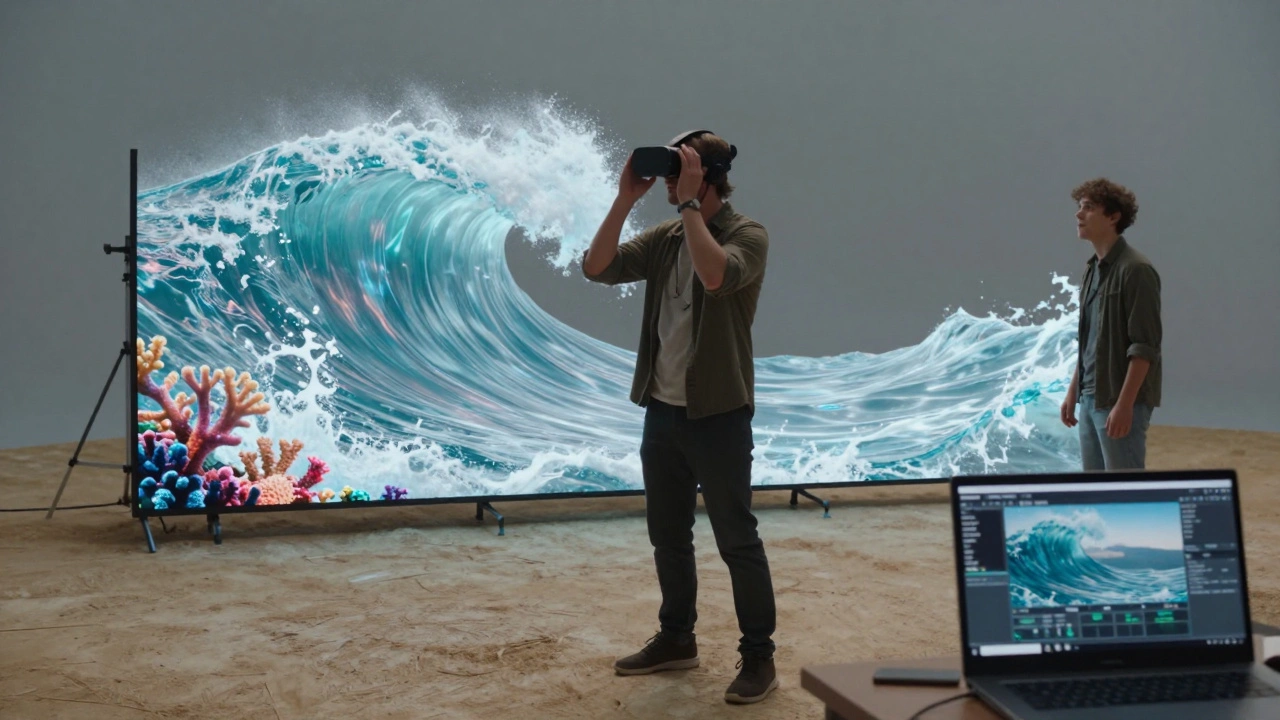
Some filmmakers are even combining virtual production with augmented reality headsets. Directors can wear AR glasses on set and see digital characters overlaid on the real world-without LED walls. This could make virtual production accessible to even smaller crews.
By 2027, it’s expected that over 60% of major studio films will use virtual production for at least 50% of their scenes. Independent films will follow. The era of green screens is fading-not because it’s bad, but because there’s something better now.
Real Examples You Can Watch
- The Mandalorian (2019-present): The first mainstream hit to use LED volumes at scale. Every episode features in-camera VFX.
- Avatar: The Way of Water (2022): Used virtual production to simulate underwater environments with real-time lighting.
- Obi-Wan Kenobi (2022): Shot on LED volumes in London, with real-time cityscapes and space scenes.
- Star Wars: Skeleton Crew (2024): Used smaller, modular LED setups to shoot on location in the UK.
These aren’t gimmicks. They’re the new standard. And they’re changing how we think about what’s possible in a movie.
How to Get Started
If you’re a filmmaker wondering how to use virtual production:
- Start small. Rent a small LED panel (some studios offer 10x10 ft setups for under $5,000/day).
- Use Unreal Engine’s free version to build a simple environment-a room, a forest, a street.
- Shoot a short scene with a single actor. Compare it to a green screen version.
- Notice the difference in lighting, performance, and time spent in post.
You don’t need a Hollywood budget to feel the shift. Just curiosity and a camera.
Can virtual production replace green screens completely?
Not yet, but it’s getting close. Green screens still work for wide landscapes, complex particle effects, or when budget is extremely tight. But for most scenes-especially those with characters interacting with environments-virtual production is faster, cheaper, and more realistic. Many studios now use virtual production as the default and only fall back to green screens when absolutely necessary.
Do actors need special training for virtual production?
No special training is required, but it helps if actors understand how the system works. Since they’re seeing real environments and lighting, they can react naturally. Many actors say it’s the most immersive experience they’ve had on set. Directors often give them a quick walkthrough of what’s happening on the LED walls so they know where to look and how to move.
Is Unreal Engine the only software used for virtual production?
Unreal Engine is the most popular, but it’s not the only one. Unity is being tested by some indie studios, and proprietary engines like Magnopus’s StageCraft are used by major studios. Unreal dominates because it’s free for film use, has strong community support, and integrates well with camera tracking systems. For most filmmakers, it’s the easiest place to start.
How much does virtual production cost compared to traditional VFX?
Building a full LED volume costs $15-25 million upfront, but it pays for itself over time. A single shot that takes 3 weeks and $50,000 to composite in post can be done in a day on set for $5,000-$10,000 in rental and labor. Studios report saving 40-70% on VFX budgets overall. For smaller projects, renting a partial volume for a week can cost as little as $15,000-far less than hiring a VFX house for a month.
Can virtual production be used for documentaries or non-fiction films?
Yes. Documentaries are using it to recreate historical scenes without location shoots. A film about ancient Rome can show a bustling forum behind the narrator without traveling to Italy. Climate documentaries can show melting glaciers or rising sea levels in real time. It’s not just for sci-fi-it’s for any story that needs to visualize something that can’t be filmed directly.


Comments(9)