When a movie hits theaters, the first three days tell you more than you think. It’s not just about how many tickets it sells on Friday night-it’s about what that number says about the rest of its life. A film that opens with $50 million might vanish by week two. Another that starts with $20 million could outlast its budget and become a cult hit. The truth? Opening weekend isn’t just a number. It’s a signal. And if you know how to read it, you can guess where the movie’s going before most people even leave the theater.
Why Opening Weekend Matters More Than You Realize
Most people think box office numbers are about total earnings. But that’s not the real story. The real story is momentum. Movies don’t survive on word-of-mouth alone. They survive on how fast they build it. A strong opening weekend means the studio has already convinced a huge chunk of the audience to show up early. That’s the fuel that keeps the movie alive through word-of-mouth, social buzz, and repeat viewings.
Take Barbie in 2023. It opened with $144 million. That wasn’t just a record-it was a statement. The studio knew they had a hit before the first reviews came out. Why? Because the opening weekend captured not just fans, but skeptics too. Grandparents took their grandkids. Men went with their partners. People who didn’t think they’d like it, went anyway. That’s the kind of opening that doesn’t just sell tickets-it changes the conversation.
On the flip side, look at Ghostbusters: Afterlife in 2021. It opened with $38 million. At first glance, that sounds fine. But when you compare it to the original 1984 film’s opening (adjusted for inflation, that’s over $100 million), it’s clear the audience didn’t show up the way the studio hoped. The movie had decent reviews, but the opening weekend didn’t carry the emotional weight or cultural momentum needed to keep it going. It faded fast.
The Four Key Factors That Shape Opening Weekend
Not all openings are created equal. You can’t just look at the dollar amount. You need to break it down into four real-world factors:
- Marketing Reach - Did the studio spend $100 million on ads? Or did they rely on viral TikTok clips and late-night TV spots? Big budgets help, but smart targeting matters more. Oppenheimer didn’t have a traditional blockbuster campaign, but its marketing tapped into historical curiosity and cultural anxiety. That drove early interest.
- Release Timing - Opening on a holiday weekend? Against another big movie? On a Tuesday? Timing changes everything. Avengers: Endgame opened on a Thursday night because the studio knew fans would come early. That pushed its three-day total into a new category. Meanwhile, The Marvels opened the same weekend as John Wick: Chapter 4-and got crushed.
- Demographic Appeal - Who’s supposed to see this movie? Is it for teens? Families? Niche audiences? A film aimed at 18-34-year-olds needs to open strong to justify its budget. A movie for older viewers might have a slower start but last longer. Sound of Metal opened with $250,000, but it held for months because it spoke to a specific group.
- Word-of-Mouth Momentum - Did people leave the theater excited? Or disappointed? A film that gets an A+ CinemaScore on opening night has a 70%+ chance of holding well. One with a B-? It’s probably headed for a steep drop.
How to Read the Numbers: The Drop Rate Rule
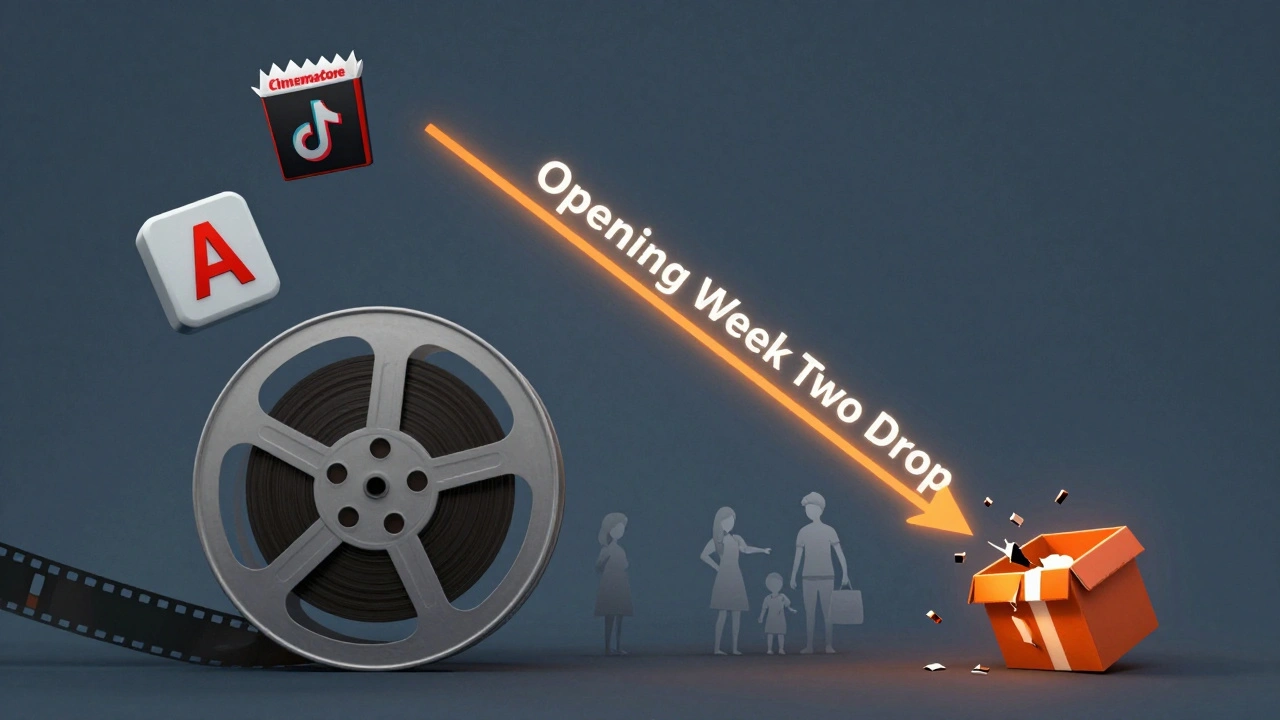
Here’s the secret most people miss: It’s not the opening weekend that matters most-it’s what happens after. The drop rate-the percentage of tickets sold from Friday to Sunday to the following weekend-is the real predictor.
Think of it this way:
- A movie that drops less than 40% from weekend one to weekend two? That’s a hit. It has staying power. Oppenheimer dropped just 32% in week two. That’s rare.
- A movie that drops 50-60%? That’s average. It had a good opening, but didn’t hold. Most summer blockbusters fall here.
- A movie that drops over 65%? That’s a warning sign. It probably didn’t connect. Transformers: Rise of the Beasts opened with $75 million but dropped 71% in week two. It was gone by week three.
Why does this happen? Because audiences are pickier now. They don’t just go to the movies because they’re advertised. They go because someone they trust says it’s worth it. If the opening weekend doesn’t create that trust, the movie dies.
What History Tells Us About Predicting Success
Over the last 15 years, data from over 1,200 wide-release films shows clear patterns:
- Films that open with more than $70 million in the U.S. have a 78% chance of making over $200 million total.
- But if they drop more than 55% in week two, only 19% of them reach $200 million.
- Low-budget films under $50 million that open with $15 million or more and drop under 45% have a 60% chance of becoming profitable. Get Out is the classic example: $33 million opening, $255 million total.
- Sequels that open under $50 million? Only 1 in 5 make back their budget. John Wick: Chapter 4 made $190 million because it opened with $77 million and dropped just 38%.
There’s also a weird trend: Movies that open on Wednesdays (like Spider-Man: No Way Home) often outperform Friday openings. Why? Because they get a 4-day head start. That extra day gives them more time to build buzz before the weekend rush.
What Happens When the Numbers Don’t Match the Hype
Every year, studios overpay for movies they think will be hits. They spend $150 million on marketing. They book 4,500 theaters. They promise a franchise. Then the numbers come in-and they’re flat.
Look at The Flash in 2023. It opened with $75 million. At first, it looked like a win. But the drop? 68%. The CinemaScore? B-. The reviews? Mixed. The studio had spent $200 million just to make it. By week three, it was gone from 80% of theaters. It’s now one of the biggest box office bombs in history.
Why? Because the opening weekend didn’t reflect real audience love. It reflected studio hype. People showed up out of curiosity, not passion. And once they saw it, they didn’t tell anyone else to go.
That’s the difference between a successful opening and a false one. A real hit doesn’t just make money-it makes people talk. A false one just makes noise.
How to Use This to Predict Future Hits
You don’t need to be a studio executive to use this. Here’s how you can predict a movie’s fate before you even buy your ticket:
- Check the opening weekend total - Is it above $50 million? That’s a good sign.
- Look at the drop rate - If it’s under 50%, it’s likely to last. If it’s over 60%, it’s probably done.
- Check the CinemaScore - A- or higher? Good. B- or lower? Red flag.
- See who’s watching - Is it mostly teens? Or families? Or older viewers? The more diverse the audience, the better the staying power.
- Compare it to similar films - If Barbie opened at $144 million and Oppenheimer at $95 million, and a new movie opens at $110 million? It’s in the same league.
Don’t just look at the headline number. Look at the pattern. A movie that opens at $40 million and drops 42%? That’s a sleeper hit. A movie that opens at $80 million and drops 70%? That’s a one-week wonder.
What’s Changing in 2026?
Streaming changed everything. People don’t wait six months anymore. They watch at home. That means studios have to get more out of theaters in the first 10 days.
Now, most movies are pulled from theaters after two weeks if they’re not holding. That’s why the opening weekend is more critical than ever. A film that doesn’t explode in its first five days? It might not even make it to week three.
Also, social media moves faster. A single TikTok clip can make or break a movie. Twisters in 2024 didn’t have a big marketing budget-but it had 20 million TikTok views in the first 72 hours. That drove its opening weekend to $70 million. The studio didn’t spend $100 million on ads. They spent $10 million-and let fans do the rest.
The new rule? If a movie doesn’t trend on social media in the first 48 hours, it won’t survive.
Final Thought: The Opening Weekend Is a Mirror
It doesn’t predict the future. It reflects what’s already happening. A strong opening means the movie already connected with a large group of people. A weak one means it didn’t. The rest is just math.
Stop thinking of box office numbers as magic. They’re just signals. Learn to read them, and you’ll know which movies are worth your time-before anyone else does.
Can a movie with a low opening weekend still become profitable?
Yes, but it’s rare. Low-budget films under $50 million that open with $15 million or more and drop under 45% have a 60% chance of turning a profit. Get Out made $255 million worldwide on a $4.5 million budget. It didn’t open huge, but it held strong because audiences loved it and told others. The key is not the opening number-it’s the drop rate and audience loyalty.
Why do some sequels fail even with big openings?
Because audiences expect more. A sequel that opens with $80 million but drops 60% in week two is telling you that people saw it out of habit, not excitement. If the story doesn’t bring something new-or feels like a repeat-the audience won’t come back. Transformers: Age of Extinction opened with $100 million but dropped 72% and lost money. Fans felt it was just spectacle with no heart.
Does international box office matter for predicting success?
It matters, but not as much as you think. A movie can make $300 million overseas and still lose money if it flopped in the U.S. The U.S. opening weekend is the real indicator of cultural impact. International success often follows U.S. buzz. Barbie made $600 million overseas-but it only got there because the U.S. opening created global momentum. Without that, it wouldn’t have worked.
How do streaming releases affect box office predictions?
They’ve made the opening weekend even more important. Studios now expect theaters to make 70% of a movie’s total revenue in the first two weeks. After that, it goes to streaming. So if a film doesn’t explode early, it gets pulled from theaters fast. That means studios are betting everything on the first five days. A movie that opens with $20 million and drops 70%? It might never hit theaters again.
Can social media trends replace traditional marketing?
Not replace-but amplify. Twisters spent $10 million on ads and made $70 million opening weekend because fans drove 20 million TikTok views. That kind of organic buzz is priceless. But it only works if the movie is actually good. You can’t fake it. Social media can boost a good movie. It can’t save a bad one.