Ever wonder how Gollum moved like a real creature, or how Caesar the ape felt so human in Planet of the Apes? It wasn’t just CGI. It was motion capture - a quiet revolution that turned actors into digital beings. This isn’t sci-fi magic. It’s physics, sensors, and raw human performance stitched together frame by frame.
What Motion Capture Actually Is
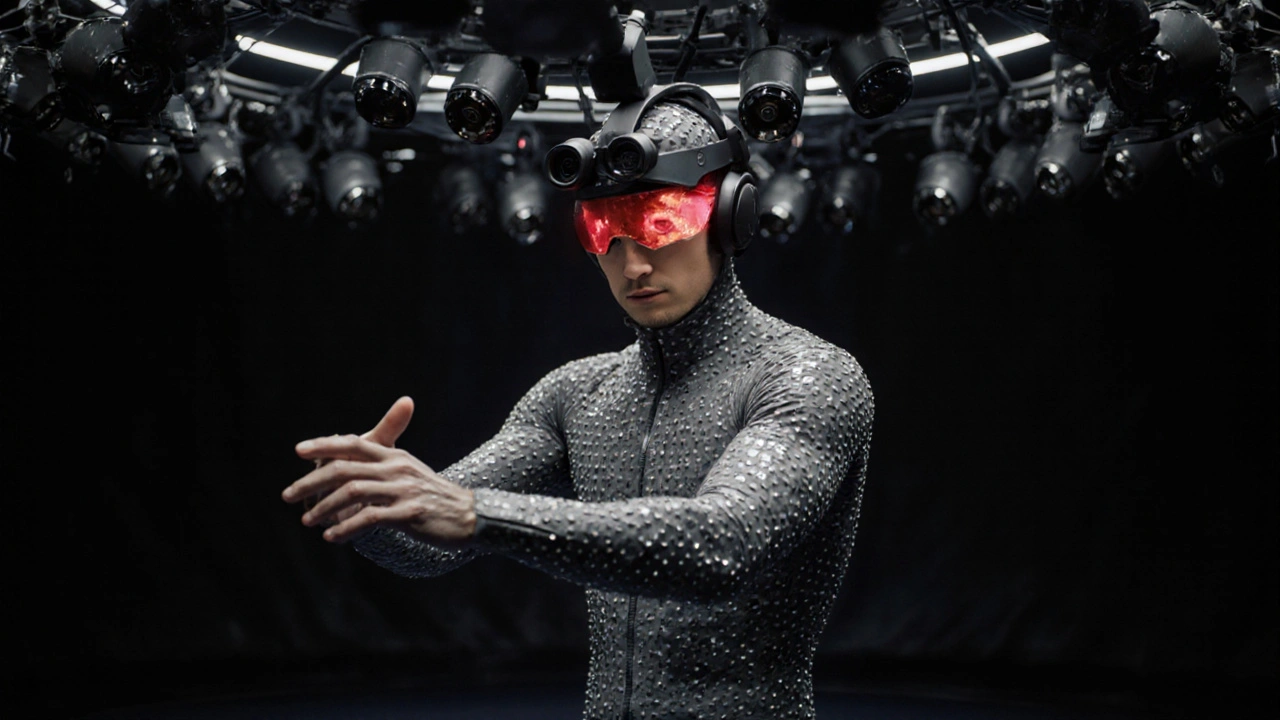
Motion capture, or mocap, records real human movement and translates it onto a digital character. Think of it like a digital puppeteer, but instead of strings, it uses cameras and sensors. An actor wears a tight suit covered in reflective dots or embedded sensors. Around them, multiple high-speed cameras track where each dot moves in 3D space. That data becomes the skeleton of a digital character - every head tilt, finger twitch, and breath.
Early versions in the 1970s used mechanical suits and were clunky. Today’s systems can capture facial expressions down to the movement of a single eyelid. Companies like Motion Analysis and Vicon make systems that track over 100 points on a body at 120 frames per second. That’s more detail than the human eye can catch.
How It Works: From Stage to Screen
It starts on a motion capture stage - a room lined with 40 to 100 infrared cameras. The actor, often in a gray bodysuit with reflective markers, performs the scene. Sometimes they wear a helmet with tiny cameras pointing at their face. These capture micro-expressions: the corner of a lip curling, the way eyebrows raise when surprised.
That raw data goes into software like Autodesk MotionBuilder or Unreal Engine. There, it’s cleaned up. Jittery frames are smoothed. Missing data from blocked markers is filled in. Then, the movement is applied to a digital model - a dragon, a robot, or an alien. The actor’s performance becomes the soul of the character.
James Cameron used this on Avatar with actors wearing head-mounted cameras. Every blink, every smirk from Sam Worthington became Jake Sully. The technology didn’t just move the character - it gave it emotion.
Performance Capture vs. Traditional Motion Capture
There’s a big difference between motion capture and performance capture. Motion capture tracks body movement. Performance capture adds facial tracking, voice, and even eye movement. It’s not just about how you walk - it’s about how you feel.
Andy Serkis didn’t just act as Gollum. He wore a head rig with two cameras pointed at his face. He recorded his performance in a motion capture studio while speaking lines, crying, laughing - all in real time. The animators didn’t have to guess what Gollum should feel. They had Serkis’s actual performance, frame by frame.
That’s why Gollum felt real. He wasn’t animated by hand. He was performed. The same happened with Caesar in War for the Planet of the Apes. Serkis again - this time with a full-face sensor mesh that tracked 1,200 points on his face. The result? An Oscar-nominated performance from a digital ape.

Why It Changed VFX Forever
Before mocap, digital characters were hand-animated. Animators watched reference footage, then drew every frame. It took weeks to get one minute of believable movement. And it often looked stiff - like a robot pretending to be alive.
Motion capture changed that. It gave digital characters the subtlety of real human behavior. A slight pause before speaking. The way someone leans in when they’re nervous. These tiny details make audiences believe.
It also cut costs. Once the system was set up, actors could record complex scenes in hours instead of months. Studios like Weta Digital and Industrial Light & Magic now rely on mocap for 80% of their major digital characters. It’s not a gimmick. It’s the standard.
Real-World Examples That Prove Its Power
Look at The Lord of the Rings. Gollum was the first fully motion-captured character to carry a movie. He wasn’t a side effect - he was the emotional core. Audiences forgot he was CGI. They felt sorry for him.
In Avengers: Endgame, Thanos wasn’t just voiced by Josh Brolin - his entire performance, from his slow blinks to his heavy sighs, came from Brolin’s face and body. The digital model didn’t add emotion. It reflected it.
Even video games use it now. The Last of Us Part I used performance capture for every character. The actors wore suits and facial rigs. Their real tears, real fear, real rage became the game’s emotional backbone. Players didn’t just see Joel and Ellie - they felt them.

Limitations and Challenges
Motion capture isn’t perfect. It needs a controlled environment. Rain, bright sunlight, or even reflective surfaces can mess up the markers. If an actor crosses their arms and blocks a sensor, the system loses data. That’s why mocap stages are dark, sterile rooms - no distractions.
Also, not every movement can be captured easily. Flying, floating, or supernatural movements (like magic spells) still need manual animation. Mocap gives realism to human motion - not physics-defying fantasy.
And it’s expensive. A full performance capture setup with 80 cameras, facial rigs, and software licenses can cost over $500,000. Only big studios can afford it. Independent filmmakers often use cheaper alternatives like smartphone-based mocap apps - but the quality isn’t the same.
The Future: Real-Time Capture and AI
Now, mocap is getting faster. With Unreal Engine 5 and cameras mounted on VR headsets, actors can perform in virtual sets and see their digital avatars in real time. Directors can watch a digital T-Rex walk through a forest - live - while filming.
AI is helping too. Tools like DeepMotion and Adobe Mixamo can take simple video of a person walking and turn it into a 3D animation. You don’t need a studio anymore. Just a phone and software. It’s not perfect, but it’s getting close.
Some studios are experimenting with neural networks that predict facial expressions from voice alone. Imagine recording an actor’s voice, and AI generates the exact lip movements and emotions - no suit, no cameras. It’s early, but it’s coming.
Why It Matters Beyond Movies
Motion capture isn’t just for blockbusters. It’s used in virtual reality training for surgeons. In sports, athletes use it to analyze form and prevent injury. In therapy, it helps people with Parkinson’s track movement changes over time.
But its biggest impact is storytelling. It lets us see the impossible - and feel it. A digital character isn’t just a visual effect. It’s a performance. And that changes everything.
Is motion capture the same as CGI?
No. CGI (computer-generated imagery) refers to any digital image created by software - like a flying dragon or a glowing sword. Motion capture is a technique used to create realistic movement within CGI. It records real human motion and applies it to a digital character. So, CGI is the tool. Motion capture is how you make it feel alive.
Do actors still get credit for motion capture roles?
Yes. Major unions like SAG-AFTRA now recognize motion capture performances as acting roles. Actors like Andy Serkis, Toby Kebbell, and Judy Greer have received award nominations and wins for their mocap work. Their performances are credited just like any other acting role - because they are.
Can you do motion capture at home?
You can get close. Apps like iPhone’s ARKit or Android’s ARCore can track basic body movement using the camera. Tools like Rokoko or Vicon’s MVN system offer affordable suits under $1,000. But professional-grade results - like those in movies - still need multi-camera studios, infrared lighting, and high-end software. Home setups are great for learning or indie projects, but not for Hollywood.
What’s the difference between optical and inertial mocap?
Optical mocap uses cameras to track reflective markers on a suit. It’s precise but needs controlled lighting and a large studio. Inertial mocap uses sensors with gyroscopes and accelerometers inside the suit. It’s more portable - you can use it outdoors - but it drifts over time and needs frequent recalibration. Most big films use optical. Indie creators often use inertial for flexibility.
How long does it take to process motion capture data?
It depends. For a simple walk cycle, cleaning and applying the data might take a few hours. For a full 90-minute film with complex facial expressions, it can take months. The actual capture might take a week. But the cleanup, retargeting, and refinement - where the magic happens - often takes 6 to 12 months. That’s why digital characters in big films cost millions.


Comments(8)