
Think about the last time a movie made your heart race without a single chase scene. Maybe it was a quiet moment in Goodfellas where the camera cuts between a family dinner and a violent cleanup. Or the silent, rapid cuts in The Social Network as code scrolls and relationships unravel. That’s not luck. That’s montage and intercutting-two script techniques that don’t need fancy camera gear, just smart writing.
What Montage Really Does in a Script
Montage isn’t just a series of quick shots. It’s a storytelling shortcut built into the script to show time passing, emotional change, or growing tension without dialogue. In a screenplay, you don’t write "cut to" or "fade out"-you write what the audience sees and feels. A good montage in script form tells the story in images, not words.
Take Rocky. The training montage isn’t just about lifting weights. It’s written as a sequence: Rocky running through Philly at dawn, punching meat in a freezer, dragging an old tire, then finally hitting the bell at the top of the stairs. Each line is a visual beat. The script doesn’t say "he gets stronger." It shows it. That’s the power of montage: it replaces exposition with action.
When you write a montage in your script, you’re not just listing shots. You’re designing rhythm. Each image should land like a drum hit-tight, purposeful, and emotionally charged. Three to seven beats is the sweet spot. More than that, it drags. Less than that, it feels rushed. The best montages in scripts are the ones you can read in under a minute and still feel the arc.
Intercutting: Juggling Two Stories at Once
Intercutting is when you jump back and forth between two or more scenes happening at the same time. It’s not just for action movies. It’s used in romances, thrillers, even comedies. The trick is making the cuts feel inevitable, not random.
In There Will Be Blood, the script intercuts Daniel Plainview’s oil drilling with his son’s piano lesson. One scene is about power and control. The other is about loneliness and failure. The script doesn’t explain the connection. It lets the audience feel it. That’s the goal: make the audience connect the dots themselves.
When you intercut in your script, ask: what’s the contrast? What’s the tension? If both scenes are about the same emotion, you’re just repeating yourself. Good intercutting creates friction. One scene is calm. The other is chaotic. One is inside. The other is outside. One is silent. The other is loud.
Write it like this: INT. KITCHEN - NIGHT - a woman whispers into a phone. CUT TO: EXT. ALLEY - NIGHT - a man drops a gun into a dumpster. CUT BACK TO: the woman hangs up. No dialogue needed. The rhythm comes from the jump. That’s intercutting done right.
Why Rhythm Matters More Than Length
Screenplays aren’t novels. You don’t win by writing more. You win by writing tighter. A 120-page script with lazy pacing will lose to a 90-page script that moves like a heartbeat.
Montage and intercutting are rhythm tools. They control how fast or slow the audience breathes. Think of it like music. A slow ballad needs space between notes. A punk song needs rapid-fire beats. Your script should do the same.
Most new writers fill pages with dialogue. But silence, cuts, and timing can say more. In No Country for Old Men, the script uses long pauses and sudden cuts to build dread. There’s no music. No jump scare. Just a man walking, then-bam-a gunshot. The rhythm makes it terrifying.
When you write, test your rhythm by reading it aloud. If you find yourself holding your breath between lines, you’re on the right track. If you’re skimming, cut it. If you feel the urge to pause after a line, that’s your cue to cut to something else.
When to Use Montage vs. Intercutting
They’re both about timing, but they serve different purposes.
- Montage is for showing change over time. Training, decay, preparation, transformation.
- Intercutting is for showing parallel action. Two people in different places, reacting to the same event.
Use montage when you want to compress time. Use intercutting when you want to raise stakes.
Let’s say your character is preparing for a heist. Montage: them gathering tools, studying blueprints, testing locks. Simple. Linear. Done in 30 seconds of script space.
Now, make it intercut: the heist team prepares while the security guard on duty gets a call from his sick daughter. One scene is cold and calculated. The other is warm and desperate. The audience feels the weight of both. The heist isn’t just risky-it’s personal.
That’s the difference. Montage builds momentum. Intercutting builds tension.
Common Mistakes in Scripting These Techniques
Writers often misuse montage and intercutting because they think it’s a shortcut to drama. It’s not. It’s a precision tool.
Mistake 1: Too many images. A 10-shot montage is a slideshow. A 5-shot montage is a poem. Stick to the essentials. Each image must carry emotional weight.
Mistake 2: No contrast in intercutting. If you cut between two people both crying, you’re not building tension-you’re repeating. Find opposites: laughter vs. silence, movement vs. stillness, light vs. shadow.
Mistake 3: Forgetting the script isn’t the edit. You’re not writing the final cut. You’re writing the blueprint. Don’t say "quick cuts" or "fast montage." Just describe the images and let the editor decide the timing. Write: INT. HOSPITAL - NIGHT - a child’s hand grips a stuffed bear. CUT TO: EXT. PARKING LOT - NIGHT - a car engine turns over. That’s enough.
Mistake 4: Using them to cover weak scenes. If your dialogue is flat, don’t fix it with fast cuts. Fix the scene. Montage and intercutting amplify what’s already there. They don’t replace it.

Real Script Examples That Get It Right
Look at how Mad Max: Fury Road’s script uses intercutting. It cuts between Furiosa’s desperate drive and Immortan Joe’s chase. But it also cuts to the wives in the back-silent, terrified, watching the horizon. Three stories. One rhythm. No exposition. Just movement and fear.
In Her, the script uses montage to show the protagonist’s emotional descent after a breakup. A single image: his hand brushing a pillow. Then: him eating alone. Then: him talking to an AI. Each beat is quieter than the last. The rhythm tells you he’s falling apart.
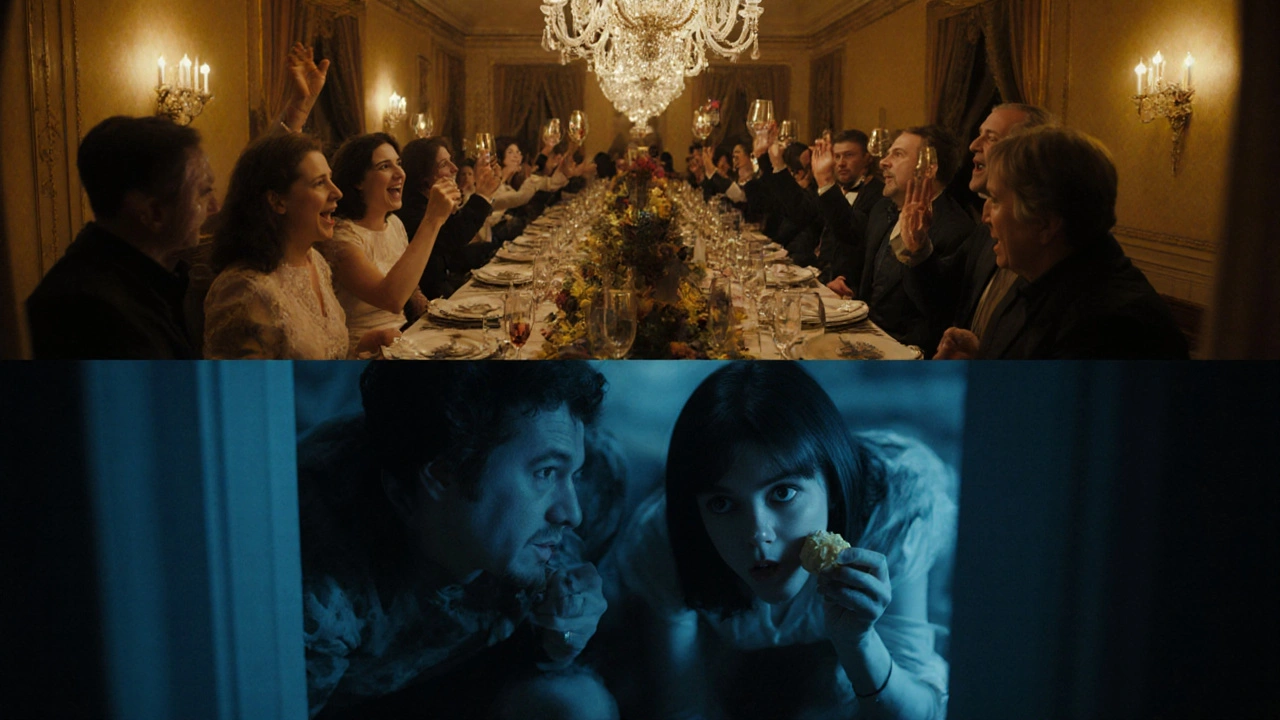
And Parasite? The script intercuts the poor family’s basement hiding with the rich family’s dinner party. The sound design in the script? Silence from below. Laughter from above. The contrast is brutal. The script doesn’t say "class inequality." It shows it in cuts.
How to Practice These Techniques
Try this exercise: pick two scenes from your script that happen at the same time. One is quiet. One is loud. One is inside. One is outside. Now, write them as an intercut sequence. No dialogue. Just action. See how the tension builds.
Next, take a moment in your story where time passes-someone waiting, training, grieving. Write it as a 5-beat montage. Each beat: one image. One emotion. No explanation.
Read your favorite scripts. Not the whole thing. Just the montage and intercutting scenes. Study how they’re written. Notice how few words are used. Notice how much is implied.
Write one new scene this week using only montage or intercutting. No dialogue. Just visuals. Then read it aloud. If you feel something-joy, dread, excitement-you’ve done it right.
Final Thought: Rhythm Is the Invisible Character
Every great film has a rhythm. It’s not just the music. It’s the pacing of the cuts. The pause before the reveal. The way a scene ends before the audience expects it. Montage and intercutting are your tools to shape that rhythm.
You don’t need a big budget. You don’t need a famous director. You just need to write with intention. Each cut should serve the story. Each image should carry weight. Let the silence speak. Let the movement breathe.
That’s how you make a script that doesn’t just get read-it gets felt.
Can montage be used in a TV pilot?
Yes, and it’s common in TV pilots to establish character arcs quickly. Think of the opening montage in Stranger Things-it shows the kids’ friendships, their world, and the looming threat in under a minute. TV pilots need to hook fast, and montage delivers that without dialogue overload.
Do I need to specify camera moves in a montage?
No. Screenwriters describe what’s seen, not how the camera captures it. Write: "A child’s drawing burns in a fireplace." Not: "Close-up, slow zoom in." Let the director and cinematographer handle the camera. Your job is to show the emotional core of the moment.
Is intercutting only for parallel action?
Not always. Sometimes it’s used to show memory or hallucination. In Requiem for a Dream, intercutting links drug use with fantasy sequences. The action isn’t happening at the same time-it’s happening in the character’s mind. That’s still intercutting. The key is contrast and emotional connection, not physical timing.
Can I use montage for a love story?
Absolutely. Think of the montage in 500 Days of Summer-the couple’s happy moments, shown in quick, colorful images. But the script also shows the same moments later, in grayscale, with the same actions. The montage doesn’t just show romance-it shows how memory distorts it. That’s emotional montage.
How do I avoid making intercutting feel chaotic?
Anchor each scene with a strong visual or emotional beat. Don’t jump randomly. If you cut from a funeral to a wedding, make sure the audience understands why. Use recurring images-a clock, a door, a song-to tie the scenes together. Rhythm comes from pattern, not speed.



Comments(7)