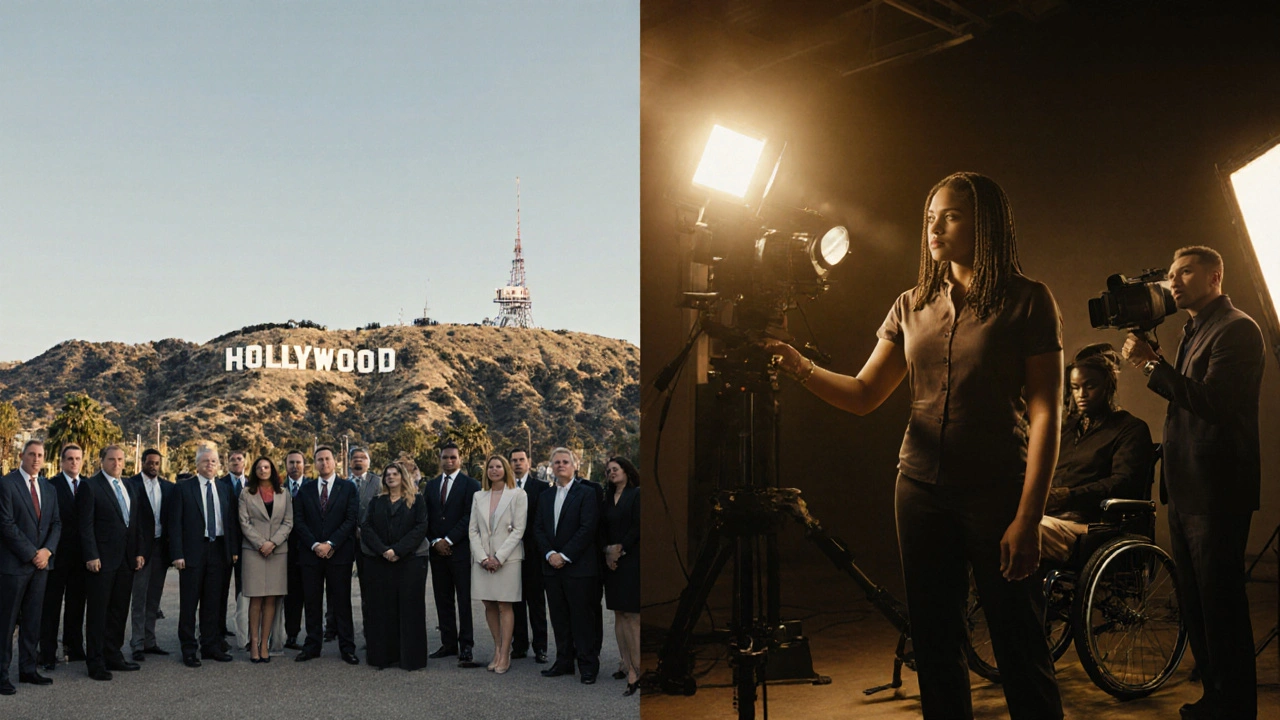
For years, Hollywood talked about diversity. But talk doesn’t change who gets hired, who gets cast, or whose stories get told. That’s why studios, activists, and researchers started building real tools to measure inclusion-not just guess at it. Today, film diversity scorecards aren’t optional extras. They’re the baseline for accountability.
What Are Film Diversity Scorecards?
A film diversity scorecard is a simple, standardized way to count who’s in front of and behind the camera. It’s not about feelings or intentions. It’s about hard numbers: race, gender, sexual orientation, disability status, and sometimes age and socioeconomic background. These scores turn vague claims like "we’re committed to diversity" into something you can check.
The most widely used system today is the Annenberg Inclusion Initiative’s scorecard. It tracks over 1,300 films released between 2007 and 2024. For each film, it records the gender and race of directors, writers, producers, lead actors, and supporting cast. It doesn’t stop there-it also looks at whether characters with disabilities or LGBTQ+ identities appear meaningfully, not just as stereotypes.
Other groups like the Geena Davis Institute on Gender in Media and ReFrame use similar frameworks. ReFrame, for example, partners with studios to award badges to productions that meet specific inclusion benchmarks-like hiring at least two women in key crew roles or casting actors from underrepresented racial groups in 30% or more of speaking parts.
How the Metrics Work
These scorecards don’t just count. They assign values. A film might get a 7/10 for gender representation but only a 3/10 for racial inclusion. That gap tells you something important: the studio might be hiring more women directors, but still ignoring Black, Latino, and Indigenous talent.
Here’s how the most common metrics break down:
- On-screen representation: Percentage of lead and supporting actors who are women, people of color, LGBTQ+, or have disabilities.
- Behind-the-scenes roles: Directors, writers, producers, cinematographers, editors-especially those in decision-making positions.
- Story authenticity: Are characters from marginalized groups portrayed with depth, or are they sidekicks, villains, or punchlines?
- Studio-wide trends: Is one film diverse, or is the whole slate improving?
These numbers aren’t random. They’re based on U.S. Census data. For example, if 13% of the U.S. population is Black, then a fair benchmark for Black actors in films would be around 13%. Anything below that signals underrepresentation. Anything above might mean tokenism or overcorrection.
What the Data Shows
Since 2015, the number of films with female directors has hovered around 10%. In 2024, only 18% of lead actors in top-grossing films were people of color-up from 11% in 2015. That’s progress, but it’s still far from matching population demographics.
Some genres are worse than others. Horror films have the highest percentage of female leads-over 40% in 2024. But sci-fi and superhero movies? Less than 20%. Documentaries lead in racial diversity, while animated features lag behind in disability representation.
Behind the camera, the numbers are even starker. In 2024, only 7% of cinematographers were women. Just 5% of studio executives were Black or Latino. And for LGBTQ+ directors? Less than 3% across all major studio releases.
But here’s what’s new: the gap is narrowing in indie films. Independent productions released in 2024 had 32% more diverse casts than studio films. Why? Because indie filmmakers aren’t bound by old assumptions about what "sells." They cast based on talent and authenticity-not market research from 2008.

Why These Scorecards Matter
These metrics aren’t just for activists. They’re used by investors, distributors, and even streaming platforms to make decisions. Netflix and Amazon now require diversity data before greenlighting projects. Studios use the scores to evaluate talent agencies. Some film festivals now require applicants to submit a scorecard as part of their submission.
And it’s working. When Parasite won Best Picture in 2020, it didn’t just break records-it broke assumptions. Afterward, studios started asking: "What if we cast a non-white lead in a thriller? What if we hire a Korean-American writer for a mainstream action film?" The scorecards gave them the proof they needed: audiences weren’t just watching-they were spending money on diverse stories.
Box office data backs this up. Films with diverse casts made 34% more globally in 2024 than those without, according to a UCLA study. Audiences aren’t just tolerating diversity-they’re seeking it out. Gen Z viewers are 60% more likely to watch a film if it features actors who look like them.
The Limits of the System
Scorecards aren’t perfect. They can’t measure quality. A film can hit every metric and still feel hollow. A Black character can be in the lead role but still be written as a sidekick in disguise. A woman can be the director but have no creative control.
Also, not all diversity is equal. A film might have a disabled actor in the cast-but if they’re only shown as inspirational or tragic, the representation is shallow. The scorecards are starting to catch this. New versions now include "narrative depth" ratings: Did the character have goals beyond their identity? Did they change over the course of the story?
Another problem: data collection is still uneven. Smaller studios, international co-productions, and streaming originals often don’t report. That means the numbers you see might be incomplete. Some studios even game the system-hiring one person of color for a minor role just to hit a threshold.
That’s why transparency matters. The best scorecards are public. Anyone can look them up. And the most respected ones-like Annenberg’s-are audited by independent researchers, not studio PR teams.
What’s Next?
The next wave of inclusion metrics will look beyond identity to power. Who owns the rights? Who controls the budget? Who gets final cut? Representation is important, but without ownership, it’s just window dressing.
Some groups are already testing "equity scorecards" that track profit-sharing, royalty splits, and development deals for underrepresented creators. A film might have a diverse cast but still be owned by a white male producer who takes 80% of the profits. That’s not inclusion-that’s exploitation dressed up as progress.
Tools like the Media Equity Index are starting to measure this. They track who benefits financially from a film’s success, not just who appears on screen. That’s the real test: Does diversity create opportunity, or just visibility?
For now, the scorecards are the best tool we have. They’ve turned a moral argument into a business case. And that’s what changes systems-not guilt, but data.
How You Can Use These Metrics
Whether you’re a filmmaker, a student, or just someone who watches movies, you can use these scorecards to make smarter choices.
- Check out Annenberg Inclusion Initiative’s public database before you stream a new film.
- Support indie films that publish their diversity data openly.
- Ask your local theater or streaming service: "What’s your diversity policy?"
- If you’re a writer or producer, use the scorecards as a checklist-not a goalpost.
Diversity isn’t about checking boxes. It’s about creating space. And scorecards? They’re the blueprint.
What is a film diversity scorecard?
A film diversity scorecard is a standardized tool that tracks representation in movies-focusing on race, gender, sexual orientation, disability, and sometimes age. It counts who appears on screen and who works behind the camera, using data from official sources like the U.S. Census. The goal is to turn vague claims about inclusion into measurable, public results.
Who created the most widely used film diversity scorecard?
The Annenberg Inclusion Initiative at the University of Southern California created the most widely used and respected film diversity scorecard. It has tracked over 1,300 films since 2007 and is used by studios, researchers, and advocacy groups around the world.
Do diverse films make more money?
Yes. In 2024, films with diverse casts earned 34% more globally than those without, according to UCLA’s Hollywood Diversity Report. Audiences, especially Gen Z, are more likely to watch and pay for movies that reflect their identities. Diversity isn’t just ethical-it’s profitable.
Are film diversity scorecards mandatory?
Not legally, but many major studios and streaming platforms now require them internally. Netflix, Amazon, and Disney use diversity metrics to evaluate projects before greenlighting. Some film festivals also require submissions to include a scorecard. It’s becoming a standard part of production planning.
Can a film pass the scorecard but still be problematic?
Absolutely. A film can hit all the numbers-having a Black lead, a female director, and a disabled supporting character-but still rely on stereotypes, give no real agency to marginalized characters, or let the same white executives control the story. Metrics measure presence, not power. That’s why newer versions now include "narrative depth" ratings to assess how characters are written.
What’s the difference between diversity and inclusion in film?
Diversity is about who is present-in front of or behind the camera. Inclusion is about who has power. A film can be diverse and still have one person of color hired as a token, while white producers control the script, budget, and final cut. True inclusion means sharing decision-making authority, not just visibility.




Comments(6)