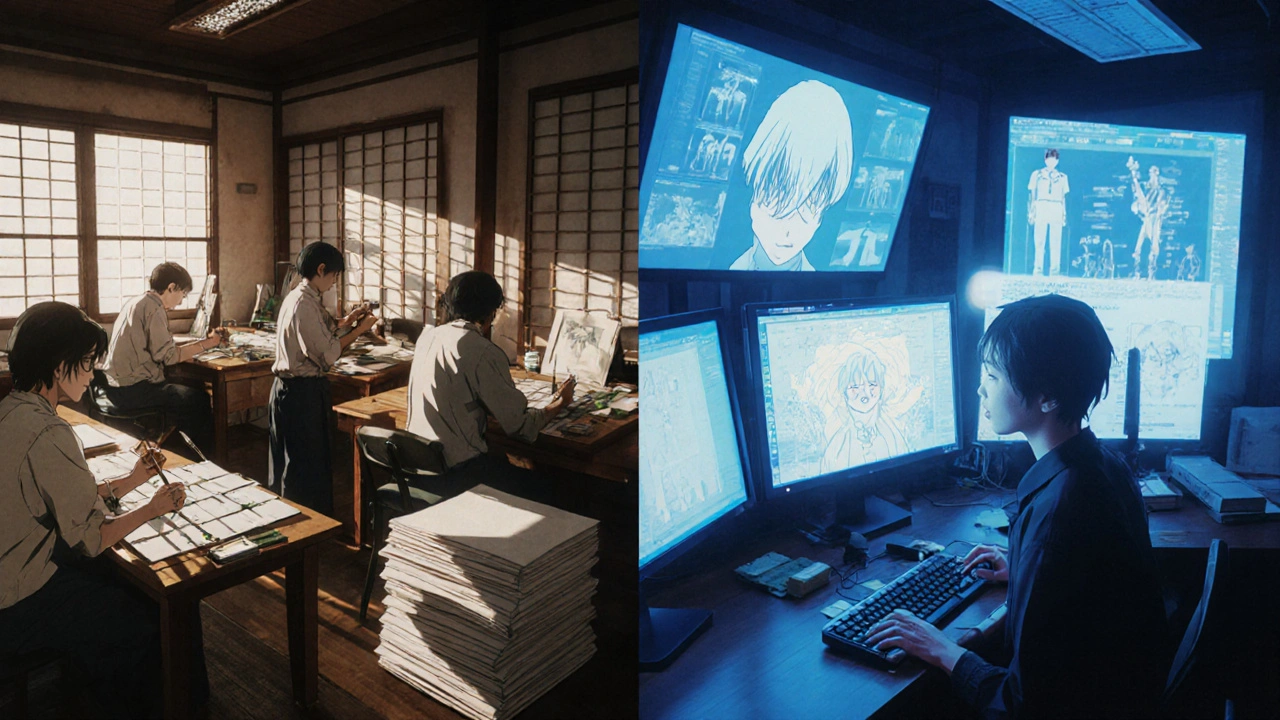
For decades, Japanese animation was defined by hand-drawn frames, inked lines, and watercolor backgrounds. Studios like Studio Ghibli and Toei Animation built empires on the painstaking art of cel animation. But today, you can’t open a new anime series without seeing CGI characters moving through 3D environments, digital effects replacing hand-painted skies, and motion-captured action sequences that look nothing like the classic style fans grew up with. The Japanese animation industry didn’t just adapt to technology-it got reshaped by it.
What Traditional Anime Production Actually Looked Like
Before digital tools, every frame of an anime was drawn by hand. Animators worked on thin sheets of celluloid-called cels-painting each character by brush, then layering them over static background art. A single episode of Dragon Ball Z in the 1990s could require over 100,000 individual drawings. The process was slow, expensive, and relied on teams of artists working under tight deadlines. Studios like Studio Ghibli were known for their attention to detail: wind blowing through hair, subtle eye movements, even the way light reflected off a teacup-all drawn frame by frame.
But this level of craftsmanship came at a cost. In the 2000s, Japanese studios began facing pressure from global demand. Netflix, Crunchyroll, and other streaming platforms wanted more content, faster. Meanwhile, production budgets stayed flat. The result? Fewer frames per second, reused backgrounds, and simplified character designs. By 2010, many studios were cutting corners just to keep up.
The Rise of CGI in Japanese Animation
CGI didn’t arrive as a luxury-it arrived as a necessity. Around 2012, studios like MAPPA and Science SARU started blending digital tools into their workflows. The first big shift? Replacing hand-drawn backgrounds with 3D environments. Instead of painting a cityscape by hand, artists built a digital model of Tokyo and rendered it from any angle. It saved weeks of labor.
Then came character animation. Early CGI anime characters looked stiff, robotic. Think of the 2013 film Blue Exorcist: The Movie-its 3D characters felt like they were floating in a video game. But by 2018, studios had cracked the code. Demon Slayer: Kimetsu no Yaiba used CGI for complex action scenes: swirling blades, smoke effects, and water splashes-all rendered in real-time. The result? Fluid motion that would’ve taken months to animate by hand, delivered in weeks.
Even Studio Ghibli, once the symbol of traditional animation, started experimenting. In The Wind Rises (2013), they used CGI for aircraft models and background movement. In Earwig and the Witch (2020), they went all-in on 3D. Critics were divided. Fans were shocked. But the studio didn’t care-they needed to survive.
Why Studios Switched: Budgets, Deadlines, and Global Demand
It’s not about creativity-it’s about economics. A single 24-minute episode of traditional anime costs between $100,000 and $250,000 to produce. With CGI, that drops to $60,000-$120,000. Why? Because once you build a 3D model of a character, you can reuse it in every scene. You don’t need 1,200 drawings for a 10-second fight sequence-you need one rigged model and a few motion keys.
Streaming services changed the game. Netflix ordered 12 episodes of Castlevania (2017) with a single contract. Crunchyroll wanted 20 new titles a year. Studios couldn’t hire enough animators fast enough. Japan’s aging animation workforce-where the average age of a key animator is now over 40-couldn’t scale. Meanwhile, countries like South Korea and the Philippines had cheaper labor, but even they couldn’t keep up with the volume.
CGI became the only way to meet deadlines without burning out teams. In 2023, over 60% of new anime series used some form of CGI for at least 20% of their runtime. For action-heavy titles like Jujutsu Kaisen or My Hero Academia, CGI handles 70% or more of the fight scenes.

The Hybrid Approach: When CGI and Hand-Drawn Work Together
Most successful modern anime don’t choose between CGI and traditional animation-they combine them. This is called the hybrid approach. Backgrounds might be 3D, but characters are hand-drawn over them. Effects like explosions, magic spells, or rain are CGI, while facial expressions remain hand-animated for emotional depth.
Take Attack on Titan: The Final Season. The Titans are fully 3D, modeled with muscle systems and physics-based movement. But Eren’s face? Hand-drawn. Every tear, every clenched jaw, every flicker of rage is animated by a human artist. The contrast makes the emotion hit harder.
Even Studio Trigger, known for wild, fast-paced action, uses hybrid techniques. In Promare (2019), fire effects are CGI, but the characters’ exaggerated movements-like spinning mid-air with a sword-are hand-drawn to keep the energy alive. The result? A film that looks like nothing else on TV.
Where Traditional Animation Still Thrives
Don’t write off hand-drawn anime just yet. Films like The Boy and the Heron (2023) and How Do You Live? still use 100% traditional methods. These projects are rare, expensive, and backed by major studios with deep pockets. But they prove that audiences still crave the texture of ink on paper.
Indie studios are also keeping traditional animation alive. Children of the Sea (2019), made by Studio 4°C, used hand-drawn watercolor effects that took over 100,000 hours to complete. It didn’t make a fortune, but it won awards and inspired a new generation of artists.
And in education? Japanese animation schools still teach cel animation as core curriculum. Why? Because understanding how to draw motion by hand makes you better at directing CGI. You can’t animate a character’s emotion in 3D if you don’t know how weight shifts in a body, or how a blink tells a story.

The Global Impact: How CGI Anime Is Changing the World
Japan’s shift to CGI didn’t just change how anime is made-it changed where it’s made. Studios in India, Thailand, and Indonesia now handle CGI cleanup, rendering, and compositing for Japanese titles. The production pipeline is global. A single episode might start in Tokyo with storyboards, move to Seoul for key animation, then to Manila for in-between frames, and finish in Vancouver with CGI effects.
Netflix and Amazon now fund anime directly, often requiring CGI-heavy visuals to appeal to global audiences. Western viewers expect fast-paced action, cinematic camera angles, and smooth motion-things CGI delivers better than hand-drawn frames ever could.
But there’s a flip side. Some fans feel the soul is being lost. Traditional anime had imperfections-slight wobbles in lines, uneven timing, smudged paint. Those weren’t mistakes. They were human. CGI is clean. Precise. Perfect. And sometimes, that feels cold.
What’s Next for Japanese Animation?
The future isn’t CGI versus hand-drawn. It’s about balance. The best studios now use CGI as a tool, not a replacement. They’re investing in real-time rendering engines like Unreal Engine to let directors preview scenes before animation even begins. AI is being tested to help with in-between frames, but not to replace artists.
Some studios are even bringing back traditional methods in new ways. In Blue Exorcist: Beyond the Snow (2024), they used digital brushes that mimic ink flow, so even the digital drawings look hand-painted. It’s not about going back-it’s about evolving without forgetting.
The Japanese animation industry is no longer just about drawing. It’s about coding, rigging, rendering, and managing global teams. But at its heart, it’s still the same: telling stories that move people. Whether it’s drawn with a pencil or rendered in 3D, if the emotion is real, the audience will feel it.
Is traditional anime dead?
No, traditional anime isn’t dead, but it’s rare. Big-budget films like Studio Ghibli’s The Boy and the Heron still use hand-drawn techniques, and indie studios keep the style alive. However, most TV anime now rely on CGI for efficiency. Traditional animation survives in art films, educational programs, and as a foundational skill for animators working with digital tools.
Why do some CGI anime look bad?
Early CGI anime looked stiff because studios used low-quality models, poor lighting, and rushed rendering. Some teams didn’t have enough experience blending 3D with 2D styles. Today, better software, experienced artists, and hybrid workflows have improved results significantly. Shows like Demon Slayer and Jujutsu Kaisen prove CGI can look stunning when done well.
Can AI replace anime animators?
AI can help with in-between frames, color fills, or background generation, but it can’t replace the creative decisions animators make. Emotion, timing, and personality in animation come from human intuition. AI tools are being used as assistants, not replacements. Studios still hire human animators to direct, refine, and approve every key frame.
What’s the difference between CGI anime and Western 3D animation?
Western 3D animation, like Pixar or DreamWorks films, focuses on realism and smooth motion. Japanese CGI anime often keeps exaggerated proportions, sharp angles, and stylized expressions-even in 3D. The goal isn’t to look lifelike; it’s to look like anime. This means Japanese studios prioritize design over physics, and they often blend 3D models with hand-drawn effects to preserve the traditional aesthetic.
Are Japanese studios hiring more CGI artists than traditional animators?
Yes. Since 2020, demand for 3D modelers, riggers, and technical animators has grown faster than for traditional key animators. Many studios now hire artists with skills in Maya, Blender, and Unreal Engine. However, traditional animators are still valued for character acting and key pose work. The best studios look for hybrid talent-artists who can do both.




Comments(10)