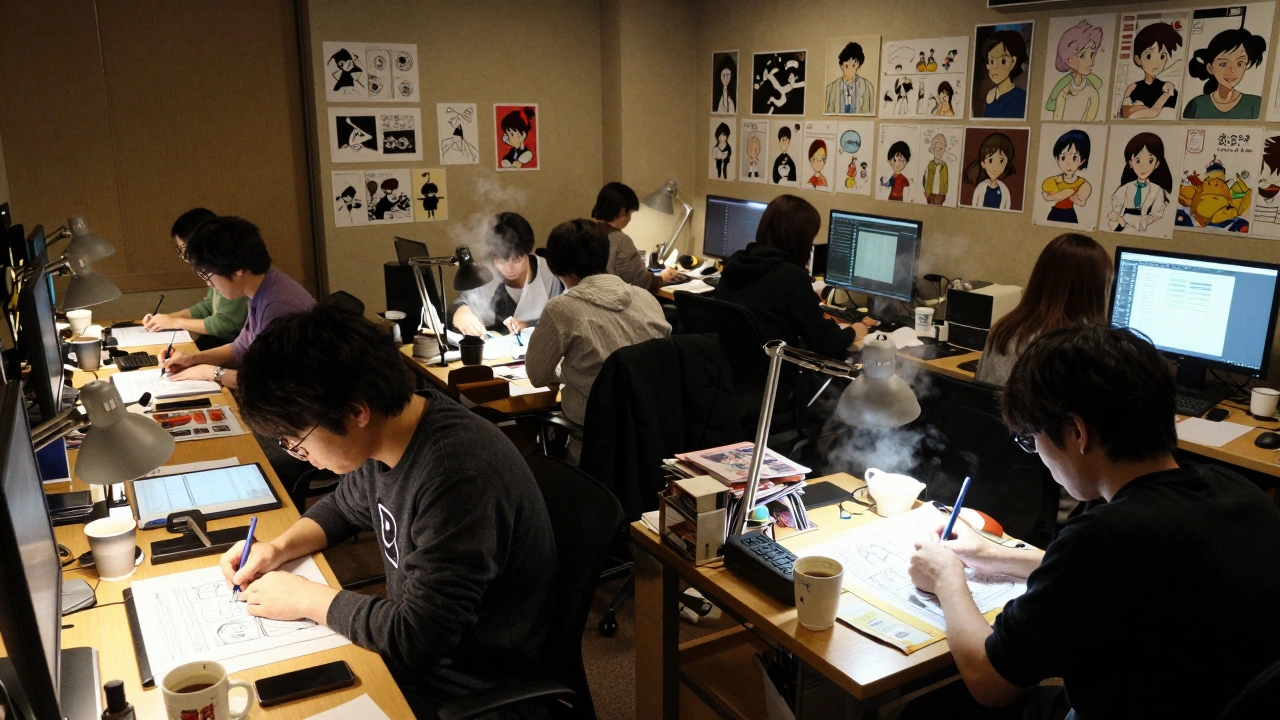
When you think of animated movies, you probably picture Studio Ghibli’s lush landscapes, Pixar’s emotional storytelling, or maybe even Disney’s classic songs. But behind every great animated film is a network of creative hubs-places where talent, culture, and technology collide to make animation happen. Three countries stand out as global anchors in this field: Japan, France, and Canada. Each has its own rhythm, its own style, and its own way of shaping the world of animation.
Japan: The Birthplace of Modern Animation
Japan doesn’t just make animation-it defines it for millions around the world. From anime series like Attack on Titan and My Hero Academia to feature films like Spirited Away, Japanese animation has become a cultural export unlike any other. The country’s animation industry generates over $20 billion annually, with more than 70% of global TV animation originating from Japan. That’s not a coincidence-it’s the result of decades of institutional support, a deeply rooted fan culture, and studios that treat animation as high art.
Studio Ghibli, Toei Animation, and MAPPA are household names among fans, but what makes Japan unique is its production pipeline. Unlike Western studios that often outsource to save costs, Japan keeps most of its animation in-house. Artists work long hours under tight deadlines, but they’re trained from childhood to treat every frame with precision. A single episode of a popular anime can involve over 100 animators, each responsible for a specific part of the motion. This system, called key animation, allows for highly detailed movement that Western studios rarely match.
Japan also leads in diversity of genres. You’ll find anime for toddlers, for teenagers, for adults, for historians, for sci-fi nerds, and for people who just like cats in space. There’s no single "anime style"-it’s a spectrum. And that’s why it resonates everywhere.
France: The Art School of Animation
If Japan is the factory of animation, France is its art gallery. French animation doesn’t chase trends. It challenges them. You won’t find many action-packed battle shonen here. Instead, you’ll see hand-painted watercolor backgrounds, surreal storytelling, and films that feel more like moving poetry than entertainment.
France has the highest number of animated feature films produced per capita in the world. In 2024 alone, over 35 full-length animated films were released in French theaters-more than the U.S. and the UK combined. Studios like Studio Ghibli’s European counterpart, Les Armateurs, and Passion Pictures (based in Paris) have won Oscars for films like The Triplets of Belleville and Ernest & Celestine.
What sets France apart is its funding model. The government gives direct subsidies to animation projects through the Centre National du Cinéma et de l’Image Animée (CNC). To qualify, a film must meet strict artistic criteria-not box office potential. This means French animators can take risks. A film might take five years to make. It might have no dialogue. It might be about a snail’s journey across a war-torn landscape. And it still gets made.
French animation schools, like Gobelins in Paris, are among the most selective in the world. They train artists in traditional techniques: cut-out animation, stop-motion, ink-on-glass. Many of the world’s top animators-like those who later worked on WALL-E or Spider-Man: Into the Spider-Verse-started in France.

Canada: The Quiet Powerhouse
Canada doesn’t shout about its animation. But if you’ve watched Peppa Pig, Bob’s Burgers, or Avatar: The Last Airbender, you’ve seen Canadian work. The country quietly produces over 60% of the animated content seen on North American TV.
Why? Because Canada has the best of both worlds: government tax credits and a deep pool of talent. The Canadian Media Fund gives studios up to 40% back on production costs. That’s why so many U.S. studios outsource their animation to Montreal, Toronto, and Vancouver. Companies like Nelvana, Doghouse Animation, and Atomic Cartoons have built entire careers on working behind the scenes for American networks.
But Canada isn’t just a outsourcing hub. It has its own voice. Films like The Breadwinner (produced by Montreal’s Cartoon Saloon) and When the Wind Blows (from Ottawa) tackle heavy themes-refugees, war, identity-with emotional depth. Canadian animators are known for their minimalist style, strong character design, and a knack for blending humor with heart.
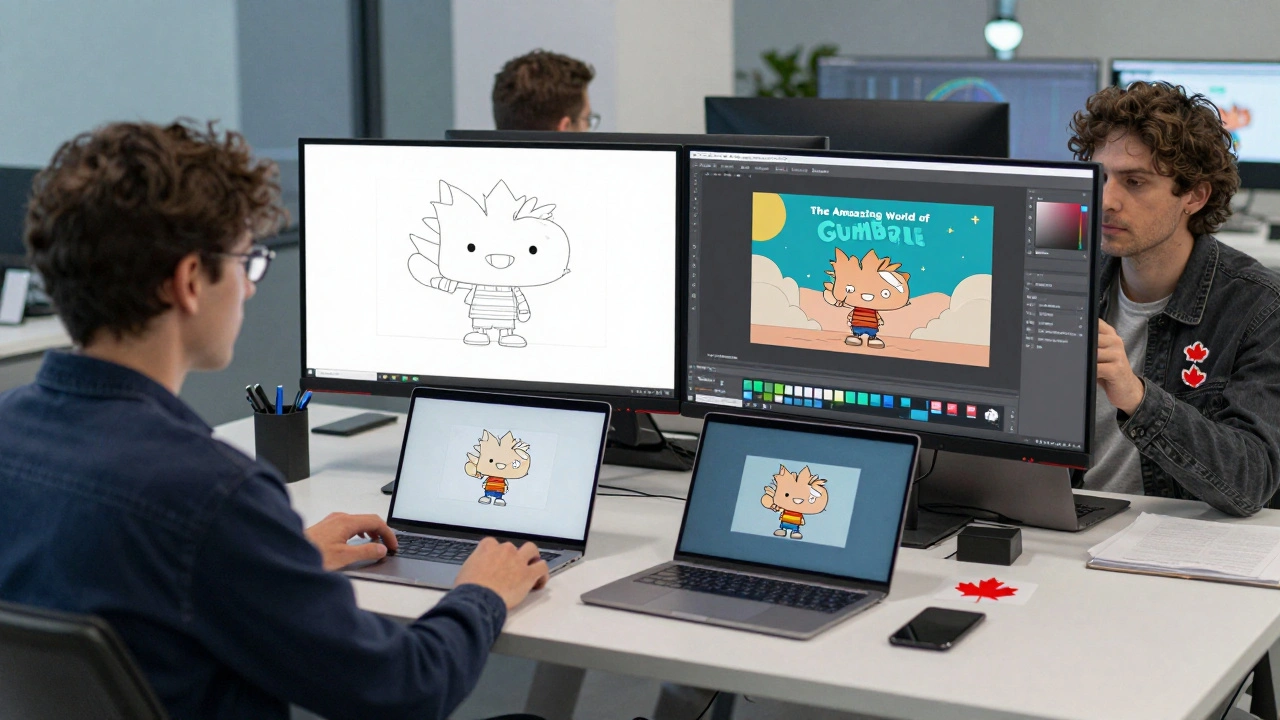
One of the biggest shifts in recent years? Canadian studios are now creating original content for global streaming platforms. 6teen, Yoko! Zom-B, and The Amazing World of Gumball (co-produced with the UK) all started in Canada. And they’re not just for kids. Canadian animation is increasingly aimed at adults, with dark comedies and experimental shorts gaining traction on platforms like Netflix and Apple TV+.
Why These Three Stand Out
Japan, France, and Canada don’t compete-they complement each other. Japan brings volume, speed, and genre diversity. France brings artistic ambition and technical mastery. Canada brings reliability, scalability, and a bridge to Western markets.
Look at any major international co-production today, and you’ll likely find all three involved. The Mitchells vs. The Machines was animated in Canada, directed by Americans, and inspired by Japanese action sequences. My Neighbor Totoro was distributed in France with a French dub that became a cultural phenomenon. Canadian studios often handle the final rendering for Japanese series because of their expertise in digital compositing.
These three hubs also share a common trait: they treat animators as artists, not just laborers. In Japan, veteran animators are revered. In France, they’re funded like painters. In Canada, they’re unionized with health benefits. That’s why all three continue to produce work that’s technically brilliant and emotionally powerful.
What’s Next for Global Animation?
AI tools are changing how animation is made. Some studios now use AI to generate in-between frames, reducing production time by 30%. But none of the big three are abandoning hand-drawn techniques. Instead, they’re using AI to handle repetitive tasks-freeing artists to focus on expression, emotion, and creativity.
Japan is investing in virtual production studios that combine motion capture with traditional 2D animation. France is launching a national archive of hand-drawn cels to preserve its heritage. Canada is training a new generation in hybrid workflows-combining 3D rigging with 2D linework.
The future of animation won’t belong to the country with the biggest budget. It’ll belong to the one that values the artist most. And right now, that’s Japan, France, and Canada.
Why is Japan the biggest producer of animation?
Japan produces the most animation because of its cultural obsession with the medium, a well-established studio system, and government-backed distribution networks. Over 70% of global TV animation comes from Japan, fueled by a fanbase that consumes anime daily and a workforce trained from childhood in frame-by-frame animation techniques.
How does France fund its animation films?
France funds animation through the Centre National du Cinéma et de l’Image Animée (CNC), which provides direct subsidies based on artistic merit-not commercial potential. This allows filmmakers to create experimental, non-commercial works that might never get made elsewhere. Over 35 animated features were released in France in 2024 alone, thanks to this system.
Why do U.S. studios outsource to Canada?
U.S. studios outsource to Canada because of generous tax credits-up to 40% of production costs are refunded-and a highly skilled, unionized workforce. Cities like Montreal and Vancouver have become animation powerhouses, handling everything from children’s shows to major Netflix series with studio-quality results.
Can AI replace traditional animation in these countries?
AI is being used to speed up tasks like in-betweening and color filling, but none of the major hubs are replacing hand-drawn animation. Japan still trains artists in traditional techniques. France preserves its hand-painted cels. Canada blends digital tools with 2D linework. The goal isn’t to replace artists-it’s to let them focus on storytelling.
Which country has the most Oscar-winning animated films?
France has the most Oscar-winning animated films among the three, with multiple wins including The Triplets of Belleville and Ernest & Celestine. Japan has been nominated frequently, especially through Studio Ghibli, but has won fewer Oscars. Canada’s wins are typically in co-productions, like The Breadwinner, which was submitted by Canada and won international acclaim.





Comments(6)