
Running a film at a festival isn’t just about prestige-it’s a business decision. You spent months shooting, editing, and scoring your movie. You paid for submissions, travel, prints, and marketing. Now what? If you can’t answer how much return you got, you’re guessing. And guessing doesn’t scale.
What ROI Actually Means for Film Festivals
ROI-return on investment-isn’t just about ticket sales. For indie filmmakers, it’s the total value you gain from a festival run compared to what you spent. That includes cash, exposure, distribution deals, audience growth, and future funding opportunities.Let’s say you spent $8,500 on submissions, travel, and promotional materials for five festivals. You didn’t sell a single ticket. But you landed a distributor who paid you $25,000 for North American rights. Your ROI? 194%. That’s not luck. That’s measurement.
Most filmmakers track only the obvious: how many people watched. But the real value hides in the shadows: a producer who saw your film at Tribeca and called you six months later. A journalist who wrote about you after SXSW. A streaming platform that added your film to their catalog because they noticed the buzz.
Track Every Dollar You Spend
Before you submit to one festival, build a simple spreadsheet. List every cost. Don’t skip the small stuff.- Festival submission fees ($50-$120 per festival)
- Travel (flights, hotels, food for you and your team)
- Shipping physical copies (DCPs, Blu-rays)
- Marketing materials (posters, trailers, press kits)
- Staff time (editing promo clips, answering emails, scheduling meetings)
- PR agency fees (if you hired one)
- Post-festival follow-up costs (mailers, ads, website updates)
For example, a filmmaker in 2024 submitted to 18 festivals. Submission fees alone cost $1,800. Travel to five festivals added $4,200. Printing and shipping cost $900. That’s $6,900 before you even hired a publicist. If you spent $1,500 on PR, your total investment was $8,400. Write that down. Don’t trust memory.
Measure What Matters: Beyond Ticket Sales
Ticket sales are the easiest metric-but the least telling. Most festivals don’t pay you per ticket. Even if they do, it’s rarely more than $5-$10 per viewer.Instead, track these five outcomes:
- Distribution deals: Did a distributor offer you a license? How much? Was it for theatrical, VOD, TV, or global rights? A $50,000 deal for streaming rights on a $10,000 investment is 400% ROI.
- Streaming platform pickups: Did Apple TV+, Amazon, or MUBI acquire your film? These deals often come with upfront payments and backend royalties.
- Press coverage: Did major outlets like IndieWire, Variety, or The Hollywood Reporter write about you? One feature can drive 5,000+ visits to your website. That’s free marketing.
- Audience growth: How many new email subscribers did you gain? How many followers did you gain on Instagram or TikTok after a festival? A 1,000-person email list is worth $5,000-$10,000 in future marketing reach.
- Future funding: Did you get invited to pitch at a market like AFM or Cannes? Did a grant organization fund your next project because they saw your festival success? That’s ROI in opportunity.
One filmmaker tracked 12 festival appearances over 14 months. She didn’t earn a cent from screenings. But she gained 3,200 email subscribers, got featured in 17 publications, and landed a $75,000 grant for her next film. Her ROI? Over 1,000%.

Use Tools to Track Results
You don’t need fancy software. But you need structure.- Google Analytics: Set up a UTM tag for every festival you promote. Example:
yourfilm.com?source=sxsw2025. Track how many visitors come from each festival. - Bitly or Rebrandly: Shorten links to track clicks on social media posts tied to festival screenings.
- Mailchimp or ConvertKit: Create a sign-up form labeled “Watch after SXSW” or “Get updates from Tribeca.” Track how many people join after each event.
- Spreadsheets: Use a simple table with columns: Festival, Cost, Outcome (deal, press, followers), Value (estimate in dollars).
One director used a free Notion template to log every festival. He assigned dollar values: $1,000 for each press mention, $5,000 for each new email subscriber, $25,000 for each distribution offer. After six festivals, his spreadsheet showed $147,000 in value against $11,000 in costs. That’s 1,245% ROI.
Know When to Walk Away
Not every festival is worth it. Some are vanity events. Some charge $300 just to screen your film and offer no audience, no press, no industry presence.Ask yourself:
- Have other films from this festival gotten distribution in the last 2 years?
- Do industry professionals actually attend, or is it mostly local film students?
- Is there a public screening, or just a private industry screening?
- Did the festival’s past winners get picked up by platforms like Hulu or Criterion?
If you can’t answer those questions with evidence, skip it. There are over 2,000 film festivals worldwide. You don’t need to go to all of them. Go to the ones that move the needle.
One filmmaker spent $3,000 on three niche festivals that didn’t lead to a single deal. She then spent $2,000 on two top-tier festivals-and got a $40,000 deal. The second group gave her 1,900% ROI. The first? Zero.
Turn Festival Success Into Long-Term Value
A festival win is a starting line, not a finish line. The real ROI comes after the lights come up.After your screening:
- Send a thank-you email to everyone who attended. Include a link to your website and a call to action: “Watch the full film here.”
- Post behind-the-scenes clips on TikTok and Instagram. Tag the festival. Use their hashtag.
- Update your website with “Now streaming on…” or “Winner of Best Feature at [Festival].”
- Reach out to journalists who covered the festival. Offer an interview.
- Run a targeted Facebook ad to people who liked your festival’s page.
One film won Best Documentary at Hot Docs. The team posted 12 short clips from the Q&A. They ran a $500 ad campaign targeting people who watched similar docs on Netflix. Within 30 days, they sold 1,800 digital rentals-earning $18,000. That was pure ROI from one festival win.
ROI Is Not a One-Time Number
Your film’s value doesn’t stop when the festival ends. It grows. A film that screens at Sundance in January might get picked up in March, stream on Netflix in June, and earn royalties through 2027.Track your ROI over time. Don’t judge a festival run after 30 days. Wait six months. A year. Some films earn their biggest returns two years later.
Remember: The goal isn’t to win awards. It’s to turn your film into an asset. Every screening, every email, every press mention adds up. Measure it. Build on it. Repeat.
Real-World Example: A $12,000 Investment That Made $110,000
In 2024, a low-budget horror film called Whisper Creek spent $12,000 on festival runs. Costs included:- 15 festival submissions: $1,200
- Travel to 4 festivals: $5,000
- DCP and marketing materials: $3,800
- PR outreach: $2,000
Results:
- Won Best Horror Feature at Fantasia (media coverage in Fangoria, Bloody Disgusting)
- Got a $75,000 VOD deal from a niche horror distributor
- Gained 4,100 Instagram followers
- Added 2,300 email subscribers
- Was invited to pitch at the American Film Market
They estimated:
- Press coverage: $15,000
- Email list: $11,500
- Followers: $5,000
- Distribution deal: $75,000
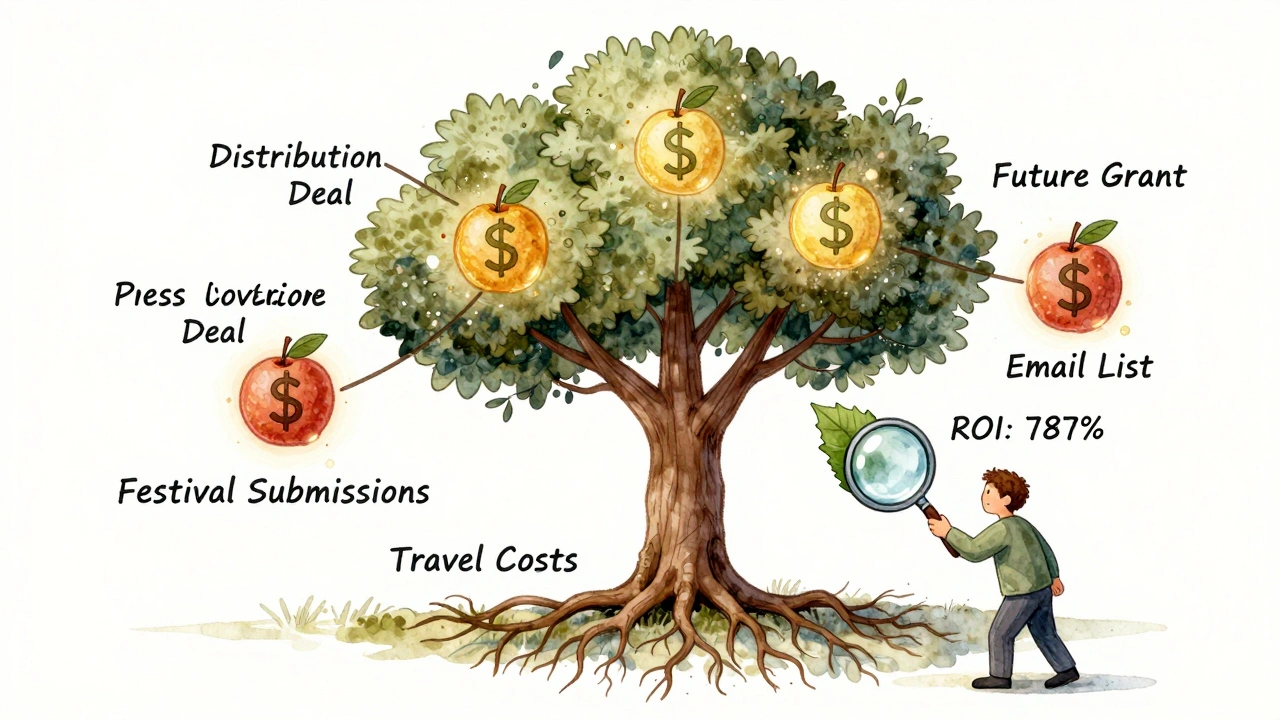
Total value: $106,500. ROI: 787%. They didn’t make money from tickets. They made money from strategy.
Can I measure ROI if I didn’t sell my film?
Yes. Even without a sale, you can measure ROI through exposure. Press coverage, social media growth, email list sign-ups, and future funding opportunities all have value. A filmmaker who gained 5,000 followers and landed a grant for their next project after a festival run earned ROI in opportunity, not cash.
How much should I budget for festival submissions?
Budget $1,500-$3,000 for 15-20 targeted festivals. Don’t submit to every festival. Focus on ones with real industry presence. A $100 submission that leads to a distributor is worth more than ten $50 submissions that lead to nothing.
Is it worth traveling to every festival?
Only if you can use the trip to meet distributors, journalists, or potential collaborators. If you’re just showing up to watch screenings, skip it. Travel costs often outweigh the benefits unless you’re actively networking. Many festivals now offer virtual Q&As-use those to save money.
What’s the minimum ROI I should expect?
Aim for at least 200% ROI. That means for every $1 you spend, you get $3 back in value-whether through deals, exposure, or future opportunities. If your ROI is below 100%, you’re losing money. Reevaluate your festival strategy.
How do I know if a festival is worth the cost?
Check past winners. Look up which films from that festival got picked up by distributors or streaming services. Search for press coverage from that event. If you can’t find at least 3-5 films that went on to earn money after screening there, it’s probably not worth your time or money.






Comments(7)