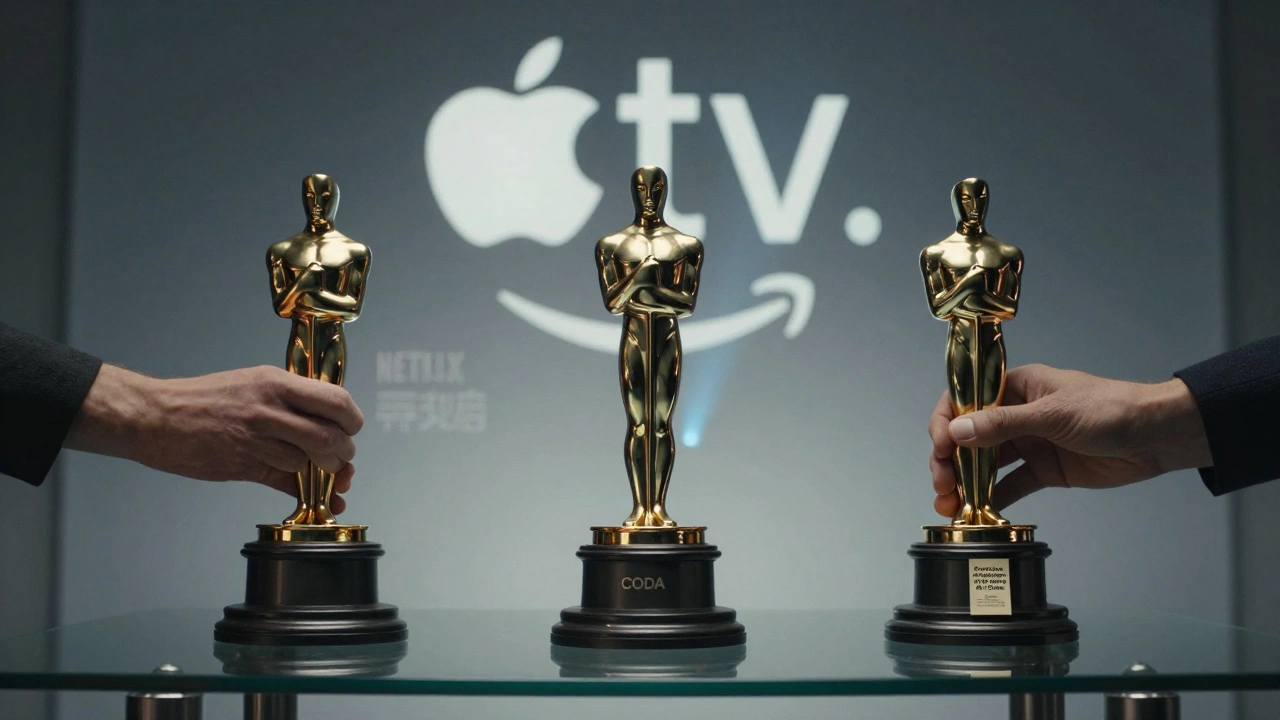
For years, the biggest film awards - especially the Oscars - were reserved for movies that played in theaters. But that rule changed. Now, streaming exclusives like Netflix’s Marriage Story and The Irishman, Amazon’s Manchester by the Sea, and Apple TV+’s CODA have not just been nominated - they’ve won Best Picture. The question isn’t whether streaming films can win awards anymore. It’s: how do they even get in the door?
What Changed? The Rules Got Smarter
The Academy of Motion Picture Arts and Sciences didn’t wake up one day and say, "Let’s let streaming services in." The shift happened because audiences changed. In 2018, only 12% of U.S. moviegoers saw films in theaters every month. By 2022, that number dropped to 6%. Meanwhile, subscription streaming platforms had over 200 million U.S. subscribers. The Academy had to adapt or risk becoming irrelevant.
In 2020, the Academy officially removed the theatrical release requirement. Before that, a film needed a minimum seven-day run in a commercial theater in Los Angeles County - with at least three daily screenings, including one between 6 p.m. and 10 p.m. That rule was scrapped. Now, a film qualifies if it meets two things: a public screening and a release window.
The Two Rules That Still Matter
Even though theaters aren’t required anymore, the Academy still has two non-negotiable conditions for eligibility:
- Public Exhibition - The film must be shown to the public in a qualifying format (digital projection, 35mm, or 70mm) in a commercial theater in Los Angeles. It doesn’t have to be for box office revenue - it can be a single paid screening. But it must be open to the public, not just industry insiders or press.
- Release Window - The film must be released on a streaming platform within 60 days of its first public theatrical screening. That means if a movie premieres in a theater on December 1, it can’t hit Netflix, Hulu, or Apple TV+ until January 31 at the earliest. If it streams before the 60-day mark, it’s disqualified.
This 60-day rule is often misunderstood. It’s not about how long a film stays in theaters. It’s about delaying the streaming debut to preserve the theatrical experience as a gateway. The Academy wants to make sure streaming services don’t skip the film festival circuit or skip the press tour entirely.
Why Do Streaming Services Bother With Theaters at All?
If you can stream a movie on day one, why spend millions on a one-week theater run? The answer is simple: awards eligibility. Without that one qualifying screening, a film can’t compete for an Oscar, a Golden Globe, or a BAFTA.
Take CODA, the 2021 Best Picture winner. Apple TV+ spent $2 million on a 10-day theatrical run across 15 theaters in L.A. and New York. That’s less than 0.5% of its marketing budget - but it was the only way to qualify. The same thing happened with The Power of the Dog (2021) and Everything Everywhere All at Once (2022). Both had limited theatrical releases - sometimes just one or two screens - before going to streaming.
Streaming studios don’t do this for profit. They do it for prestige. Winning an Oscar increases subscriber retention, boosts brand value, and gives them leverage when negotiating with talent and distributors.
What About Film Festivals?
Film festivals like Sundance, Cannes, and Toronto aren’t required for eligibility - but they’re practically mandatory in practice.
Why? Because the Academy’s voting members don’t watch 1,200 films a year. They rely on festivals to surface the best work. If a film doesn’t screen at a major festival, it’s unlikely to get the buzz, reviews, or industry attention needed to make it onto voters’ radar.
Netflix’s Marriage Story premiered at Venice and Toronto. Amazon’s The Post debuted at AFI Fest. Apple’s Swan Song opened at Sundance. These aren’t accidents. Studios now plan festival premieres as part of their award strategy - even if they’re streaming-only.
There’s one exception: documentaries. They don’t need a theatrical run at all. If a documentary is available on a streaming platform and meets the release window, it’s eligible. That’s why Netflix’s My Octopus Teacher and 20 Days in Mariupol won Oscars without ever playing in theaters.
Are All Streaming Platforms Treated the Same?
Yes - and no.
Technically, the rules apply equally to Netflix, Amazon, Apple, Disney+, Hulu, and even smaller platforms like MUBI. But in practice, the bigger players have more influence.
Netflix, for example, has spent over $2 billion on awards campaigns since 2015. They hire full-time Oscar consultants, buy out entire theater chains for qualifying runs, and host exclusive screenings for Academy voters. Smaller platforms don’t have that budget. A film on a platform like Tubi or Peacock might qualify under the rules - but without a campaign, it’s invisible.
That’s why you rarely see a film from a lesser-known streaming service win Best Picture. It’s not that the rules are unfair - it’s that the game is stacked. The Academy doesn’t care who you are. But the voters do.

What About International Awards?
Other major awards have similar rules - but with twists.
The BAFTAs (British Academy) require a theatrical release in the UK. A film can’t qualify if it only streams in the UK - even if it had a U.S. theatrical run. That’s why Parasite (2019) and Anatomy of a Fall (2023) had to open in UK cinemas before being eligible.
The Golden Globes (Hollywood Foreign Press Association) removed their theatrical requirement in 2021. Now, any film released on a streaming service during the eligibility window can compete - no theater needed. That’s why Minari (2020) and The Banshees of Inisherin (2022) were eligible even though they skipped theaters entirely.
The César Awards (France) still require a theatrical release in France. The Goya Awards (Spain) do too. So a film can be eligible for an Oscar and a Golden Globe - but not a César - if it didn’t play in French theaters.
What’s Next? The Rules Keep Shifting
The Academy is already looking ahead. In 2025, they introduced a new rule: films must have at least one day of screenings in a theater outside of Los Angeles and New York. That means a film can’t just play in those two cities - it needs to reach audiences in places like Austin, Atlanta, or Chicago.
Why? To prevent studios from gaming the system. In 2023, a few films played in just one theater in L.A. for seven days - with no other screenings anywhere. The Academy didn’t want awards to become a Los Angeles-only club.
They’re also considering requiring a minimum number of screenings per theater - not just one show per day. And they’re exploring whether films should be required to have a public Q&A or press tour before qualifying.
The future of film awards isn’t about theaters versus streaming. It’s about access. The goal isn’t to keep streaming out - it’s to make sure the best films, no matter how they’re released, get seen by enough people to be judged fairly.
Can a film win an Oscar if it only streams and never plays in theaters?
No. Even if a film is a streaming exclusive, it must have at least one public theatrical screening in Los Angeles County before it can qualify. The screening doesn’t need to be profitable or long - just one showing open to the public. After that, it can stream immediately.
Do all streaming platforms have the same chance to win awards?
Technically, yes. The rules don’t favor one platform over another. But in practice, bigger platforms like Netflix, Apple, and Amazon have far more resources to run campaigns, buy theater time, and promote films to Academy voters. Smaller services rarely win because they lack the budget to make their films visible.
Why do streaming services spend money on short theatrical runs?
Because without a qualifying theatrical screening, a film can’t compete for major awards like the Oscars. Even if a movie is designed for streaming, studios still spend millions on a one-week theater run - not to make money, but to unlock eligibility. It’s a cost of entry.
Can documentaries qualify without a theatrical release?
Yes. Documentaries are exempt from the theatrical requirement. As long as they’re released on a streaming platform within the eligibility window and meet other criteria (like runtime and public availability), they can compete for Oscars without ever playing in theaters.
Do international awards have the same rules as the Oscars?
No. The BAFTAs require a UK theatrical release. The Césars require a French release. The Golden Globes removed their theater rule entirely. So a film can be eligible for an Oscar and a Golden Globe but disqualified from a BAFTA if it didn’t play in UK cinemas.
Final Thought: It’s Not About How You Watch - It’s About What You See
The real question isn’t whether streaming films deserve awards. It’s whether the best films - regardless of how they’re released - are being seen and judged fairly. The rules have changed. The gatekeepers have changed. The audience has changed. And the awards? They’re finally catching up.






Comments(7)