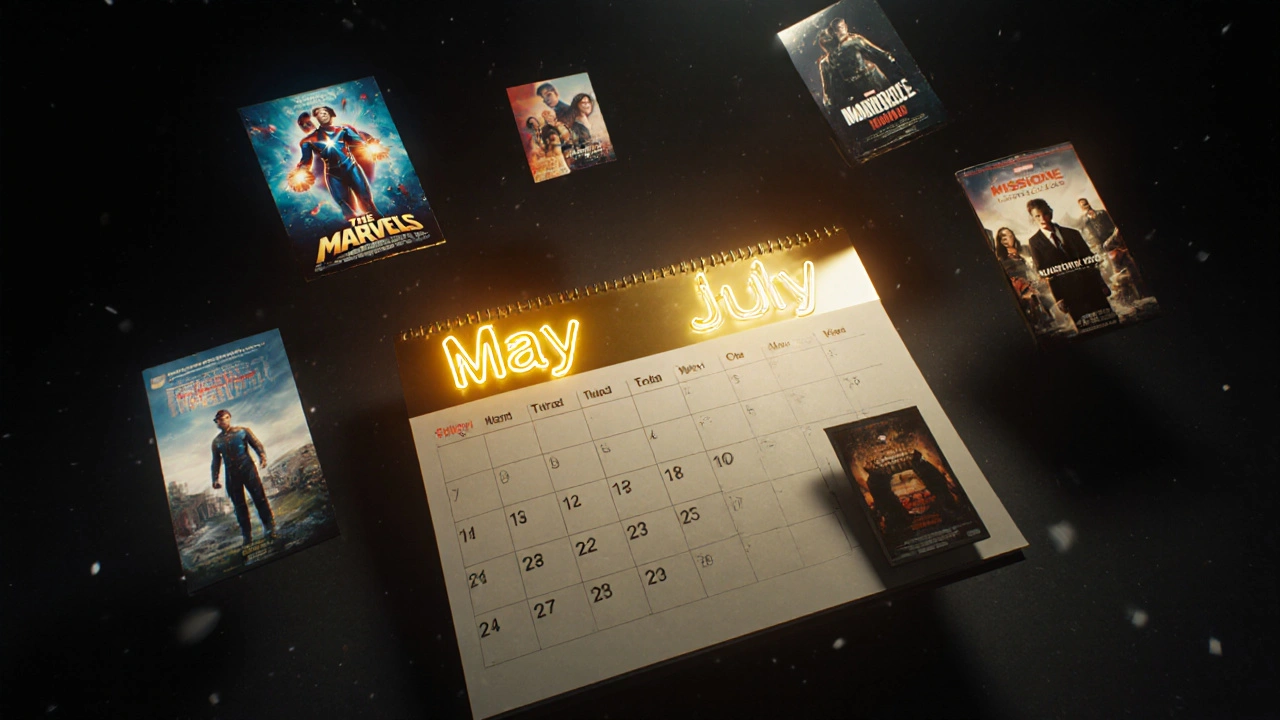
When a movie hits theaters, the date it opens isn’t just a calendar entry-it’s a make-or-break decision that can swing a film’s earnings by tens of millions. A summer blockbuster released in May might crush the competition, while the same movie dropping in January could vanish without a trace. It’s not about how good the movie is-it’s about when it shows up.
Why Timing Matters More Than You Think
Think about it: why do studios push big action movies into May or July? It’s not because those months are magically better for storytelling. It’s because kids are out of school, families have more disposable income, and there’s less competition from other major releases. In 2023, box office hits like The Marvels and Mission: Impossible - Dead Reckoning Part One both opened in July and earned over $500 million globally. Meanwhile, a critically praised drama like The Holdovers opened in November and made $75 million-strong for its genre, but nowhere near the summer blockbusters.
Studies from the University of Southern California’s Annenberg School show that movies released in the summer months (May-August) earn, on average, 38% more than those released in the winter. That’s not a coincidence. It’s strategy.
Holiday Releases: The Double-Edged Sword
Holiday weekends-Thanksgiving, Christmas, New Year’s-are goldmines. But only if you know how to use them. Movies like Avatar: The Way of Water and Frozen II opened the week before Christmas and pulled in over $2 billion because they became family traditions. Audiences don’t just watch these films-they plan their holidays around them.
But here’s the catch: holidays also bring heavy competition. In 2022, four major films opened within three days of each other around Thanksgiving. One of them, Strange World, lost $100 million despite decent reviews. Why? It was buried under the noise. Timing isn’t just about picking a good date-it’s about picking a date where you’re the only big thing on the menu.
Avoiding the Curse of the Friday the 13th
Some dates are just bad luck. Friday the 13th has become a punchline in Hollywood, but it’s not superstition-it’s data. Since 2010, films opening on Friday the 13th have averaged 32% lower opening weekends than those opening on a regular Friday. That’s not because people avoid theaters on the 13th. It’s because studios often dump lower-budget horror flicks on that date, expecting it to be a “safe” slot for cheap movies. Audiences notice the pattern. They know if a movie is opening on Friday the 13th, it’s probably not worth the price of popcorn.
Even big studios have stumbled. Friday the 13th (2009) opened on that date and made $28 million-good for a horror reboot, but half of what Star Trek made the week before. The date didn’t help. It hurt.

Competition Is the Real Enemy
A movie can be amazing, but if it opens against another blockbuster, it’s doomed. In 2023, The Marvels opened the same weekend as The Hunger Games: The Ballad of Songbirds & Snakes. Both were big-budget films with strong fanbases. The result? The Marvels made $125 million globally in its opening weekend; The Ballad of Songbirds & Snakes made $102 million. Both were underperformers by studio standards. But if they’d opened two weeks apart, each might have crossed $200 million.
Studios track release dates like chess players. They don’t just pick a date-they pick a date to avoid other studios’ moves. In 2024, Universal delayed Wicked from November to December to avoid clashing with Disney’s The Marvels sequel. That kind of scheduling chess game happens every year.
What Works for Blockbusters Doesn’t Work for Indies
Big studios have the budget to fight for summer slots. Independent films don’t. So they play a different game. They wait for the quiet months-January, February, September. That’s when awards season begins, critics are looking for gems, and audiences are hungry for something different after the holiday rush.
Everything Everywhere All at Once opened in March 2022 with a budget of $25 million. It earned $140 million. Why? Because it was the only bold, original movie in theaters. No competition. No noise. Just word-of-mouth growing every week. That’s the indie playbook: avoid the circus, find the gap, and let the buzz build.

The Streaming Factor Changes Everything
Five years ago, a movie had to open in theaters to matter. Now, studios can release a film in theaters for two weeks, then drop it on streaming. That’s changed release strategy. In 2024, The Marvels opened in theaters and hit Disney+ just 45 days later. That meant the studio could afford to open it in a crowded month-because they knew they’d make up the difference on subscriptions.
But here’s the twist: theaters still matter. A film’s theatrical opening determines its cultural footprint. If Barbie had gone straight to streaming, it wouldn’t have become a global phenomenon. People didn’t just watch it-they dressed up, went with friends, and made it an event. That kind of buzz drives merchandising, social media trends, and long-term revenue. Streaming is a safety net. Theaters are the launchpad.
What You Can Learn From This
If you’re a filmmaker, a producer, or even just a movie fan trying to understand why your favorite film flopped, remember this: timing is everything. A great movie can fail if it opens on the wrong day. A mediocre movie can succeed if it lands in the right window.
Here’s what to look for next time you check a movie’s release date:
- Is it opening during a holiday weekend? (Good for family films, bad for adult dramas)
- Is it competing with another big movie? (Check Box Office Mojo for release calendars)
- Is it a horror movie on Friday the 13th? (Probably not worth your time)
- Is it a small film in January? (Could be an awards sleeper hit)
- Is it a sequel opening in July? (High chance of success)
Studios don’t guess. They run simulations. They test audience sentiment. They track historical data. And they move release dates like pawns on a board. If you understand the pattern, you can predict which movies will win before they even open.
Final Thought: It’s Not About the Movie-It’s About the Moment
The best movie ever made won’t make money if no one shows up. And no one shows up if the timing’s wrong. The box office isn’t a meritocracy. It’s a calendar game. The winner isn’t always the best story. It’s the one that showed up when the crowd was ready to listen.
Do release dates really make that much difference in box office earnings?
Yes. A movie opening in summer can earn 30-40% more than the same film released in winter, according to USC Annenberg research. Timing affects audience availability, competition, and marketing momentum-all critical to box office success.
Why do horror movies often open on Friday the 13th?
It’s a tradition, but also a low-risk strategy. Studios use Friday the 13th as a dumping ground for cheaper horror films because they expect lower expectations and lower marketing costs. The date draws a niche audience, but it also signals to general viewers that the film isn’t a major release-which hurts broader appeal.
Can a movie still succeed if it opens against a blockbuster?
It’s rare, but possible. If the movie is highly targeted-like a niche indie or a sequel to a cult favorite-it can carve out a loyal audience. But most films that open head-to-head with a major release lose 20-50% of their potential earnings. Studios avoid this by delaying releases or choosing quieter windows.
Why do award hopefuls open in late-year months like November and December?
Because critics are actively looking for standout films during awards season. A film opening in November gets more press, more reviews, and more buzz before the Oscars. It also avoids summer blockbusters, giving it breathing room. Films like Manchester by the Sea and Marriage Story used this strategy to win awards and build long-term revenue.
Has streaming changed how studios pick release dates?
Absolutely. Studios now use theatrical releases as marketing tools for streaming. A film might open in theaters for just 30-45 days before hitting streaming, which allows studios to take more risks with timing. But the theatrical opening still matters-it’s how a film becomes a cultural event. Without it, even great movies fade quickly.



Comments(10)