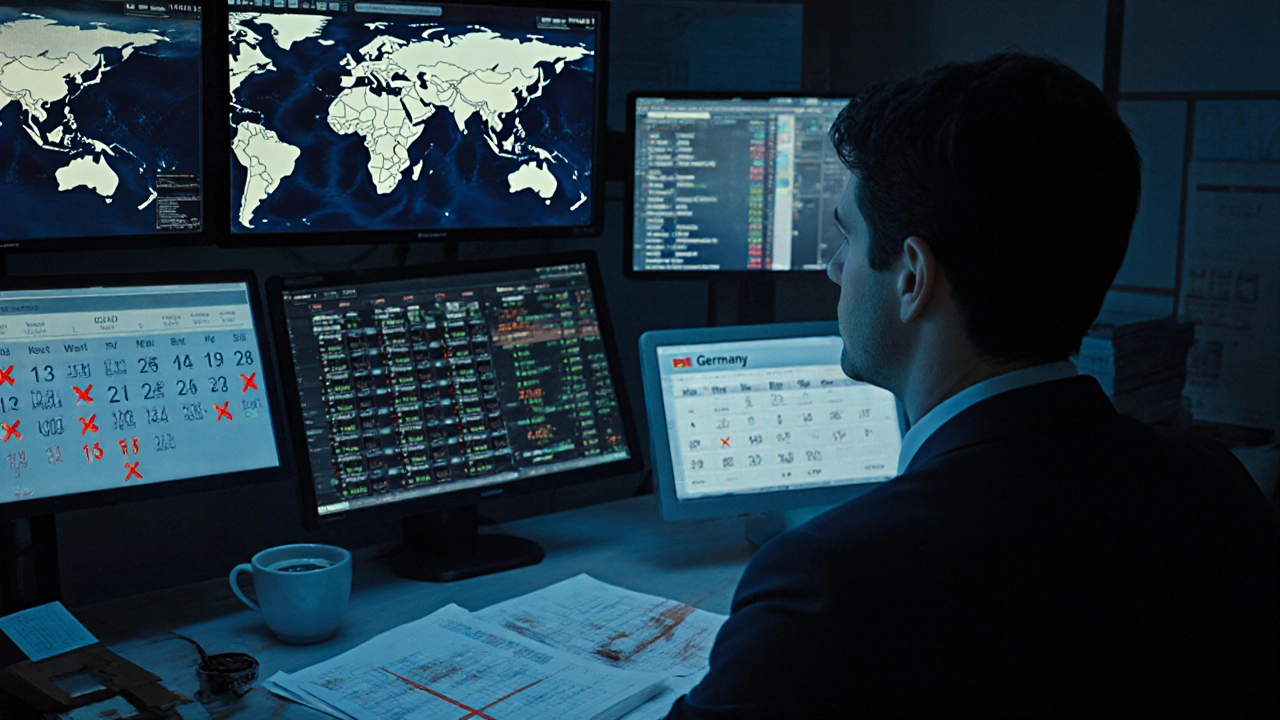
When you’re making a film with partners in Canada, Germany, and South Korea, your budget isn’t just numbers on a spreadsheet-it’s a ticking clock tied to exchange rates. A 5% drop in the Canadian dollar between signing the contract and shooting day can eat up your entire location budget. This isn’t theory. It’s what happened to the 2024 co-production Borderlands, where a sudden euro slump forced producers to cut three weeks of shooting in Berlin and reshoot key scenes in cheaper locations in Eastern Europe.
Why FX Risk Hits Co-Productions Harder Than Domestic Films
Domestic films deal with one currency. Co-productions juggle three, four, or even five. Each partner brings funding in their own currency: euros from France, pounds from the UK, won from South Korea. That means every payment-actor salaries, equipment rentals, post-production fees-depends on how those currencies move against each other.
Take a typical co-production: 40% of the budget comes from Germany (euros), 30% from the U.S. (dollars), and 30% from Japan (yen). If the yen weakens 12% against the dollar during pre-production, Japan’s contribution buys less. To keep the budget balanced, someone has to cover the gap. Usually, it’s the producer. That’s when you start cutting extras, reducing VFX time, or delaying reshoots.
The problem isn’t just the size of the shift-it’s the timing. Most co-production agreements lock in funding amounts, not exchange rates. So if the British pound falls 15% after you’ve hired your crew in London, you’re stuck paying them in dollars while your pound funding has shrunk. No contract clause can fully protect you from that.
How Macroeconomic Shifts Trigger Currency Volatility
Currency moves don’t happen in a vacuum. They’re driven by real-world events that co-producers can’t control:
- Central bank decisions: When the European Central Bank raises interest rates to fight inflation, the euro strengthens. That’s good if you’re collecting euros, bad if you’re spending them.
- Political instability: The 2024 Italian election led to a 9% drop in the lira within three weeks. A co-production with Italian tax credits suddenly lost millions in value.
- Trade wars and tariffs: The U.S.-China tech tariffs in early 2025 caused the yuan to fall 8% against the dollar overnight. A film with post-production in Shanghai had to renegotiate vendor contracts mid-shoot.
- Commodity prices: Canada’s dollar is tied to oil. When oil prices dropped 20% in late 2024, Canadian funding for Arctic-set films lost value-just as snow season was about to begin.
These aren’t rare events. In the last 18 months, 7 out of 12 major international co-productions experienced currency swings larger than 10% between financing and principal photography. That’s not volatility-it’s the new normal.

Real-World Budget Impacts: What Gets Cut First
When FX risk bites, producers don’t just cut the budget-they cut the film. Here’s what usually disappears:
- Supporting cast: A $150,000 fee for a well-known actor in Australia becomes unaffordable when the Aussie dollar drops 12%. The role gets recast with a local unknown.
- Location days: Shooting in Paris for five days instead of eight? That’s a 37% savings on hotel, transport, and permits.
- Visual effects: VFX studios in India and Bulgaria often quote in local currencies. If the rupee or leu strengthens, their rates go up. Studios get trimmed from 120 shots to 70.
- Post-production: Sound mixing in London or color grading in Los Angeles gets delayed or moved to cheaper markets like Prague or Manila.
- Marketing: Trailers, festival submissions, and digital ads are the first to be slashed. That’s why many co-productions now launch with zero marketing budget-relying on film festivals to do the heavy lifting.
In 2024, a U.S.-Brazil co-production lost $2.1 million in FX value. They cut the entire second unit, scrapped the drone cinematography package, and reduced the final mix from 5.1 to stereo. The film still premiered at Cannes-but it looked like a lower-budget project.
How Producers Protect Their Budgets (And When It Doesn’t Work)
Some producers try to hedge. They lock in exchange rates with forward contracts. Others use currency options. But here’s the truth: most indie co-productions can’t afford it.
Forward contracts cost $5,000 to $20,000 to set up. They require collateral. They’re handled by banks that won’t work with small production companies. Even if you can get one, it only covers a portion of your budget-usually just the first 30%.
Some co-productions build currency buffers into their budgets. A 10-15% cushion sounds smart. But if the currency moves 20%, you’re still underwater. And if you over-allocate that buffer, you’re starving your film of resources upfront.
One effective tactic? Pay vendors in the currency they’re paid in. If your editor in Argentina works in pesos, pay them in pesos. If your DIT in Poland bills in zloty, pay them in zloty. That way, you avoid converting twice. But this only works if your funding sources allow it-and many tax credit programs require payments in local currency.

What You Can Do Today to Reduce FX Risk
You can’t predict currency moves. But you can build resilience:
- Lock funding early: Secure and disburse as much funding as possible before principal photography. Even a 30-day delay can cost you 3-5% in FX.
- Use multi-currency accounts: Platforms like Wise or Revolut let you hold and transfer euros, pounds, yen, and dollars with low fees. Use them to receive and pay in local currencies without conversion.
- Structure payments in stages: Don’t pay 100% upfront. Tie payments to milestones: 30% at pre-production, 40% at shoot start, 30% at delivery. This spreads out your exposure.
- Choose partners wisely: Countries with stable currencies (Switzerland, Singapore) are safer than those with volatile ones (Turkey, Argentina). Tax credit systems matter too-some, like Canada’s, pay in local currency regardless of FX.
- Build a 10% FX buffer: It’s not magic, but it’s the minimum most experienced producers use. If you’re working with three currencies, assume at least one will move 10% or more.
And if you’re the lead producer? Insist on a currency clause in your co-production agreement. Something like: “In the event of a currency fluctuation exceeding 10% against the agreed baseline, funding partners will adjust their contributions proportionally.” It’s not standard. But it’s becoming necessary.
The Bigger Picture: Co-Productions Are Becoming Financial Instruments
International film co-productions are no longer just creative collaborations. They’re complex financial instruments-part investment fund, part currency trade, part political risk hedge.
That means producers need more than a script and a shooting schedule. They need a treasurer. A financial analyst. Someone who watches Bloomberg, reads central bank minutes, and tracks commodity prices.
Small teams can’t do this alone. That’s why more co-productions are bringing on financial coordinators-people who aren’t accountants but understand FX, tax credits, and cross-border payments. Their salary is cheaper than losing $500,000 to a bad exchange rate.
The films that survive-and thrive-are the ones that treat budgeting like a financial model, not just a line item list. The ones that know: if the yen drops, your movie changes. Not your vision. Your reality.
How often do currency fluctuations affect co-production budgets?
Currency fluctuations impact nearly every international co-production today. In the last two years, 7 out of 12 major co-productions experienced FX moves of 10% or more between financing and shoot dates. For projects involving emerging market currencies, it’s closer to 9 out of 10.
Can I insure against currency risk in film production?
There’s no standard film insurance policy that covers FX risk. Some large studios use bespoke financial hedging tools, but these are cost-prohibitive for most indie co-productions. The best protection is proactive budgeting: locking funds early, using multi-currency accounts, and building a 10% FX buffer.
Which currencies are most volatile for film co-productions right now?
As of late 2025, the Turkish lira, Argentine peso, and Brazilian real are the most volatile. The Canadian dollar and Australian dollar are also sensitive to commodity swings. The euro and Swiss franc are relatively stable, making them safer funding sources.
Should I avoid co-producing with countries that have unstable currencies?
Not necessarily. Countries like India, South Korea, and Mexico offer strong tax incentives and skilled crews. The key is to structure payments in their local currency and avoid converting funds until the last possible moment. Don’t avoid the country-avoid the currency risk.
What’s the biggest mistake producers make with FX risk?
Assuming the budget is fixed. Many producers treat currency as a footnote, not a core variable. They sign agreements based on projected exchange rates from six months ago. When rates shift, they panic and make reactive cuts that damage the film’s quality. The fix? Treat FX like a production department-with a budget, a plan, and a person responsible.






Comments(7)