
Think about the last time a movie made your heart race, your eyes well up, or your skin crawl. Chances are, it wasn’t just the actors or the script. It was the music. A single cello note can make a quiet scene feel like a funeral. A pounding timpani roll can turn a simple chase into pure panic. Film scoring isn’t background noise-it’s emotional engineering.
What Film Scoring Actually Is
Film scoring is the process of writing original music to match the visuals, emotions, and pacing of a movie. It’s not just picking songs or looping loops. It’s building a sonic architecture that supports every scene, often without the audience realizing it’s there. A great score makes you feel something before you even know why.
Composers work closely with directors from early stages-sometimes even before filming starts. They read scripts, watch rough cuts, and discuss tone. Is this a horror film that needs dissonant strings and eerie silence? Or a romantic drama that calls for warm piano and swelling strings? The music has to serve the story, not steal it.
The Tools of the Trade
Modern film composers don’t just write on paper anymore. They use digital audio workstations like Logic Pro, Cubase, or Reaper. But the real magic happens when they layer real instruments over virtual ones. A sample library might give you a violin sound, but a live player adds breath, imperfection, and soul.
Orchestras are still the backbone of big-budget films. The London Symphony Orchestra, for example, has recorded scores for over 2,000 movies, from Star Wars to The Lord of the Rings. But indie films often rely on smaller ensembles-a solo cello, a lone piano, or even a theremin. It’s not about size. It’s about intention.
Sound design overlaps heavily with scoring. A heartbeat might be a real drum, but it could also be a processed bassoon or a slowed-down recording of footsteps. Composers often collaborate with sound designers to blur the line between music and noise.
The Anatomy of a Film Score
Every score follows a basic structure, even if it’s hidden. Most composers build around leitmotifs-repeating musical themes tied to characters, places, or ideas. John Williams’ Jaws theme is two notes. That’s it. But those two notes mean danger. They’re unforgettable because they’re simple and repeated at key moments.
Another key element is tempo. Action scenes need driving rhythms. A slow-motion death scene? The music slows down, sometimes to a crawl. Composers often use tempo maps synced to the frame rate of the film. One frame equals 1/24th of a second. Every note has to land exactly where the emotion peaks.
Harmony matters too. Major keys feel hopeful. Minor keys feel sad or tense. But modern composers break these rules. Hans Zimmer’s Inception score uses a slowed-down version of Edith Piaf’s Non, Je Ne Regrette Rien-a French pop song turned into a haunting, time-bending motif. It’s not classical. It’s not traditional. But it’s perfect for the film.
How Composers Start: From Script to Score
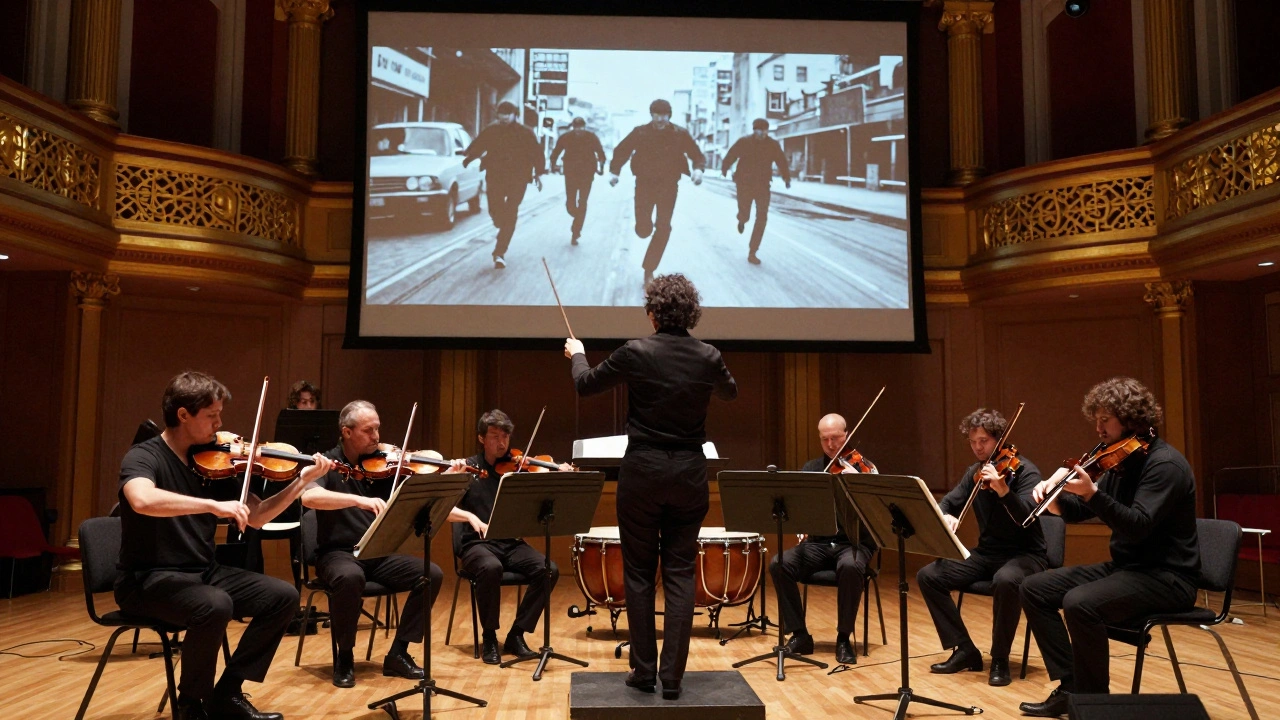
The process usually begins with a spotting session. That’s when the composer, director, and editor sit together with the film and decide exactly where music should enter and exit. They mark spots like:
- Opening theme (establishes tone)
- Character theme (introduces the hero or villain)
- Emotional climax (the moment the music swells)
- Transition cues (music that bridges scenes)
- End credits (often a reprise or variation)
After that, the composer writes sketches-short musical ideas on piano or in a DAW. These are shared with the director for feedback. No one wants a full 10-minute orchestral piece only to find out the director hated the melody. Early drafts are rough, sometimes just a single instrument playing a melody over a click track.
Once approved, the full score is orchestrated. That means turning a piano sketch into parts for 80 musicians. An orchestrator helps with this, assigning which instruments play which notes. A flute might carry the main theme, while low brass adds weight underneath. It’s like painting with sound.
Real-World Examples That Changed the Game
Some scores are so iconic, they’re studied in music schools. Bernard Herrmann’s score for Psycho used only strings-no woodwinds, no brass. The stabbing violins in the shower scene were revolutionary. No percussion. Just pure tension.
Similarly, Vangelis’ Blade Runner score blended analog synths with choral voices and ambient textures. It didn’t sound like a movie score. It sounded like the future. And it still does.
For modern films, Ludwig Göransson’s score for Black Panther mixed African tribal rhythms with orchestral power. He recorded instruments like the talking drum and the kora in Ghana and layered them with Western strings. The result wasn’t just music-it was cultural storytelling.
Common Mistakes New Composers Make
Many beginners think more music equals better. They write for every second of the film. That’s wrong. Silence is just as powerful. In No Country for Old Men>, the Coen brothers used almost no score. The tension came from wind, footsteps, and the absence of music. That’s harder than writing a full symphony.
Another mistake? Writing music that tells the audience how to feel. If a character is crying, don’t play sad strings. Let the actor’s face do the work. Sometimes, a single sustained chord is enough. Less is more.
Also, avoid clichés. The rising arpeggio for a hero’s entrance? Overused. The minor key for a villain? Predictable. Great composers find fresh ways to express emotion. They don’t rely on formulas.

How to Learn Film Scoring
You don’t need a degree. But you do need to listen-deeply. Watch films with the sound off. Then turn it on. Notice how the music changes your reaction. Try scoring short scenes yourself. Use free tools like MuseScore or GarageBand. Start with a 30-second clip from a silent film.
Study the masters. Break down their scores. How many instruments did they use? Where did the melody sit? What key was it in? Did the rhythm match the edit? You’ll learn more from analyzing five minutes of a Hans Zimmer cue than from watching ten hours of YouTube tutorials.
Build relationships. Film scoring is a collaborative art. Send your work to student filmmakers. Offer to score their short films for free. You’ll get feedback, experience, and maybe a credit on your reel.
Why Film Scoring Still Matters in the Age of Playlists
With streaming services pushing curated playlists and AI-generated background tracks, some wonder if original film scores are becoming obsolete. They’re not. People still crave emotional depth. A well-placed chord can make a viewer remember a movie for decades.
Think about Interstellar. The organ in the final act doesn’t just accompany the scene-it becomes part of the story. The music isn’t playing over the visuals. It’s telling you what the characters can’t say. That’s the power of film scoring. It’s not decoration. It’s the soul of the film.
Do film composers write music before or after the movie is filmed?
It varies. Some composers, like John Williams, write themes before filming begins to help guide the director’s pacing and tone. Others, like Hans Zimmer, work after rough cuts are locked. Most do a mix-sketching early ideas, then refining after seeing the final edit.
Can you be a film composer without knowing how to read sheet music?
Yes, but it’s harder. Many modern composers use digital tools and work with orchestrators who translate their ideas into sheet music. However, understanding notation helps you communicate clearly with musicians and directors. It’s not required, but it’s a major advantage.
What’s the difference between a film score and a soundtrack?
A film score is original music written specifically for the movie. A soundtrack is a collection of songs used in the film, which may include pop tracks, classical pieces, or licensed music. The score is custom. The soundtrack is curated.
How long does it take to score a movie?
It usually takes 6 to 12 weeks for a major film, but it can stretch to months if the schedule is tight. Indie films might be scored in just a few weeks. The clock starts after the film is locked and ends when the final mix is delivered.
Do film composers get royalties?
Yes, but not always right away. Composers typically get an upfront fee for writing the score. They may also earn performance royalties when the film is broadcast on TV or streamed. These are collected by organizations like ASCAP or BMI. It’s not a quick payday-it’s long-term income tied to how often the film is shown.
Final Thought: Music Is the Invisible Character
A movie can lose its lead actor, its special effects, even its script-but if the music works, the audience still feels it. The best film scores don’t announce themselves. They breathe with the story. They’re the unseen character that holds everything together. That’s why composers aren’t just musicians. They’re emotional architects.


Comments(9)