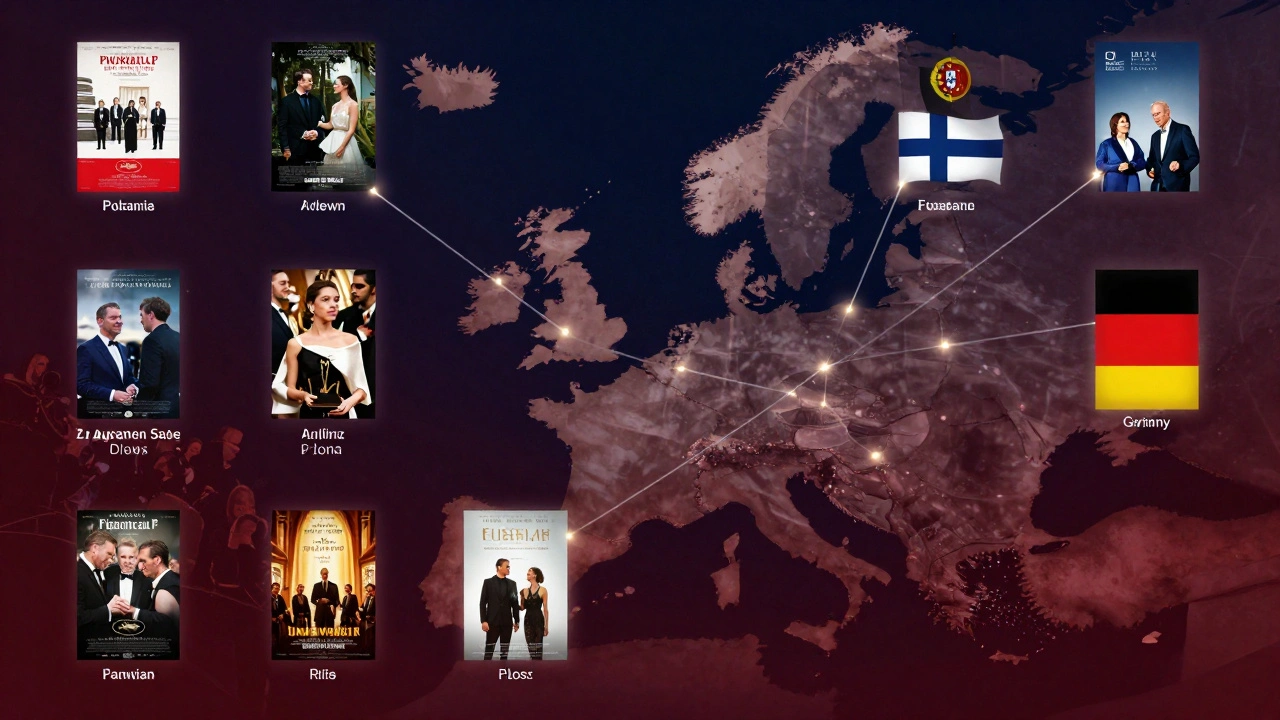
When you look at the lineups for Cannes, Berlin, or Venice, you’ll see the same names over and over: films backed by Europa International members. These aren’t random hits. They’re the result of a tightly woven network that’s been quietly shaping European cinema for over 30 years. If you’ve ever wondered why certain films keep showing up at top festivals while others vanish, the answer isn’t just talent or budget-it’s the sales network behind them.
What Europa International Actually Does
Europa International isn’t a funding body. It doesn’t give grants or produce films. It’s a sales and distribution alliance made up of 27 independent film companies from 18 European countries. Each member handles sales for films in their home market but also collaborates across borders. Together, they control access to over 80% of European arthouse and festival films released internationally.
Think of them as the invisible pipeline between filmmakers and festival programmers. A director in Poland finishes a film. Their local sales agent, say, Film & TV Poland, doesn’t just push it domestically. They immediately share it with the Europa network. Within days, the film is being pitched to buyers in France, Germany, Spain, and beyond. That’s why you see the same titles at Sundance, Toronto, and Locarno-they’ve been pre-vetted by a continent-wide system that knows what works.
Why Festival Programmers Rely on Them
Festival curators don’t have time to sift through thousands of unsolicited submissions. They need filters. Europa International acts as a quality control layer. Each member company has a track record. They know what audiences respond to. They know what critics respond to. And they know what fits the tone of each festival.
For example, a film from Portugal that won a prize at Locarno in 2023 didn’t get there by accident. Its sales agent, Lusomundo, had already secured pre-sales in Belgium and the Netherlands before the festival even started. That gave the film credibility. Festival programmers saw it as a safe bet with built-in audience interest. That’s the power of the network: it turns risky indie films into low-risk, high-reward selections.
A 2024 study by the European Audiovisual Observatory found that 73% of films selected for the official competition at Cannes had at least one Europa International member as their sales agent. That’s not coincidence. It’s structure.
The Co-Production Advantage
Most films backed by Europa International aren’t made by one country alone. They’re co-productions. A German director, a French producer, a Spanish cinematographer, a Swedish composer. These collaborations aren’t just artistic-they’re financial and logistical.
Each country involved brings tax incentives, funding pools, and local crew talent. But more importantly, each brings access to its own national film market. A co-production between Italy and Sweden doesn’t just get funding from both countries-it gets two sales teams pushing it internationally. That doubles the chances of securing distribution deals.
Europa International members specialize in managing these cross-border deals. They handle legal paperwork, currency exchanges, and rights splits. Without them, most co-productions would collapse under bureaucracy. With them, they become unstoppable.

How They Beat the Odds
Independent film is a brutal business. Most films never find an audience. But films with Europa International backing have a 60% higher chance of securing international distribution than those without, according to data from the European Film Market in 2025.
Here’s how they do it:
- Early access: Members get exclusive previews of films months before public submissions open.
- Shared data: They track which genres, themes, and directors perform best in each territory.
- Joint marketing: Instead of 27 separate campaigns, they run coordinated campaigns across Europe.
- Festival strategy: They don’t just submit films-they plan festival runs like a chess game, targeting the right events in the right order.
Take the 2024 film Winter in Helsingfors. Made by a Finnish-Swedish team, it had no big-name actors. But its sales agent, Nordisk Film Sales (a Europa member), targeted Berlinale first, then Rotterdam, then Toronto. By the time it hit Sundance, it already had offers from seven territories. It ended up selling in 32 countries.
Who Gets Left Out
This system works brilliantly-for those inside it. But it’s not open to everyone. Most independent filmmakers from Eastern Europe, the Balkans, or smaller nations like Latvia or Lithuania don’t have direct access. Their local sales agents aren’t members. They’re forced to go through intermediaries, which cuts their profit and delays their exposure.
There’s also a language barrier. Films in Hungarian, Slovenian, or Estonian get less attention unless they’re subtitled early and packaged with strong English-language marketing. Europa members often prioritize films that are easier to sell in English-speaking markets, even if they’re not the most artistically ambitious.
And then there’s the funding gap. Films backed by Europa members often have 3-5 production partners. Films without that network usually rely on one or two national funds. That means less money, less promotion, and less chance of making it to a major festival.

The Future of European Film Sales
The system isn’t perfect, but it’s evolving. In 2025, Europa International launched a new initiative called Open Access, inviting non-member sales agents from underrepresented regions to participate in joint pitch sessions at the European Film Market. It’s a small step, but it’s a start.
Streaming platforms are also changing the game. Netflix and Amazon now buy films directly from Europa members more than ever. But here’s the twist: they still rely on the network to find the films. Even tech giants need trusted curators.
The real winners aren’t the biggest studios. They’re the small, agile sales companies that know how to connect filmmakers with the right audiences. That’s the heart of Europa International. It’s not about money. It’s about access.
What This Means for Filmmakers
If you’re a director or producer outside this network, here’s what you need to know:
- Build relationships with sales agents who are already members. Don’t wait for your film to be finished.
- Make sure your film is eligible for co-production funding. That means partnering with a company in another EU country early.
- Learn how festivals work. Don’t just submit everywhere. Target the ones where your film’s sales agent has influence.
- Don’t assume talent alone will get you noticed. In European cinema, who you know matters as much as what you made.
The system favors those who play the game. But the game isn’t rigged-it’s just structured. And once you understand how it works, you can find your way in.
What is Europa International?
Europa International is an alliance of 27 independent film sales companies from 18 European countries. It helps distribute and promote European films at international festivals and markets. It does not fund films but connects filmmakers with buyers and programmers through shared networks and expertise.
Why do so many festival films have the same sales agents?
Because those agents are members of Europa International, which controls over 80% of European arthouse film distribution. They have early access to films, shared data on what works, and strong relationships with festival programmers. This gives them a major advantage in getting films selected.
Can independent filmmakers outside Europe join Europa International?
Not directly. Membership is limited to sales agents based in European countries. But since 2025, Europa International has offered Open Access sessions where non-member agents from underrepresented regions can pitch films alongside members, giving them exposure to buyers and programmers.
Do streaming platforms prefer Europa International films?
Yes. Netflix, Amazon, and other platforms increasingly rely on Europa International members to find curated, festival-ready films. These agents do the heavy lifting of vetting, packaging, and marketing, making it easier for streamers to acquire content with proven appeal.
Are co-productions necessary to succeed in European festivals?
Not absolutely, but they significantly increase your chances. Co-productions unlock funding from multiple countries, reduce financial risk, and give you access to multiple sales networks. Films with two or more European partners are twice as likely to be selected for major festivals, according to 2025 data from the European Audiovisual Observatory.






Comments(10)