
When a film is ready to hit theaters or streaming platforms, it doesn’t just get uploaded and go live. There’s a strict, often brutal, chain of legal and technical handoffs that must happen before anyone sees the final cut. These are called deliverables-and missing even one can delay a release by months, cost tens of thousands in penalties, or kill a deal entirely.
What Exactly Are Film Deliverables?
Film deliverables are the physical and digital assets a distributor requires to legally release a movie. Think of them as the checklist a studio or streaming service demands before they pay the final check. These aren’t optional extras. They’re contractually binding. If you don’t hand over the right files, the right paperwork, and the right certifications on time, you don’t get paid.Deliverables fall into three buckets: technical, legal, and administrative. Technical means video, audio, and subtitle files. Legal means copyright registrations, chain of title documents, and clearances. Administrative means invoices, insurance certificates, and delivery logs. Missing any one of these can trigger a breach notice-and distributors don’t care if your editor was sick or your sound mixer quit.
Why Delivery Schedules Matter More Than You Think
Every distributor has a delivery schedule tied to their release calendar. These aren’t suggestions. They’re deadlines carved in stone. For example, if a film is scheduled to drop on Netflix on March 1, the distributor will typically require all deliverables to be submitted by January 15. That gives them 45 days to QC, encode, upload, and market the title.Missing that date doesn’t just mean a late release. It means the distributor can charge you penalties-often $500 to $2,000 per day-for every day late. Some contracts even let them withhold the entire distribution fee until everything is delivered. I’ve seen indie films lose over $80,000 in revenue because a single music clearance wasn’t signed.
Delivery schedules are also tied to film festivals. If you’re planning to submit to Sundance or Toronto, you need your deliverables locked down by October. Festivals don’t wait. They lock their lineups in November. No deliverables? No screening. No screening? No buzz. No buzz? No distributor.
The Core Legal Deliverables You Can’t Skip
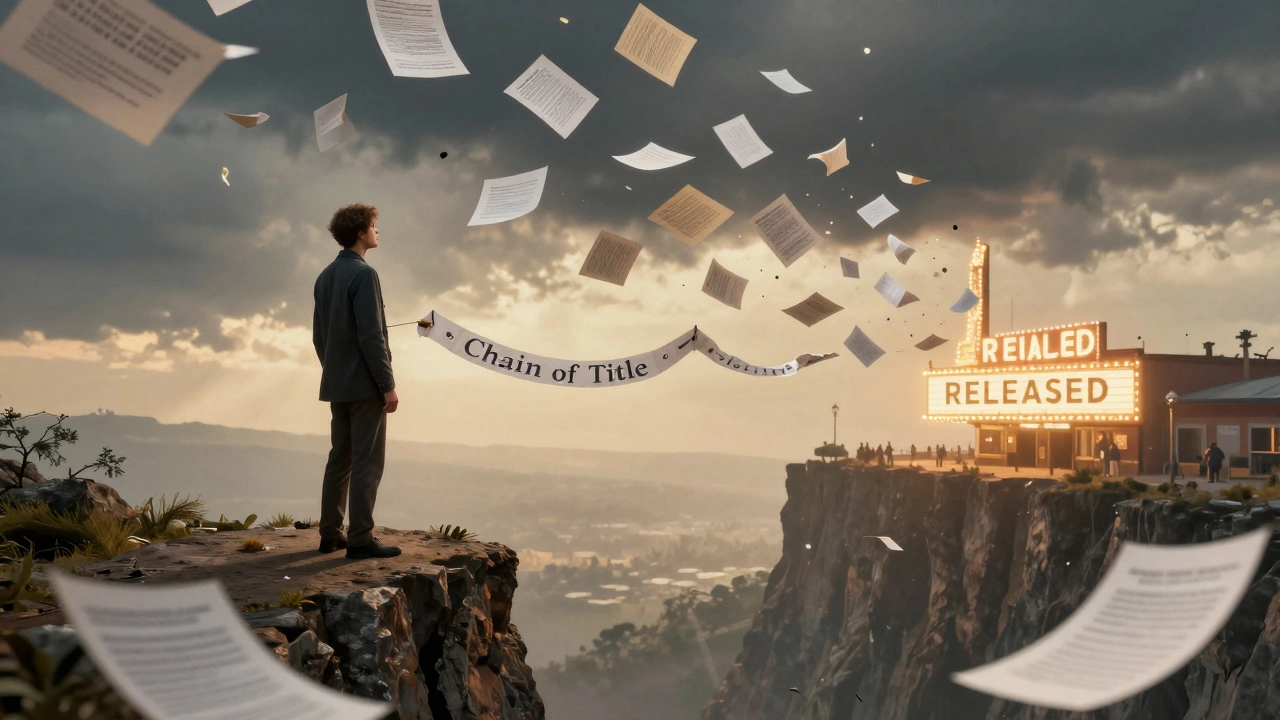
Here’s what every distributor demands, no exceptions:- Chain of Title Documentation-This proves you own the rights to make and distribute the film. It includes option agreements, screenplay rights, underlying rights (like books or true stories), and talent releases. If you adapted a novel, you need the written permission from the author or estate.
- Errors & Omissions (E&O) Insurance-This isn’t optional. It protects the distributor from lawsuits over copyright infringement, defamation, or unauthorized use of trademarks. Most require at least $1 million in coverage. The policy must name the distributor as an additional insured. Without this, no platform will touch your film.
- Music Clearances-Every song, no matter how short, needs two clearances: synchronization (for using the recording) and mechanical (for using the composition). Even a 5-second snippet of a Beatles song requires both. Many filmmakers assume royalty-free music is safe. It’s not. You still need a written license from the provider.
- Talent Releases-Everyone who appears on screen, even in the background, must sign a release. This includes crowd extras, street musicians, and people filmed in public spaces if they’re identifiable. Courts have ruled that even 2 seconds of someone’s face without consent can lead to liability.
- Location Releases-If you filmed on private property, you need written permission from the owner. That includes homes, businesses, parks, and even public buildings if they’re recognizable. Some cities require permits, which also count as legal deliverables.
- Copyright Registration-In the U.S., you must register your film with the U.S. Copyright Office. While copyright exists the moment you create it, registration is required to sue for infringement. Distributors demand proof of registration before paying out.

Technical Deliverables: The Digital Pack
Once the legal stuff is sorted, you need to deliver the actual movie files. These vary by platform, but here’s the standard set:- DCP (Digital Cinema Package)-The industry standard for theatrical release. Must be encrypted, conform to SMPTE standards, and include 2K or 4K resolution.
- ProRes 422 HQ or DNxHR HQX-High-resolution master files for streaming platforms like Netflix, Apple TV+, or Amazon. These are usually 10-bit, 4:2:2, and 1920x1080 or higher.
- Subtitle Files-Closed captions in SCC, SRT, or VTT format for each language. Must be timed perfectly. Netflix requires 100% accuracy-no auto-generated captions allowed.
- Audio Mixes-Stereo, 5.1, and sometimes 7.1. Each must be delivered as separate files with metadata tags.
- Still Images-Poster art, key art, and promotional stills in 300 DPI, TIFF or JPEG format. Must include metadata with title, year, and copyright info.
Many filmmakers think they can just send a QuickTime file. They can’t. Platforms like Hulu and Disney+ have automated QC systems that reject files that don’t meet exact specs. One wrong frame rate or bit depth, and your film gets bounced back.
The Film Completion Binder: Your Legal Lifeline
The most organized filmmakers keep a film completion binder-a digital or physical folder that contains every single deliverable, organized and labeled. It’s not glamorous, but it’s the difference between getting paid and getting sued.Each item should have:
- A clear filename (e.g., "Talent_Release_JaneDoe_Scene12.pdf")
- A date of execution
- A signature (wet or digital)
- A copy of the original contract or agreement
Many distributors now require this binder to be uploaded to a secure portal like Frame.io or Aspera. Some even use blockchain-based systems to verify authenticity. If your files are scattered across Dropbox, Google Drive, and a thumb drive, you’re already behind.
What Happens When You Miss a Deliverable?
I’ve worked with three films that missed one key deliverable. Each story is different, but the outcome is the same.One indie documentary lost its Netflix deal because the director didn’t get a release from a talking head who appeared in a 3-second clip. The distributor found out during QC. The film was pulled two weeks before launch. The filmmaker lost $120,000 in distribution fees and had to re-edit the entire film to remove the clip.
Another film had perfect technical files but no E&O insurance. The distributor refused to pay the final 30% of the advance. The filmmaker had to take out a high-interest loan just to buy the policy-and even then, the delay cost them festival eligibility.
These aren’t edge cases. They happen every week. The industry doesn’t make exceptions for small budgets. Your film isn’t special because you’re independent. Distributors treat every title the same: if it doesn’t meet the spec, it doesn’t move.
How to Avoid Disaster: A Simple Checklist
Here’s a no-fluff checklist to follow from day one:- Sign all talent and location releases before you shoot.
- Secure music clearances before editing begins.
- Apply for E&O insurance as soon as principal photography wraps.
- Register your copyright with the U.S. Copyright Office within 30 days of completion.
- Keep a digital binder with every file, labeled and dated.
- Confirm delivery specs with your distributor before post-production starts.
- Set internal deadlines 14 days before the distributor’s deadline.
Don’t wait until the last week to start organizing. By then, it’s too late. People are gone. Files are lost. Contracts are buried. You’ll be scrambling while your film sits idle.
Who Handles This? The Producer’s Job
This isn’t the editor’s job. It’s not the director’s job. It’s the producer’s job. The producer is the one who signs the distribution agreement. They’re the one legally responsible for delivering everything on time.That’s why smart producers hire a delivery coordinator-or outsource to a company like PostHaste, Cinedigm, or Deluxe. These firms specialize in assembling deliverables. They know exactly what each platform wants. They’ve done it hundreds of times. For $3,000 to $8,000, they’ll handle the entire process. That’s cheaper than losing a $50,000 deal.
Final Reality Check
Making a film is hard. But finishing it and getting it seen? That’s a whole different level of work. The creative part ends when the last frame is rendered. The business part starts the moment you hit export.There’s no magic trick. No shortcut. No “I’ll fix it later.” The legal deliverables are non-negotiable. They’re the price of entry. If you want your film to be seen, you have to play by the rules-even if they’re boring, tedious, and feel unfair.
Because in this industry, the best film in the world won’t get seen if the paperwork isn’t signed.
What happens if I don’t have E&O insurance for my film?
Without E&O insurance, no major distributor, streaming platform, or theater chain will accept your film. They face legal liability if someone sues over copyright infringement, defamation, or unauthorized use of trademarks. Most require at least $1 million in coverage with the distributor named as an additional insured. You can’t skip this-it’s not negotiable.
Can I use royalty-free music without a license?
No. Even if music is labeled “royalty-free,” you still need a written license agreement that grants you synchronization rights for distribution. Many free music sites only allow personal or non-commercial use. Distributors require proof of a legal license that covers worldwide theatrical, TV, and streaming rights. Always request the license document and keep it in your deliverables binder.
Do I need releases for people in the background?
Yes-if they’re identifiable. Courts have ruled that even a 2-second shot of someone on the street can lead to a lawsuit if they’re recognizable and didn’t sign a release. If someone is clearly the subject of the shot, you need a release. If they’re a blurry, unidentifiable crowd member in a wide shot, you’re usually safe. When in doubt, get the release.
How early should I start gathering deliverables?
Start on day one. Get talent and location releases signed before you shoot. Secure music rights before you edit. Register your copyright within 30 days of finishing. Waiting until post-production means you’ll be racing against deadlines you didn’t plan for. The earlier you organize, the less stress and cost you’ll face later.
What’s the most common mistake filmmakers make with deliverables?
The most common mistake is assuming that because something was legal to film, it’s legal to distribute. You can film a song playing in a café, but you still need a sync license to use it in your film. You can interview someone on the street, but you still need a release to include them. Distribution rights are far more restrictive than filming rights. Never assume-always verify.





Comments(5)