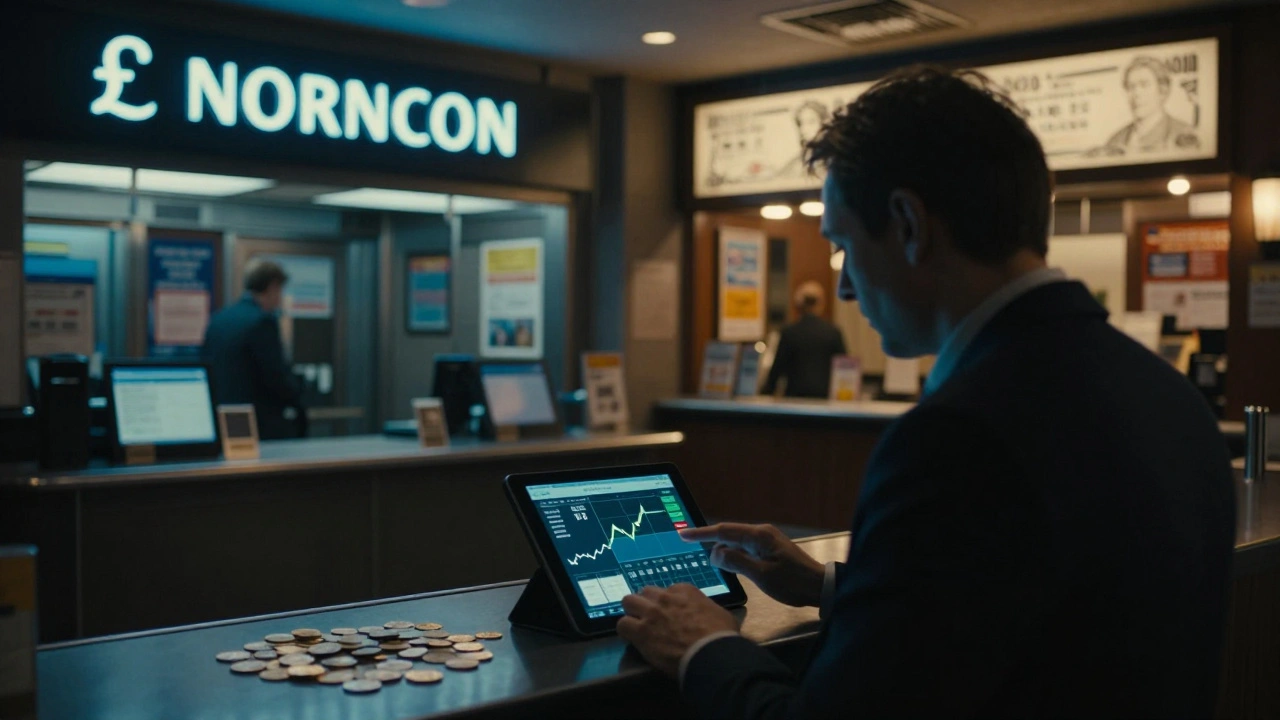
Imagine your blockbuster just smashed records in London, Paris, and Tokyo. The headlines scream 'Global Hit!' But when the money actually hits your studio’s bank account, the numbers look... different. Maybe significantly lower than expected. This isn't a glitch in the matrix; it's the invisible hand of currency fluctuations, which shifts in the value of one currency against another that can drastically alter the final profit margin of international entertainment projects. For decades, Hollywood treated the global box office as a simple sum: add up the dollars from New York, the pounds from London, and the yen from Tokyo, convert them at a steady rate, and celebrate. That era is over. In today’s volatile financial landscape, exchange rates are no longer background noise. They are active players that can turn a modest hit into a massive win-or shrink a guaranteed winner into a disappointment. Understanding this dynamic is crucial for anyone tracking the real health of the film industry.
The Mechanics of Global Box Office Revenue
To understand why exchange rates matter, we first need to look at how money moves in the film business. When you buy a ticket to see a movie in Berlin, you pay in Euros, the official currency of the Eurozone, used by 20 of the 27 European Union member states.. In Seoul, you pay in South Korean Won, the national currency of South Korea, often abbreviated as KRW.. In Mexico City, you pay in Mexican Pesos, the official currency of Mexico, subject to significant volatility based on oil prices and US economic policy.. However, most major film studios-Disney, Warner Bros., Universal-are headquartered in the United States. Their balance sheets are denominated in US Dollars, the primary reserve currency of the world and the standard unit for reporting global box office performance.. This creates a fundamental mismatch. The revenue comes in local currencies, but the profits must be reported in dollars. This process involves two key steps:
- Collection: Local distributors collect ticket sales in their native currency.
- Conversion: At the end of the reporting period (usually weekly or monthly), these funds are converted to USD using the prevailing exchange rate.
Historical Shifts: From Stable to Volatile
Twenty years ago, exchange rate movements were relatively predictable. The Bretton Woods system had long since collapsed, but major currencies like the Euro, Pound, and Yen moved within manageable bands. Studios could forecast international revenue with reasonable accuracy. Then came the financial crises. The 2008 global recession triggered massive swings in currency values. More recently, geopolitical tensions, pandemic-related economic shocks, and divergent monetary policies between the Federal Reserve and other central banks have increased volatility. Consider the Euro. In 2015, one Euro bought about $1.13. By early 2024, that number hovered around $1.08, before swinging back up. For a film earning €100 million across Europe, that difference represents a swing of millions of dollars in reported revenue. While individual films may absorb small variances, blockbusters operating on thin margins after huge marketing spends feel every cent. Another critical factor is the rise of emerging markets. Countries like China, India, and Brazil now represent a huge chunk of global box office. Their currencies-the Chinese Yuan, the the official currency of the People's Republic of China, managed by the government within a floating band., Indian Rupee, the the national currency of India, known for gradual depreciation against the dollar over the past decade., and Real-are inherently more volatile than traditional Western currencies. A sudden devaluation in any of these markets can instantly erase weeks of box office gains.
Real-World Examples: Winners and Losers
Let’s look at concrete examples where exchange rates played a decisive role in a film’s financial narrative. The Strong Dollar Era (2022-2023) During this period, the US Federal Reserve raised interest rates aggressively to combat inflation. This made the dollar incredibly strong compared to other currencies. Many films released globally during this time saw their international earnings shrink when converted to dollars. Take a hypothetical action thriller that earns £50 million in the UK. If the exchange rate is £1 = $1.30, that’s $65 million. But if the dollar strengthens so that £1 = $1.20, that same £50 million becomes only $60 million. That’s a $5 million loss purely due to currency, not because fewer people bought tickets. The Weak Dollar Advantage (2024-2025) Conversely, when the dollar weakens, international revenues get a boost. Films released in 2024 benefited from a softer dollar, making their overseas earnings appear larger in USD terms. This created a temporary illusion of growth for some studios, even if actual ticket sales remained flat. The Japanese Yen Crisis Japan has historically been a top-three box office market. However, the Japanese Yen, the the national currency of Japan, which experienced historic lows against the dollar in recent years due to interest rate differentials. plummeted in 2023 and 2024. For every ¥1 billion earned in Japan, studios received significantly fewer dollars than they would have five years prior. This forced many Hollywood studios to reconsider their release strategies in Japan, sometimes delaying releases or reducing marketing spend to mitigate losses.
| Market | Local Currency Earned | Exchange Rate (Strong USD) | USD Value (Strong USD) | Exchange Rate (Weak USD) | USD Value (Weak USD) | Difference |
|---|---|---|---|---|---|---|
| United Kingdom | £50,000,000 | 1 GBP = 1.20 USD | $60,000,000 | 1 GBP = 1.30 USD | $65,000,000 | +$5,000,000 |
| Europe (Eurozone) | €80,000,000 | 1 EUR = 1.05 USD | $84,000,000 | 1 EUR = 1.15 USD | $92,000,000 | +$8,000,000 |
| Japan | ¥10,000,000,000 | 1 USD = 150 JPY | $66,666,666 | 1 USD = 130 JPY | $76,923,076 | +$10,256,410 |

Risk Management Strategies for Studios
Studios don’t just accept these fluctuations passively. They employ sophisticated financial instruments to hedge against currency risk. Here’s how they manage it:
- Forward Contracts: A studio might lock in an exchange rate today for a future date. If they expect €100 million from a summer release, they can agree to sell those euros at a fixed rate three months later. This guarantees a minimum return but caps potential upside if the euro strengthens further.
- Options Trading: Similar to forwards, but with flexibility. The studio pays a premium for the right, but not the obligation, to exchange currency at a set rate. This protects against downside while allowing participation in favorable moves.
- Netting: Large studios with multiple films releasing globally can offset receivables and payables. If they owe money to a vendor in London and are owed money from box office receipts in London, they settle the net difference, reducing the amount exposed to exchange rate swings.
- Local Financing: Some productions raise part of their budget in local currencies. If a film is partially funded in Euros, and it earns revenue in Euros, the currency risk cancels out for that portion of the budget.
Impact on Production Decisions
Currency fluctuations don’t just affect post-release accounting; they influence pre-production decisions too. Location Shooting When the dollar is strong, filming abroad becomes cheaper. A production budget of $10 million goes much further in Canada, Ireland, or Hungary when the local currency is weak. Studios actively seek out countries with favorable exchange rates to maximize production value. This is why so many American films shoot in Vancouver or Budapest-it’s not just about scenery; it’s about economics. Talent Compensation International stars often negotiate contracts in dollars. If their home currency weakens, their purchasing power drops. Agents may demand higher fees to compensate for anticipated currency depreciation. Conversely, when the dollar is weak, Hollywood studios may struggle to attract top international talent unless they offer bonuses or adjust payment structures. Release Timing Studios monitor currency trends closely. If the dollar is weakening against the Euro, they might accelerate a release in Europe to capture stronger conversion rates. If the Yen is crashing, they might delay a Japan release until the currency stabilizes. These timing adjustments can mean the difference between breaking even and turning a healthy profit.

The Future of Box Office Economics
As globalization deepens, the link between cinema and finance will only tighten. We’re seeing new trends emerge: Digital Distribution and Streaming Streaming platforms operate similarly to theatrical releases regarding currency exposure. Netflix, Amazon Prime, and Disney+ generate vast amounts of international revenue. They face the same exchange rate risks. However, digital payments allow for faster settlement, potentially reducing the window of exposure. Cryptocurrency Experiments Some smaller indie festivals and distributors have experimented with accepting Bitcoin or stablecoins to bypass traditional banking fees and currency volatility. While still niche, this could become more relevant if fiat currencies continue to fluctuate wildly. Regional Blockbusters Non-Hollywood industries like Bollywood, Nollywood, and Chinese cinema are growing. These films earn primarily in local currencies, insulating them from dollar-centric volatility. As these markets expand, the global center of gravity for film revenue may shift, changing how we measure success.
What This Means for Audiences
You might wonder: "Why should I care about exchange rates?" The answer lies in what gets made and what gets released. When currency headwinds reduce profitability, studios become more conservative. They greenlight safer sequels and franchises rather than risky original scripts. International markets that become too expensive to distribute in might see fewer premieres or shorter runs. Ticket prices in certain countries might rise to offset currency losses. Understanding currency fluctuations helps explain why some films vanish from certain markets, why others get delayed, and why the global box office numbers don’t always reflect the cultural impact of a movie. It’s the hidden layer beneath the red carpets and opening weekend hype.
How do exchange rates affect my favorite movies?
While you don't pay in dollars for a ticket, exchange rates influence whether a studio decides to release a film in your country, how much marketing they invest, and potentially the price of your ticket. If the local currency is weak against the dollar, studios might limit distribution or raise prices to maintain profitability.
Do all films suffer equally from currency fluctuations?
No. Big-budget blockbusters with massive international appeal are more exposed because a larger percentage of their revenue comes from overseas. Smaller domestic films with limited international release face less currency risk. Additionally, films produced locally in non-US countries are less affected by dollar strength.
Can studios predict currency movements accurately?
Not reliably. Financial markets are influenced by countless unpredictable factors including political events, economic data, and central bank decisions. Studios use hedging strategies to protect against worst-case scenarios rather than trying to guess exact future rates.
Why does the US dollar dominate box office reporting?
The US dollar is the world's primary reserve currency and the largest single market for films. Most major studios are US-based, so their financial statements are in dollars. Standardizing reporting in USD allows for easier comparison across global markets, despite the distortion caused by exchange rates.
How does currency fluctuation impact independent films?
Independent films often lack the resources for complex hedging strategies. They may rely on sales agents who take on currency risk or accept lower upfront payments. This can make international distribution more challenging for indies, forcing them to focus on domestic markets or secure co-financing in local currencies.






Comments(7)