
Imagine watching a scene where a character makes a razor-sharp pun about British royalty. It’s clever, it’s witty, and the audience erupts in laughter. Now, imagine that same scene being watched by someone who doesn’t speak English. If you simply translate the words literally, the joke dies instantly. The pun relies on specific cultural knowledge and linguistic structure that just doesn’t exist in Spanish, Japanese, or Arabic. This is the core challenge of cross-cultural humor, which is the complex process of adapting comedic content so it resonates with audiences from different linguistic and cultural backgrounds.
For film critics and translators, this isn't just a technical hurdle; it's an artistic crisis. Comedy is arguably the most fragile genre in cinema. While action scenes can be understood visually, and drama often relies on universal emotions like grief or love, humor requires a shared context. When we talk about comedy localization, we are discussing the strategic adaptation of jokes, timing, and cultural references to ensure they land effectively in a target market. In this article, we’ll break down why translating comedy is so difficult, the methods professionals use to save a joke, and how these choices impact your experience as a viewer.
The Anatomy of a Lost Joke
To understand how to fix a broken joke, you first have to understand why it broke in the first place. Most people think translation is just swapping Word A for Word B. But humor rarely works that way. Humor usually relies on three things: surprise, ambiguity, and cultural reference. When you move across borders, all three are under threat.
Take wordplay, for example. In English, "I’m reading a book on anti-gravity. It’s impossible to put down." works because "put down" has two meanings: physically placing a book on a surface, and stopping the act of reading. If you translate this into German, the idioms don't align. You might get a sentence that means "It is impossible to place on the ground," which is a factual statement about heavy books, not a funny observation about good literature. The semantic triple here is simple: English Pun [relies on] Double Meaning [which lacks] Equivalent in Target Language.
Then there are cultural references. A joke about the IRS (Internal Revenue Service) might make an American laugh because of their collective trauma with taxes. But to a viewer in France, the IRS is just another bureaucratic acronym without emotional weight. They might need a reference to the French tax authority, but even then, the tone might differ. The humor shifts from "universal dread" to "specific administrative annoyance."
- Linguistic Structure: Puns, rhymes, and rhythm depend on the specific sounds of a language.
- Cultural Context: References to history, politics, or pop culture require shared knowledge.
- Social Norms: What is considered taboo or funny varies wildly between conservative and liberal societies.
When a translator encounters these barriers, they face a choice: stay faithful to the original text and lose the humor, or sacrifice accuracy to keep the audience laughing. This tension defines the entire field of audiovisual translation.
Subtitles vs. Dubbing: Two Different Battles
How you deliver the translated dialogue changes everything. There are two main ways viewers consume foreign films: subtitles and dubbing. Each method imposes different constraints on how comedy can be adapted.
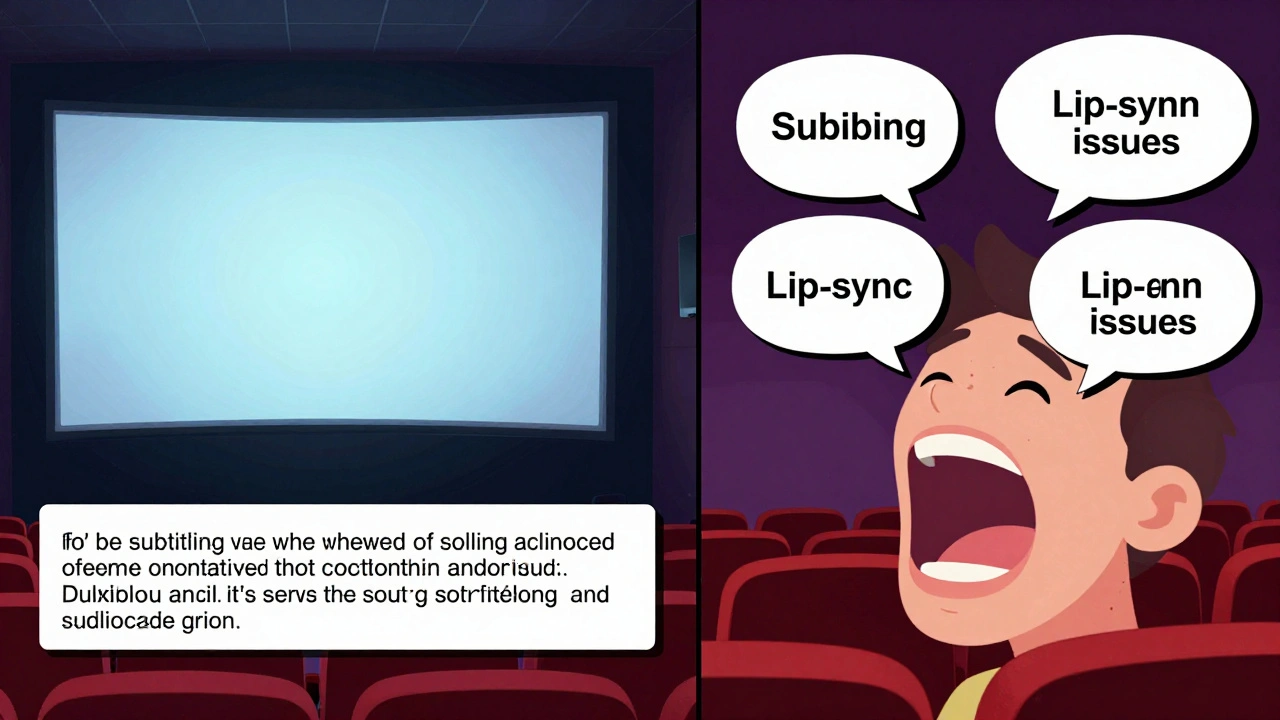
Subtitling is the practice of displaying translated text at the bottom of the screen while the original audio plays. Subtitles have a severe space limit. You generally can only show 15-20 characters per line, and the text must appear long enough to read but short enough not to obscure the action. This forces translators to condense jokes. If a comedian tells a five-minute story leading to a punchline, the subtitle might need to cut the story down to its essence. The translator becomes an editor, deciding which parts of the setup are essential and which can be thrown away to save space for the punchline.
Dubbing is the replacement of the original audio track with a new recording in the target language, synchronized with lip movements. Dubbing faces a different enemy: lip-sync. In languages like German or Spanish, sentences are often longer than in English. To make the actor’s lips match the words, translators must use filler words, adjust pacing, or completely rewrite sentences to fit the mouth movements. For comedy, this is a nightmare. Timing is everything. If the punchline arrives half a second late because the translator had to add extra syllables to match the lip flap, the joke falls flat. Conversely, if the lip movement suggests a short word but the translation requires a long phrase, the viewer feels dissonance.
| Feature | Subtitling | Dubbing |
|---|---|---|
| Primary Constraint | Space and Reading Speed | Lip-Sync and Audio Length |
| Humor Strategy | Condensation and Simplification | Adaptation and Equivalence |
| Actor Performance | Original Voice Preserved | New Voice Actor Required |
| Best For | Nuanced, Verbal Wit | Physical Slapstick and Broad Comedy |
Generally, slapstick comedy translates better through dubbing because the visual gags carry the weight. Verbal wit, sarcasm, and irony often survive better in subtitles, provided the translator is skilled enough to compress the meaning without losing the sting.
Strategies for Saving the Laugh
So, what do professional translators actually do when they hit a wall? They don't just give up. They employ several established strategies to bridge the cultural gap. These aren't random guesses; they are calculated decisions based on years of industry experience.
The first strategy is Equivalence. This involves replacing a culturally specific reference with one that serves the same function in the target culture. For example, if an American character complains about the high price of avocados, a translator might change this to a locally expensive food item in the target country, such as certain cheeses in Europe or specific fruits in Asia. The specific object changes, but the emotion-frustration over cost-remains the same. The semantic relationship here is: Source Culture Item [is replaced by] Target Culture Item [to preserve] Emotional Impact.
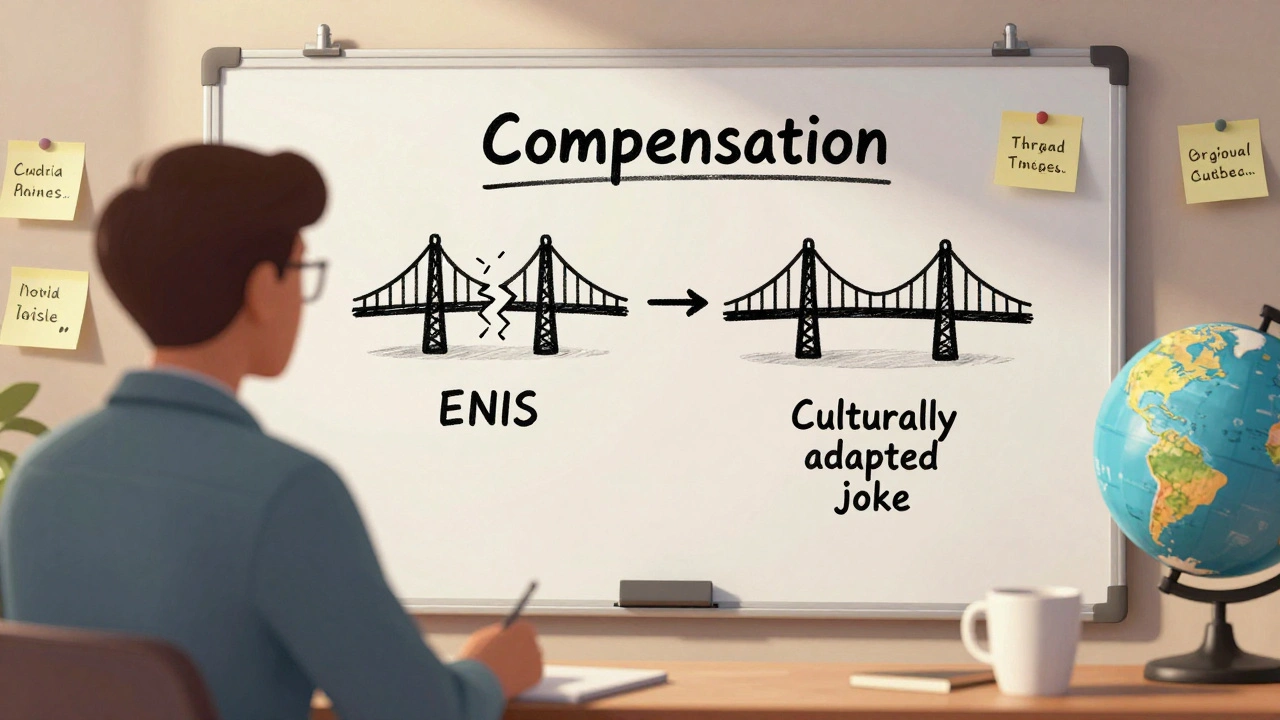
The second strategy is Compensation. If a joke is impossible to translate, the translator might drop it entirely but insert a new joke later in the scene that captures the same tone or character trait. This ensures the audience still perceives the character as funny, even if the specific mechanism of the humor changed. It’s a balancing act. You lose one point of humor to gain another elsewhere, maintaining the overall comedic rhythm of the film.
The third strategy is Explicitation. Sometimes, a joke relies on subtle innuendo that won't travel well. The translator might make the hidden meaning explicit. Instead of a vague double entendre, they might choose a clearer, slightly cruder phrase that guarantees the audience understands the sexual or political undertone. This risks making the character seem less sophisticated, but it saves the laugh.
- Identify the Core Function: Is the joke meant to show intelligence, cruelty, or absurdity?
- Assess Translatability: Can the literal translation work? If not, why?
- Select a Strategy: Choose equivalence, compensation, or explicitation.
- Test for Timing: Ensure the new joke fits the visual or audio constraints.
These strategies require deep cultural literacy. A translator isn't just bilingual; they are bicultural. They need to know what makes people laugh in both worlds.
The Role of the Film Critic
As a film critic, how should you evaluate a translated comedy? It’s easy to say, "This movie was funnier in the original." But that’s not always fair. A bad translation can ruin a great script, and a brilliant translation can elevate a mediocre one. Your job is to look beyond the surface.
Ask yourself: Does the translated version maintain the character’s voice? If the original character was sarcastic and dry, does the translation sound sarcastic and dry, or did it become loud and boisterous because the translator couldn't find equivalent slang? Consistency in tone is more important than literal accuracy. A consistent, adapted joke is better than an accurate, boring sentence.
Also, consider the medium. If you’re reviewing a dubbed version, critique the performance of the voice actors. Are they matching the energy of the original? Do they seem like they’re having fun? Dubbing is a performance art. A flat delivery will kill any joke, no matter how clever the writing. Conversely, a charismatic voice actor can salvage a weak translation through sheer charm and timing.
Finally, recognize the limitations. Some jokes are untranslatable. Acknowledge this in your review. Saying "The pun regarding Shakespeare didn't work in Spanish, but the physical comedy remained strong" provides valuable context for your readers. It helps them understand what to expect and sets realistic expectations.
Case Study: Why 'The Big Lebowski' is Hard to Translate
Let’s look at a concrete example. *The Big Lebowski* is filled with idiosyncratic slang, nihilist philosophy, and bowling metaphors. The Dude says things like "That rubs me the wrong way." This is an idiom. Literally translating "rub" might confuse viewers who don't use that phrase for irritation. A good translator might use a local idiom for annoyance, like "That gets under my skin" in English-speaking variants, or a completely different phrase in other languages that conveys mild disgust.
Furthermore, the film’s humor is slow-burn. It relies on the contrast between the chaotic world around the Dude and his zen-like indifference. If the translation rushes the dialogue to fit subtitle limits, it destroys the pacing. The silence and the pauses are part of the joke. A translator who cuts too much text kills the rhythm. This highlights a key attribute of comedic timing, which is the precise scheduling of dialogue and action to maximize humorous effect. Timing is not just visual; it’s textual.
Future Trends in AI Translation
We are entering an era where Artificial Intelligence is attempting to solve these problems. Machine translation has improved dramatically, but it still struggles with nuance. AI can translate words accurately, but it often misses the intent behind the joke. An AI might translate a sarcastic remark literally, resulting in a sincere statement that confuses the audience.
However, AI is becoming a useful tool for human translators. It can handle the bulk of non-dialogue text, allowing humans to focus on the tricky comedic lines. We are seeing hybrid models where AI suggests equivalents, and human experts refine them for cultural resonance. This collaboration could lead to faster turnaround times without sacrificing quality, provided the human element remains central to the creative decision-making.
In summary, translating comedy is an act of creative betrayal. You must betray the literal words to remain faithful to the spirit of the humor. For film critics, understanding this process enriches your analysis. It allows you to appreciate the skill involved in bringing a joke across borders, rather than dismissing it as inferior to the original. Next time you watch a foreign comedy, pay attention to the laughs. Are they genuine? If so, thank the invisible team of translators who worked hard to make them happen.
Why is it harder to translate comedy than drama?
Comedy relies heavily on cultural context, wordplay, and timing, which are deeply tied to specific languages and societies. Drama often deals with universal emotions like love, loss, and anger, which are easier to convey through facial expressions and basic dialogue without needing complex linguistic nuances.
What is the difference between localization and translation in film?
Translation is the direct conversion of words from one language to another. Localization goes further by adapting cultural references, idioms, and humor to resonate with the target audience. For example, changing a reference to Thanksgiving to Christmas if the film is being released in a region that doesn't celebrate Thanksgiving.
Can AI fully replace human translators for comedy?
Currently, no. AI struggles with sarcasm, irony, and cultural subtleties. While AI can handle literal translations efficiently, it lacks the cultural intuition required to adapt jokes effectively. Human oversight is essential to ensure the humor lands correctly and maintains the intended tone.
Which is better for comedy: subtitles or dubbing?
It depends on the type of comedy. Subtitles are often better for verbal wit and nuanced dialogue because they preserve the original actor's performance and timing. Dubbing can be effective for slapstick or broad physical comedy, but it risks altering the timing and lip-sync, which can detract from the humor if not done expertly.
How do translators handle untranslatable puns?
Translators often use compensation or equivalence strategies. They might replace the pun with a different pun that works in the target language, even if it changes the subject slightly. Alternatively, they might explain the joke briefly if the context allows, though this is rare in fast-paced comedies.




Comments(6)