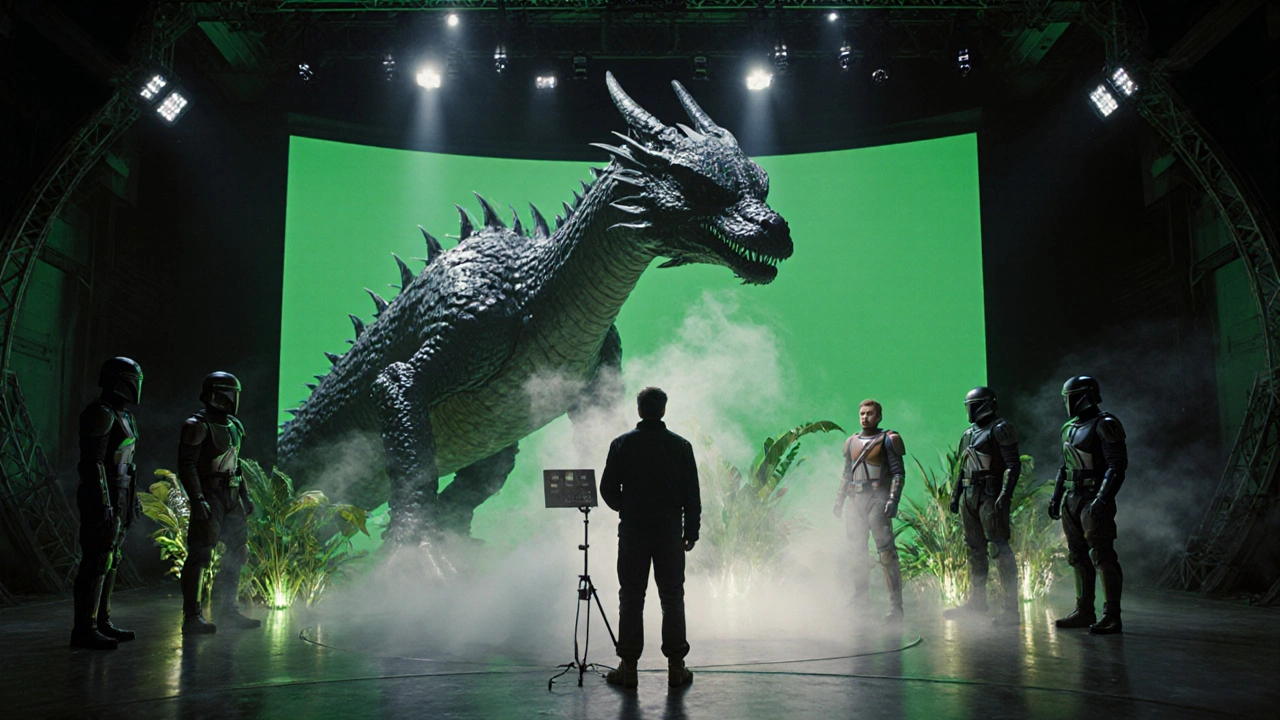
Twenty years ago, a dragon breathing fire in a movie meant a puppet on a stick or a hand-drawn animation. Today, that same dragon can blink, breathe smoke that reacts to wind, and cast realistic shadows on a castle wall-all made by a team of artists typing code. CGI isn’t just a tool in modern cinema anymore. It’s the invisible hand that reshapes how stories are told, how emotions are conveyed, and how audiences experience the impossible.
What CGI Actually Does in Today’s Movies
CGI stands for Computer-Generated Imagery. It’s not just about making monsters or spaceships. It’s about replacing reality with something more controlled, more precise, and sometimes, more emotionally powerful. In Avatar: The Way of Water, every drop of water, every ripple on a character’s skin, every glint of light on a bioluminescent plant was digitally crafted. The actors weren’t swimming in a tank-they were performing on a stage with motion capture suits, and the entire ocean world was built frame by frame in a computer.
CGI doesn’t just add things. It fixes things. In The Irishman, de-aging technology didn’t just make Robert De Niro look younger-it made him look like he did in the 1970s, with the same facial muscle movements, the same wrinkles, the same way he squinted in low light. That’s not magic. That’s thousands of hours of scanning, modeling, and animating real human expressions.
Even when you think you’re watching real footage, you’re often watching CGI. The crowd in a stadium? Mostly digital. The explosion behind the hero? Almost always computer-generated. The sky? Often replaced to match the tone of the scene. What’s real and what’s fake? That line has blurred so much that filmmakers now use CGI not to trick you, but to serve the story better.
How CGI Changed the Role of the Director and Cinematographer
Before CGI, a director had to work with what the physical world offered. If they wanted a city skyline at sunset, they had to shoot it at sunset. If they needed a storm, they waited for rain. Now, they can design the entire environment before the first actor steps on set.
Modern cinematographers don’t just set lights and lenses-they set virtual cameras. In Avengers: Endgame, the battle in New York wasn’t filmed on location. It was shot in a warehouse with green screens and motion capture. The camera movements, the lighting, the perspective-all were planned in a 3D virtual space first. The director could walk through the scene like it was real, adjusting angles and distances before a single frame was rendered.
This shift means filmmakers now think in layers. They build scenes like architects: environment, lighting, characters, physics, and sound-all separate, but interconnected. A shot that took weeks to set up in the 1990s can now be tweaked in minutes. That freedom changes how stories are written. Writers can include a thousand-year-old dragon flying over a collapsing cathedral because they know it’s possible now, not because they’re hoping for a miracle.
The Hidden Costs of CGI: Time, Money, and Talent
CGI sounds like magic, but it’s expensive labor. A single shot in Avengers: Age of Ultron cost over $1 million to render. Why? Because every pixel has to be perfect. A character’s eyelash needs to reflect the right light. Their skin needs to sweat under heat. Their coat needs to flap in the wind without looking like a plastic bag.
It takes teams of 50 to 200 artists to make one movie’s visual effects. These aren’t just coders. They’re sculptors, painters, physicists, and animators. A single character like Gollum from The Lord of the Rings required 12 animators working for two years just to get his movements right. His facial expressions were based on Andy Serkis’s real performance, mapped frame by frame.
And time? A studio might spend 18 months on VFX alone. That’s longer than the entire production of many indie films. The pressure is intense. Studios often cut corners, and when they do, audiences notice. A poorly rendered hand, a floating object, a face that doesn’t match the actor’s real expression-these are the things that break immersion.

When CGI Works Best: The Art of Invisible Effects
The best CGI is the kind you don’t notice. Think of the dinosaurs in Jurassic Park. They weren’t perfect, but they felt real because they moved like living animals. They had weight. They reacted to their environment. The rain soaked their skin. The mud stuck to their feet.
That’s the secret: CGI works best when it enhances reality, not replaces it. In 1917, the entire film looks like one continuous shot. But it’s not. There are dozens of hidden cuts, and many of the backgrounds are digital extensions. The explosions, the burning buildings, the soldiers in the distance-all CGI. Yet you never question it. Why? Because the lighting matches. The smoke behaves naturally. The shadows fall where they should.
Some directors, like Christopher Nolan, still prefer practical effects. But even he uses CGI to enhance what’s real. In Dunkirk, the Spitfires weren’t real planes-they were models, and CGI was used to add motion blur, engine smoke, and sky reflections. The goal wasn’t to fake the plane. It was to make the audience feel like they were flying with it.
The Rise of Real-Time CGI and the Future of Filmmaking
Today, some studios are using game engine technology-like Unreal Engine-to create movie sets in real time. Directors can walk onto a soundstage and see a virtual forest behind the actors, lit exactly how they want it, with clouds moving in the sky, all rendered live on monitors. This is called virtual production.
In The Mandalorian, the entire planet of Nevarro was built inside a 360-degree LED wall. The actors saw the environment as they performed. The light from the virtual sun hit their faces correctly. No green screen. No post-production color correction. Just real-time interaction between actor and world.
This isn’t the future. It’s happening now. In 2025, studios are using AI to auto-generate textures, simulate physics, and even animate secondary motion like hair and cloth. A single artist can now simulate the movement of 10,000 leaves in a breeze with one click. That’s a revolution.
What does this mean for filmmakers? More control. Faster iterations. Lower costs over time. But it also means the line between director, artist, and programmer is disappearing. The next great filmmaker might not just know how to direct actors-they’ll know how to code a lighting simulation.

Why Audiences Still Care About Emotion, Not Just Effects
CGI can make a dragon fly. But it can’t make you cry. That’s still up to the story, the acting, the music, the silence between lines.
Look at Oppenheimer. Almost no CGI. Just faces, shadows, and tension. It won Oscars. Not because it had the best effects-but because it made you feel the weight of history.
CGI is a tool. A powerful one. But it’s not the story. A movie with perfect explosions and flawless digital faces can still feel empty if the characters don’t matter. The best films use CGI to serve emotion, not distract from it.
When you watch a superhero leap across a city, what stays with you isn’t the CGI. It’s the moment they hesitate before saving someone. The fear in their eyes. The silence after the crash. Those are human. And no algorithm can fake that.
Final Thoughts: CGI Isn’t Replacing Filmmaking-It’s Expanding It
CGI didn’t kill practical effects. It gave filmmakers more options. Some still build real sets. Some still use miniatures. Some still risk their lives to film stunts. But now, they can also create worlds that never existed-and make them feel real.
The magic of cinema has always been about illusion. CGI is just the newest brush in the artist’s toolkit. The best filmmakers don’t ask, "Can we do this with CGI?" They ask, "Does this serve the story?"
And that’s the real change.
Is CGI cheaper than practical effects?
Not always. While CGI can save money on building sets or hiring stunt teams, high-quality visual effects require expensive software, powerful computers, and skilled artists who work for months. A simple practical effect-like a real explosion-can cost less than a single CGI shot that needs to look flawless. The real savings come when you need to create something impossible, like a giant alien creature or a floating city.
Can CGI replace actors?
No. Even the most advanced digital characters rely on real human performances. Motion capture records an actor’s movements, facial expressions, and timing. Without that real performance, CGI characters feel lifeless. Gollum, Thanos, and the Na’vi all work because the actors behind them brought emotion and nuance. CGI can replicate motion, but it can’t invent soul.
Why do some movies look fake even with CGI?
It’s usually because the lighting, physics, or textures don’t match the real elements in the scene. If a digital character is lit with a different color temperature than the live-action background, or if their shadow doesn’t fall correctly, your brain notices something’s off. Poor compositing-how the digital and real elements are blended-also causes this. It’s not about how detailed the model is; it’s about how well it fits into the world.
What’s the difference between CGI and VFX?
CGI is a subset of VFX. CGI refers specifically to images created on computers-like a digital dragon or a glowing sword. VFX (visual effects) is the broader term that includes CGI, but also practical effects like miniatures, pyrotechnics, matte paintings, and in-camera tricks that are enhanced digitally. So all CGI is VFX, but not all VFX is CGI.
Are there movies today made without any CGI?
Yes. Films like Oppenheimer, The Revenant, and 1917 used almost no digital effects. They relied on real locations, practical stunts, natural lighting, and in-camera techniques. Even in these films, minor digital fixes-like removing a modern power line or cleaning up a stray microphone-are often added. But the core visuals are real. These movies prove that storytelling doesn’t need digital magic to be powerful.


Comments(7)