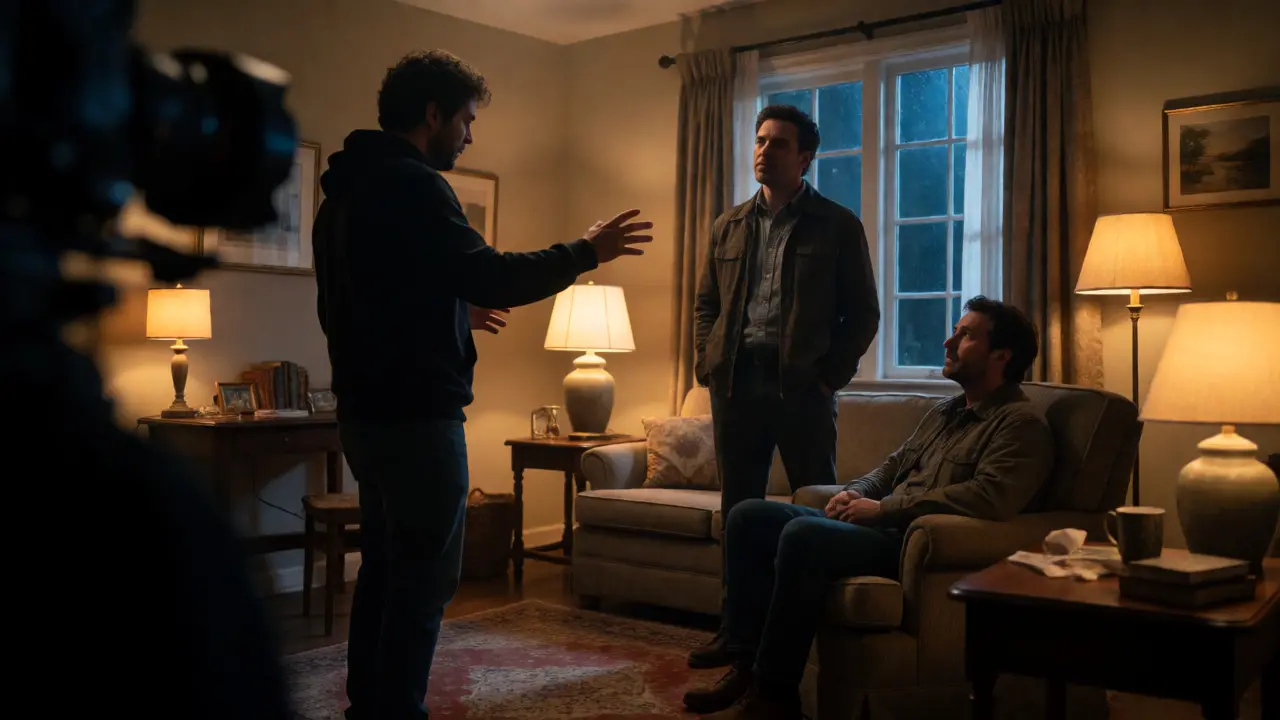
You walk onto a set. The camera is ready. The actors are standing there, waiting for you to tell them what to do. You say, "Stand here," and they stand there. You say, "Walk over there," and they walk. It works, technically. But does it feel alive? Does the movement mean anything, or is it just furniture arrangement?
Here’s the truth most new directors learn the hard way: blocking isn’t about keeping people out of each other’s eyelines. It’s about psychology made physical. When you decide where an actor stands, how they move, and when they stop, you’re telling the audience who has power, who is hiding, and who is lying before a single word is spoken. If your characters move without purpose, your story stalls. If they move with intent, every step adds subtext.
Why Static Shots Kill Tension
Think about the last boring scene you watched. Chances are, two people stood still and talked at each other. Maybe the lighting was pretty. Maybe the dialogue was okay. But visually? Dead. Human beings don’t stand still when we’re emotional. We pace when we’re anxious. We lean in when we’re interested. We turn away when we’re ashamed. If your actors are glued to the floor while discussing their breakup, you’re fighting human nature.
Blocking is the strategic placement and movement of actors within the frame to convey narrative meaning. Unlike theater, where blocking must work from multiple angles, film blocking serves one master: the camera lens. This constraint is actually a gift. It lets you control exactly what the audience sees, hides, and feels.
When you block poorly, you force the editor to cut around mistakes. When you block well, the cuts happen naturally because the movement motivates them. A character turning their back on another creates a natural cut point. A character walking into a room changes the energy, prompting a wider shot. The movement drives the editing rhythm.
The Three Pillars of Effective Staging
To make movement meaningful, you need to think in three layers: Power, Intimacy, and Obstruction. These aren’t just abstract concepts; they are tools you can use on any set, from a low-budget indie to a blockbuster.
Power Dynamics Through Height and Position
Who holds the power in a scene? Often, it’s not who speaks the loudest. It’s who occupies the space. In film language, height equals authority. If Character A is standing and Character B is sitting, A has the upper hand. If both are seated, but A leans forward while B leans back, A is dominating the conversation.
Consider a job interview. If the interviewer sits behind a massive desk and the candidate sits in a small chair opposite, the power imbalance is visualized instantly. Now, imagine the candidate stands up and walks around the desk to sit next to the interviewer. The power shift is palpable. They’ve bridged the gap. They’ve claimed equal status. Did they say "I deserve this job"? No. Their body said it.
Intimacy and Distance
Proximity signals intimacy. Far distance signals isolation or conflict. But it’s not just about inches; it’s about barriers. Are there objects between them? A table, a counter, a window? Objects create psychological walls.
In a romantic drama, if two lovers are arguing across a kitchen island, the island is a shield. Neither wants to be vulnerable enough to close the gap. If one person steps around the island, they are breaking down that defense. They are saying, "I’m willing to risk being hurt to reach you." Use the environment to map the emotional arc of the relationship.
Obstruction and Revelation
Sometimes, what you hide is more important than what you show. Blocking allows you to reveal information gradually. Start a scene with a character partially obscured by a doorframe or a foreground element. As they move into full light, we see their face-and perhaps realize they’ve been crying. This visual reveal hits harder than a line of dialogue explaining their sadness.
| Technique | Description | Emotional Effect |
|---|---|---|
| The Lean In | Actor moves closer to camera or partner during key dialogue. | Increases intensity, signals interest or threat. |
| The Turn Away | Actor turns profile or back to camera/partner. | Signals rejection, secrecy, or internal processing. |
| The Cross | Actor moves across the frame, interrupting eye contact. | Breaks tension, shifts focus, or indicates dismissal. |
| The Anchor | One actor remains static while others move around them. | Highlights stability vs. chaos, or isolation vs. activity. |
Practical Steps for Directors on Set
You don’t have to choreograph every step like a ballet. In fact, over-directing kills spontaneity. Here is a simple workflow to keep your blocking purposeful but flexible.
- Start with the Script: Read the scene and identify the emotional beats. Where does the power shift? Where does the character change their mind? Mark these moments. These are your anchors for movement.
- Dry Run Without Camera: Have the actors play the scene in the actual location, but ignore the camera. Let them move naturally. Do they fidget? Do they look for props to hold? Note these instincts. Real behavior is better than imposed movement.
- Find the Camera Angle: Once you know where the actors want to go, find the angle that captures it best. Sometimes, you’ll need to adjust their path slightly to stay in frame. This is compromise, not correction.
- Test the Eyeline: Ensure the actors can maintain eye contact (or deliberate avoidance) without looking into the lens. If the angle forces them to look too far off-axis, adjust the position. Unnatural eyelines break immersion.
- Refine for Light: Check if the movement takes the actors out of the light source. A great performance is useless if the face goes black as the actor turns. Adjust the blocking or the lights to ensure continuity.

Common Pitfalls to Avoid
Even experienced directors fall into traps. Watch out for these:
- The Ping-Pong Match: Cutting back and forth between two static faces. It’s efficient but boring. Break the pattern by having one character move during their line, forcing the other to react physically.
- Ignoring Props: Actors often freeze because they don’t know what to do with their hands. Give them tasks. Pouring coffee, folding laundry, checking a phone. These actions provide natural pauses and movement cues.
- Over-Choreographing: If an actor looks like they are following a GPS route, you’ve failed. The movement should feel motivated by emotion, not by your instructions. If they stumble, keep it. Imperfection reads as real.
- Forgetting the Background: Blocking isn’t just about the foreground. If a background extra walks directly through the focal plane during a critical moment, it distracts the viewer. Coordinate background action with foreground intent.
Case Study: The Kitchen Argument
Let’s apply this to a common scenario. Two spouses are arguing about money in a kitchen.
Bad Blocking: Both stand side-by-side facing the counter, chopping vegetables, talking to the air. They never look at each other. The audience feels nothing because the visual connection is broken.
Better Blocking: Spouse A starts at the sink, washing dishes aggressively. Spouse B enters, leaning against the doorway, arms crossed. Spouse A ignores B. B moves closer, invading A’s space. A stops washing, turns to face B. The confrontation begins. As the argument escalates, A throws the sponge down and walks toward B, backing B into the fridge. Power shifts from A (active/aggressive) to B (cornered/defensive). Then, B laughs bitterly and walks past A, exiting the frame. A is left alone, holding the sponge. The exit signifies disengagement. The argument is over, not resolved.
Notice how the movement tells the story. The invasion of space, the cornering, the exit. No dialogue needed to explain the power dynamics.
Tools for Planning Your Blocks
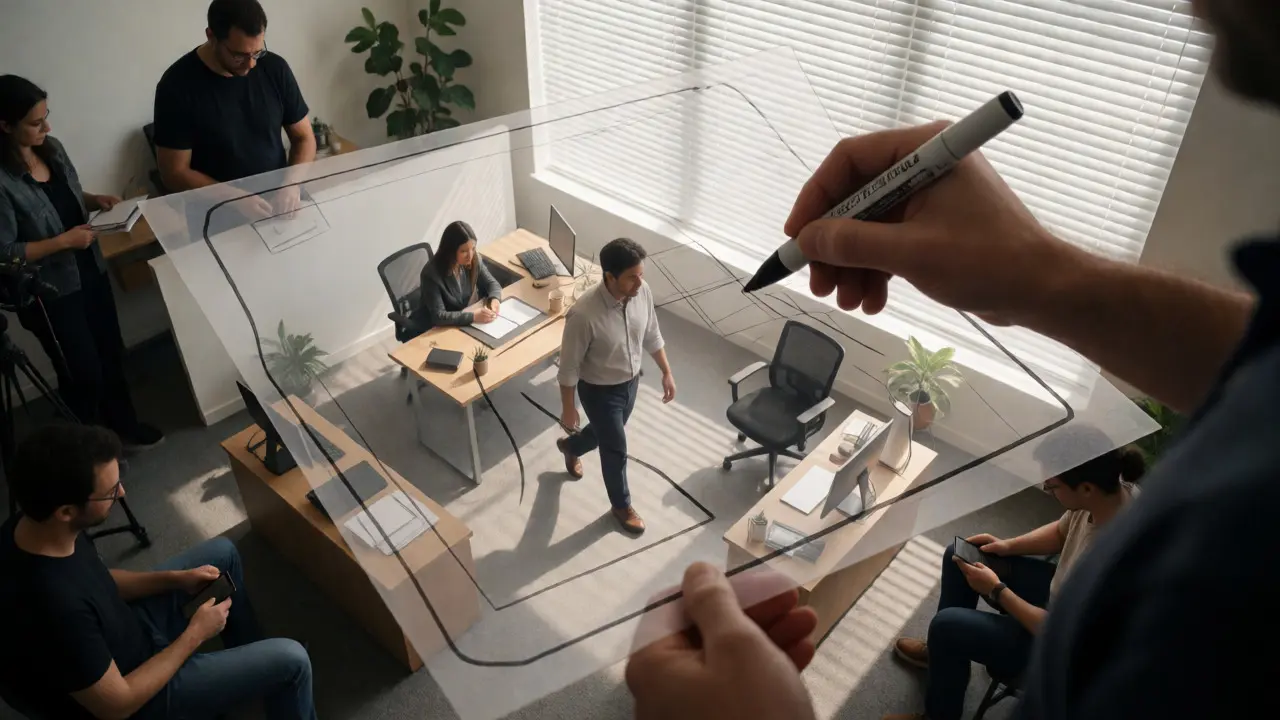
You don’t need fancy software, but having a plan helps. Many directors use simple floor plans. Draw the room. Mark the doors, windows, and major furniture. Use colored dots for actors. Draw arrows for movement paths. This helps you visualize sightlines and potential obstructions before you waste time on set.
Some directors use apps like Shot Designer or even storyboard apps to sketch frames. Others prefer whiteboards. The medium doesn’t matter; the visualization does. Share your plan with your cinematographer early. They might suggest a different angle that requires less complex blocking, saving you setup time.
Frequently Asked Questions
What is the difference between blocking and staging?
While often used interchangeably, blocking specifically refers to the precise movement and positioning of actors within the frame relative to the camera. Staging is broader, encompassing the entire arrangement of the scene, including set design, props, and lighting, to support the narrative. Blocking is the active component of staging.
How much should I direct my actors' movements?
It depends on your style and the actor. Some actors thrive on specific direction (e.g., "Pick up the glass on the count of three"). Others need only the emotional motivation (e.g., "Show me your frustration") and will find their own physical expression. The best approach is to collaborate: propose a block, let them try it, and adjust based on their instinctive choices.
Does blocking affect the pacing of a scene?
Absolutely. Fast movement creates urgency and tension. Slow, deliberate movement builds suspense or emphasizes gravity. If characters move quickly, the scene feels rushed or chaotic. If they move slowly, it feels heavy or contemplative. Use speed as a tool to manipulate the audience's heartbeat.
How do I handle blocking for large groups?
In group scenes, avoid making everyone stand in a semicircle facing the camera. Create clusters. Have some characters engaged in side conversations while the main pair argues. Use depth by placing some characters in the foreground and others in the background. This creates a living, breathing world rather than a staged tableau.
What if the location is too small for good blocking?
Small spaces can enhance claustrophobia or intimacy. Use tight shots and shallow depth of field to isolate characters. Encourage actors to use vertical space (standing, sitting, kneeling) to differentiate power. Sometimes, limiting movement forces stronger performances and creative camera angles, such as handheld shots that follow the actor closely.




Comments(7)