
Imagine your indie drama is ready to shoot in Prague. You’ve locked in a $2 million budget, secured tax incentives, and signed the crew. Then, overnight, the US dollar drops 8% against the Czech koruna. Suddenly, that fixed-rate location fee just became significantly more expensive. Your profit margin? Gone.
This isn’t a hypothetical nightmare; it’s a standard reality for international co-productions and global film releases. In the world of film financing is the process of securing capital from various sources to produce a motion picture, currency fluctuation is often the silent killer of profitability. For producers and studio executives, understanding currency hedging is a financial strategy used to reduce or eliminate the risk of adverse price movements in foreign exchange rates isn't just about accounting-it's about survival.
The Hidden Cost of Exchange Rate Volatility
Film budgets are rarely static. They involve payments across multiple currencies over long timelines. A production might pay actors in USD, rent equipment in Euros, hire local crew in British Pounds, and market the final cut in Japanese Yen. When you have cash flows denominated in different currencies, you are exposed to foreign exchange risk is the potential for loss due to changes in the value of one currency relative to another.
Consider a typical mid-budget thriller shooting in London. If the producer budgets based on today’s exchange rate but pays invoices six months later, a shift in the GBP/USD pair can add hundreds of thousands to the bottom line. This is known as transaction exposure is the risk that exchange rates will change between the time a transaction is initiated and when it is settled. Without protection, your budget becomes a guess rather than a plan.
The impact isn't limited to production costs. Distribution deals often hinge on box office performance in foreign markets. If the Euro weakens against the Dollar during a European release window, the repatriated revenue shrinks. This is economic exposure is the long-term effect of exchange rate changes on a company's competitive position and future cash flows. It affects not just what you spend, but what you earn.
Core Hedging Instruments for Filmmakers
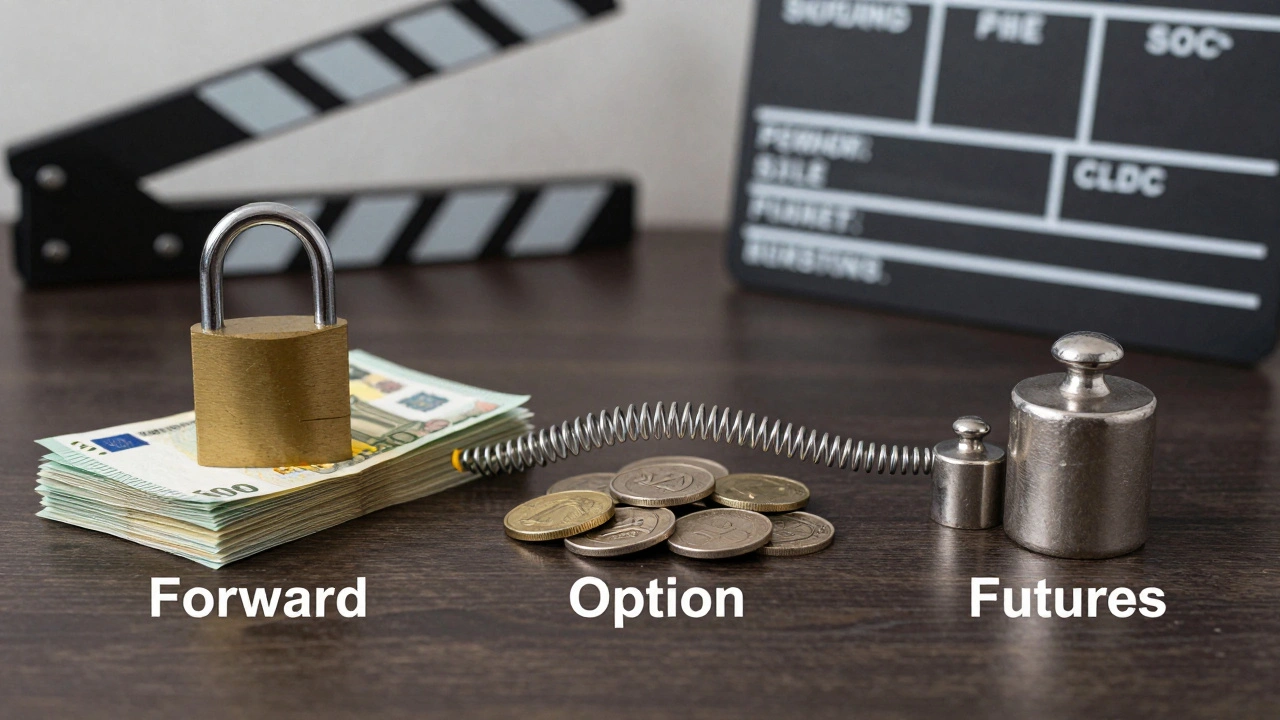
You don’t need to be a Wall Street trader to manage this risk. Several financial instruments exist specifically to lock in exchange rates. The three most common tools in film finance are forwards, futures, and options.
| Instrument | How It Works | Cost Structure | Best Use Case |
|---|---|---|---|
| Forward Contract | A private agreement to exchange currencies at a set rate on a future date. | No upfront premium; cost is embedded in the rate. | Known, fixed expenses like location fees or actor salaries. |
| Options | Gives the right, but not the obligation, to exchange currency at a set rate. | Requires an upfront premium payment. | Uncertain timelines or optional expenses (e.g., marketing bonuses). |
| Futures | Standardized contracts traded on exchanges to buy/sell currency later. | Marginal requirements; daily mark-to-market adjustments. | Large-scale studios with standardized, high-volume needs. |
Forward contracts are customized agreements between two parties to exchange a specified amount of currency at a predetermined rate on a future date are the workhorse of film hedging. They are simple and effective. If you know you need €500,000 in six months for post-production in Berlin, you sign a forward contract today. Regardless of where the Euro goes, you pay the agreed-upon Dollar amount. It eliminates uncertainty completely.
However, forwards have a downside: they remove upside potential. If the Dollar strengthens against the Euro, you still pay the higher, pre-agreed rate. You lose the benefit of favorable market moves. This is why some producers prefer currency options are financial derivatives that give the buyer the right, but not the obligation, to exchange currency at a specific strike price. You pay a premium-usually 1-3% of the notional amount-for the flexibility. If the market moves against you, you exercise the option. If it moves in your favor, you let the option expire and buy currency at the better spot rate. It’s insurance, not a guarantee.
Structuring Hedges Around Production Phases
Effective hedging isn’t a one-time decision. It must align with the production calendar. Different phases carry different types of risk.
- Pre-Production: Costs are mostly speculative. Location scouts, legal fees, and initial casting calls may happen in multiple countries. At this stage, use short-dated forwards or collars (a combination of buying a put and selling a call) to limit downside while allowing some upside participation.
- Principal Photography: This is when the bulk of cash leaves the bank. Daily craft services, hotel accommodations, and equipment rentals are fixed obligations. Lock these in with medium-term forwards (3-6 months). Accuracy here is critical because these costs are non-negotiable.
- Post-Production & Marketing: Timelines can slip. Editing might take longer; marketing campaigns might expand. Here, options make sense. You want protection if the currency spikes, but you also want to benefit if the timeline extends into a period of favorable rates.
A common mistake is over-hedging. If you hedge 100% of your budget but the project gets delayed by three months, you might find yourself holding expired contracts while new costs emerge unhedged. Always build in a buffer or use rolling hedges that mature in stages.
Natural Hedging Through Co-Production Structures
Before turning to financial derivatives, look at your deal structure. Natural hedging is a risk management technique that matches revenues and expenses in the same currency to offset exposure is often cheaper and simpler than buying derivatives.
If you’re filming in Japan, try to source Japanese revenue streams. Partner with a Japanese distributor who guarantees a minimum buyout in Yen. Or, secure a tax rebate from the Japanese government paid in Yen. By matching your Yen expenses with Yen income, you neutralize the risk without paying banks for contracts.
International co-production treaties often facilitate this. Countries like Canada, Australia, and several EU nations offer automatic eligibility for their tax credits if you partner with local entities. These partnerships can naturally balance your currency exposure. For example, a UK-US co-production might split costs 50/50 and share revenues in both currencies, effectively hedging each other.

Pitfalls and Practical Tips
Hedging introduces its own risks. Counterparty risk is real. If you sign a forward contract with a small, unstable bank, and that bank fails before settlement, you’re left exposed. Always use major, reputable financial institutions. Check their credit ratings. In the wake of the 2008 financial crisis, many producers learned this lesson the hard way.
Another pitfall is complexity. Some banks sell exotic products like zero-cost collars or barrier options that sound great on paper but behave unpredictably in volatile markets. Stick to basics unless you have a dedicated treasury department. For most independent producers, a plain vanilla forward or a simple option is sufficient.
Finally, document everything. Lenders and investors want to see how you managed FX risk. Include a section in your budget breakdown detailing hedging strategies. Show them you’ve considered the worst-case scenario. This builds confidence and can sometimes lead to better loan terms.
FAQ
What is currency hedging in film production?
Currency hedging in film production is a financial strategy used to protect against losses caused by fluctuations in exchange rates. Since films often involve spending money in multiple countries, hedging locks in exchange rates for future payments, ensuring that the budget remains stable regardless of market volatility.
How much does it cost to hedge a film budget?
The cost varies depending on the instrument used. Forward contracts typically have no upfront cost, though the exchange rate offered may be slightly less favorable than the current spot rate. Options require an upfront premium, usually ranging from 1% to 3% of the total amount being hedged. This cost should be factored into the overall production budget.
Should independent filmmakers use hedging?
Yes, especially if the production involves significant expenses in foreign currencies. Even for smaller budgets, a sudden swing in exchange rates can wipe out thin profit margins. Simple forward contracts are accessible to independents through most commercial banks and can provide essential peace of mind.
What is the difference between a forward contract and an option?
A forward contract obligates you to exchange currency at a set rate on a specific date, eliminating both downside risk and upside potential. An option gives you the right, but not the obligation, to exchange currency at a set rate. With an option, you pay a premium upfront, but you can choose not to exercise it if the market moves in your favor.
Can natural hedging replace financial derivatives?
In some cases, yes. Natural hedging involves structuring deals so that revenues and expenses are in the same currency. For example, earning tax rebats in the same currency as production costs. While it doesn't eliminate all risk, it reduces exposure without the cost of financial instruments. It is best used in conjunction with traditional hedging for comprehensive protection.







Comments(5)