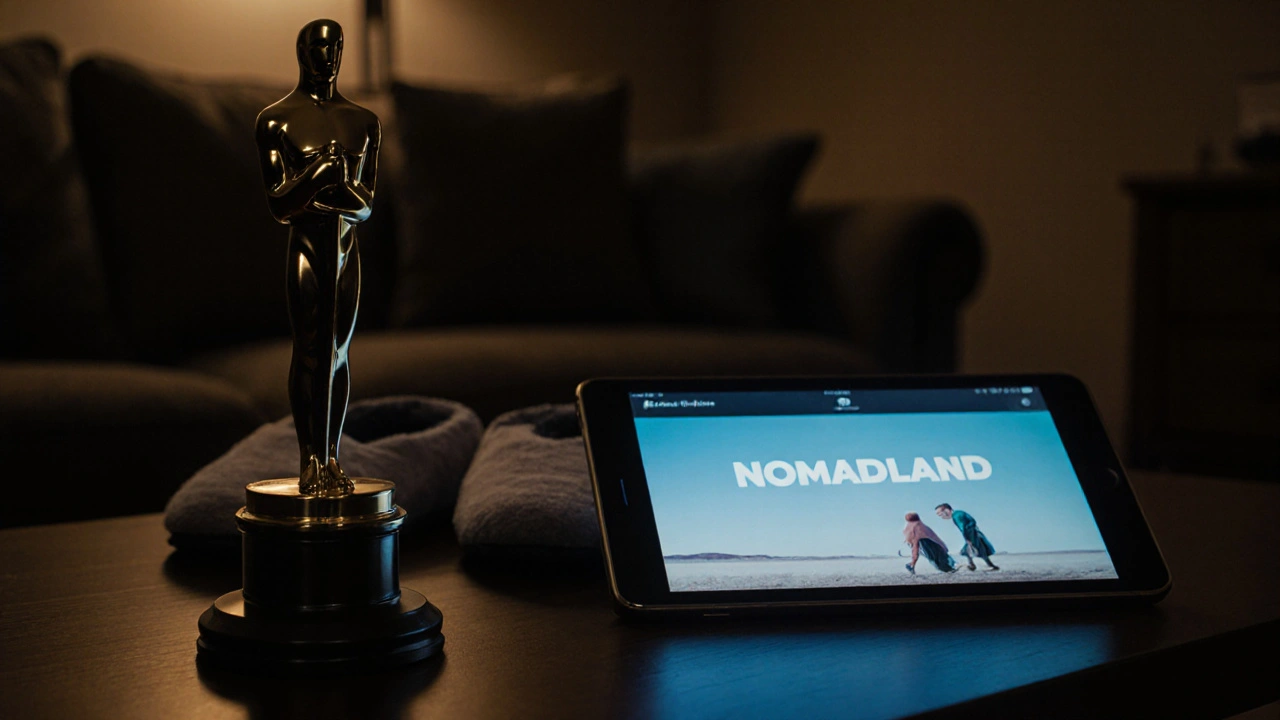
For years, the Oscars were the domain of theaters. Big budgets, red carpets, and limited runs in select cities defined the path to Academy recognition. But now? A film can premiere on your TV screen, phone, or tablet and still walk away with Best Picture. The rules changed in 2020, and since then, streaming films haven’t just entered the race-they’ve started winning it. Streaming films are no longer the underdogs. They’re the favorites.
Why Streaming Films Are Now Oscar Contenders
The Academy lifted its theater requirement in June 2020, right as pandemic lockdowns shuttered cinemas. That decision wasn’t temporary. It was permanent. By 2021, Minari and Nomadland-both released on streaming platforms-won major Oscars. Nomadland took Best Picture, Best Director, and Best Actress. No theater run. No premiere in Los Angeles. Just a digital release on Hulu.
That wasn’t luck. It was strategy. Studios realized: if you make a film with awards potential, you don’t need to rent out 300 theaters. You need to get it in front of Academy voters. And they’re watching at home. According to the Academy’s own 2024 membership survey, 87% of voters now watch eligible films primarily on streaming platforms. That’s up from 42% in 2018. The theater is no longer the gatekeeper. Your algorithm is.
How Streaming Studios Win Awards
It’s not enough to just upload a movie. Winning requires a calculated campaign. Here’s how the top players do it:
- Targeted qualifying runs: Even if a film streams globally, studios often book a one-week run in Los Angeles and New York to meet eligibility rules. These aren’t for audiences-they’re for voters. Think 12 screens, 3 showings a day, free tickets mailed to every Academy member.
- Screenings over screenings: Netflix, Amazon, and Apple don’t just send links. They host private, invite-only virtual screenings with Q&As. Directors and actors appear live. Voters feel connected. They remember the experience.
- Timing matters: A film released in January gets lost. A film released in October? It’s fresh. The sweet spot is mid-October to late November. That’s when voters are actively watching and deciding. The Power of the Dog (Netflix, 2021) dropped in November. It won 12 nominations and Best Director.
- Marketing that feels personal: Instead of billboards, streaming studios use targeted ads. A voter who watched Marriage Story gets an email about The Lost Daughter. They get a postcard with a quote from the lead actor. It’s not mass advertising. It’s one-on-one persuasion.
What the Academy Wants-And What It Doesn’t
The Oscars still favor drama. They still love quiet stories with emotional weight. But they’ve stopped demanding spectacle. You don’t need a 12-minute opening shot or a war sequence. You need authenticity.
Look at Anatomy of a Fall (2023). It was a French courtroom drama. No Hollywood stars. No big VFX. It came from a small French distributor but was picked up by Apple TV+ for international release. It got nominated for Best Picture, Best Director, and Best Actress. Why? Because it felt real. Voters watched it at home, paused it, talked about it with their partners. That’s the kind of film that wins now.
What doesn’t work? Overproduction. Films that feel like they were made for the Oscars-overly sentimental, too long, too obvious-get ignored. Voters are tired of being manipulated. They want substance, not spectacle.

The Role of Film Festivals
Festivals still matter-but not in the way they used to. Venice, Toronto, and Sundance aren’t just launchpads anymore. They’re credibility filters.
A film that premieres at Venice and wins the Golden Lion? That’s a signal to the Academy: this is serious. Marriage Story premiered at Venice. The Power of the Dog at Venice. Emancipation at Toronto. All went on to Oscar nominations. Streaming studios know this. They don’t just buy films-they buy festival slots. A $20 million acquisition deal often includes $5 million for festival promotion, press tours, and qualifying runs.
But here’s the twist: a film can skip festivals entirely and still win. Nomadland didn’t premiere at Sundance until after it was already picked up. It won because voters saw it, not because it was hyped at a festival.
Why Some Streaming Films Still Lose
Not every digital release wins. In fact, most don’t. Here’s why some fail:
- No campaign budget: If you’re a small indie with no marketing team, you’re invisible. The Oscars aren’t decided by popularity-they’re decided by who gets seen by the right people.
- Wrong release window: A film that drops in August? It’s forgotten by December. Voters have hundreds of films to watch. If yours isn’t top of mind, it’s out.
- Too many releases: Netflix dropped 150 films in 2024. That’s too many. Voters can’t keep up. If your film gets lost in the flood, it dies.
- No star power: Even in streaming, names matter. A film with a known actor like Cate Blanchett or Paul Mescal gets more attention. Not because they’re better-but because voters are more likely to watch them.

What’s Changing in 2025
This year, the Academy is testing a new rule: films must have at least one qualifying theatrical screening in a major U.S. city. That sounds like a step backward-but it’s not. It’s a compromise. Streaming studios still control the release. They just can’t skip the minimum.
Also, the voting window has expanded. Voters now have until February 1 to submit ballots. That means campaigns are longer. You can’t just drop a film in November and call it done. You need to sustain buzz for three months.
And now? AI-generated trailers are banned. The Academy wants real human voices, not synthetic ones. That’s a sign they’re still guarding authenticity. The Oscars still care about the soul of the film-not just its distribution model.
Can a Streaming Film Win Best Picture in 2025?
Yes. And it’s more likely than ever.
Look at the 2025 frontrunners: The Brutalist (Apple TV+), Emilia Pérez (Netflix), and A Complete Unknown (Amazon). All were released digitally. All have major Oscar buzz. All have studio campaigns worth over $20 million. None have traditional theatrical releases.
Theaters are no longer the gate. The voters are. And they’re at home. The question isn’t whether a streaming film can win. It’s whether you’ve made one worth watching.
Can a film released only on streaming platforms win an Oscar?
Yes. Since 2020, the Academy removed the requirement for a theatrical release. Films like Nomadland (Hulu) and The Power of the Dog (Netflix) have won Best Picture with digital-only releases. All that’s needed now is a one-week qualifying run in Los Angeles or New York to meet eligibility rules.
Do streaming films have the same chance as theater-released films?
They do-if they’re marketed right. The Academy’s voting body now watches films primarily on streaming platforms. A well-funded campaign with targeted screenings, personalized outreach, and smart timing gives a streaming film an equal-or better-chance than a traditional release. The medium doesn’t matter. The quality and visibility do.
Why do streaming studios spend millions on Oscar campaigns?
Because awards boost subscriptions. A Best Picture win can add millions of new viewers to a streaming service. Apple TV+ gained 12 million subscribers after CODA won in 2022. Netflix’s Parasite win in 2020 helped them secure global licensing deals. The ROI on an Oscar campaign is high, especially when it’s cheaper than a wide theatrical rollout.
Is it harder for indie films to win on streaming?
Yes, if they lack resources. Big streamers like Netflix and Apple have teams of Oscar strategists, PR firms, and screening coordinators. Small indies without budgets get lost in the flood. But if the film is powerful enough-like Minari or Anatomy of a Fall-it can still break through with festival buzz and word-of-mouth.
What’s the best release strategy for a streaming film aiming for Oscars?
Release in mid-October to late November. Secure a one-week qualifying run in LA/NYC. Host private virtual screenings with the cast and director. Send personalized postcards and emails to Academy voters. Avoid dropping the film too early or too late. Sustain the campaign through February. And above all-make sure the film is worth watching.




Comments(5)