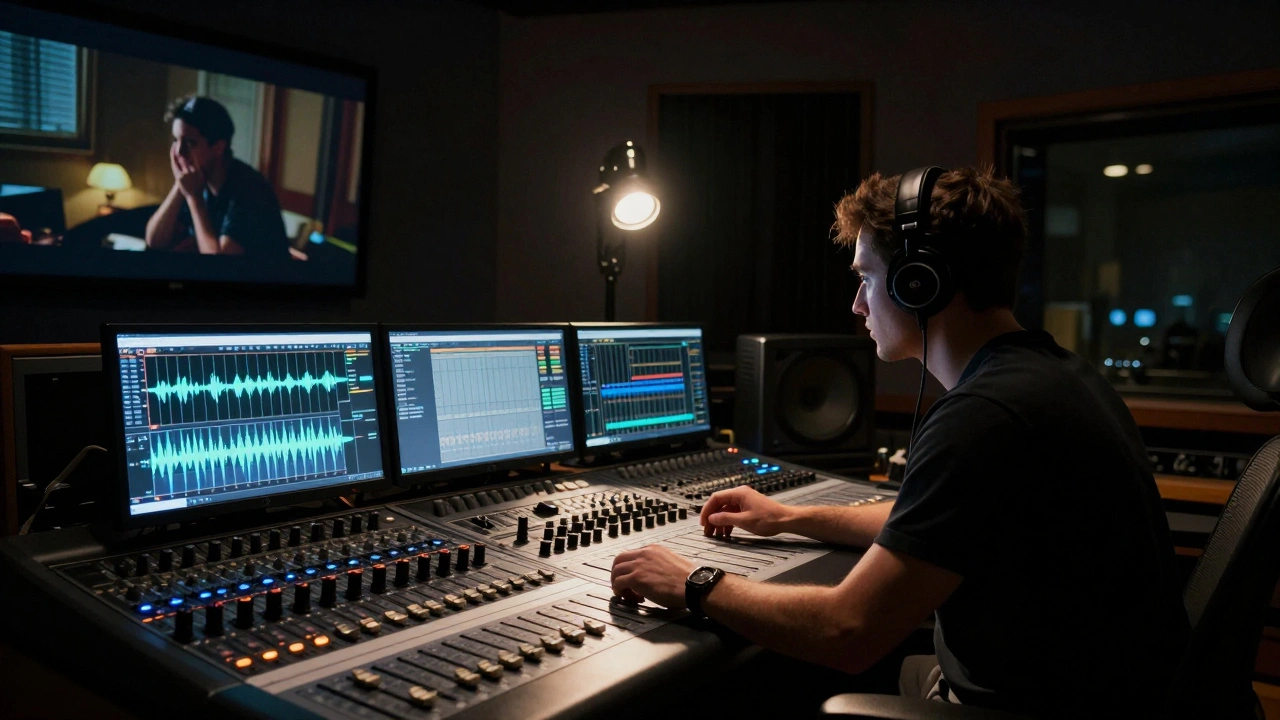
Most people don’t notice good film audio. That’s how you know it’s done right. But when the villain’s whisper gets drowned out by a thunderstorm, or the emotional score clashes with a character’s line, you feel it. That’s where audio mixing fails-and it’s one of the most overlooked parts of filmmaking. Balancing dialogue, music, and sound effects isn’t about turning knobs until it sounds "nice." It’s about serving the story. Every element has a job. Get it wrong, and the audience checks out. Get it right, and they don’t even realize they’re being pulled deeper into the scene.
Dialogue is the anchor
Dialogue carries the plot. If the audience can’t understand what the characters are saying, the movie breaks. That’s why dialogue gets top priority in the mix. In a quiet room, a whisper should be clear. In a crowded street, a shout still needs to cut through. The rule? Dialogue must always be louder than music and most sound effects-unless you’re going for intentional distortion, like a phone call or a memory.
Real films don’t use the same volume for every line. A character leaning in to confess something? Lower the background noise, soften the reverb, and bring the voice forward. A character yelling across a battlefield? Let the wind and explosions breathe around them, but keep the voice intelligible. Tools like noise gates and de-essers help clean up breaths and sibilance, but they’re not magic. The real work happens in manual editing. You listen. You move. You cut. You ride the fader.
Many indie filmmakers make the mistake of recording dialogue in noisy locations and hoping the mix will fix it. It won’t. Clean recordings start on set. But even if you’re stuck with imperfect audio, a skilled mixer can recover 80% of it with multiband compression, spectral repair, and careful EQ. Don’t rely on plugins to fix bad recording. Use them to polish good recordings.
Music sets the mood-but doesn’t steal the show
Music is emotional glue. It tells the audience how to feel when words aren’t enough. But music that’s too loud feels manipulative. Too quiet, and it’s invisible. The sweet spot is where the music supports, not competes.
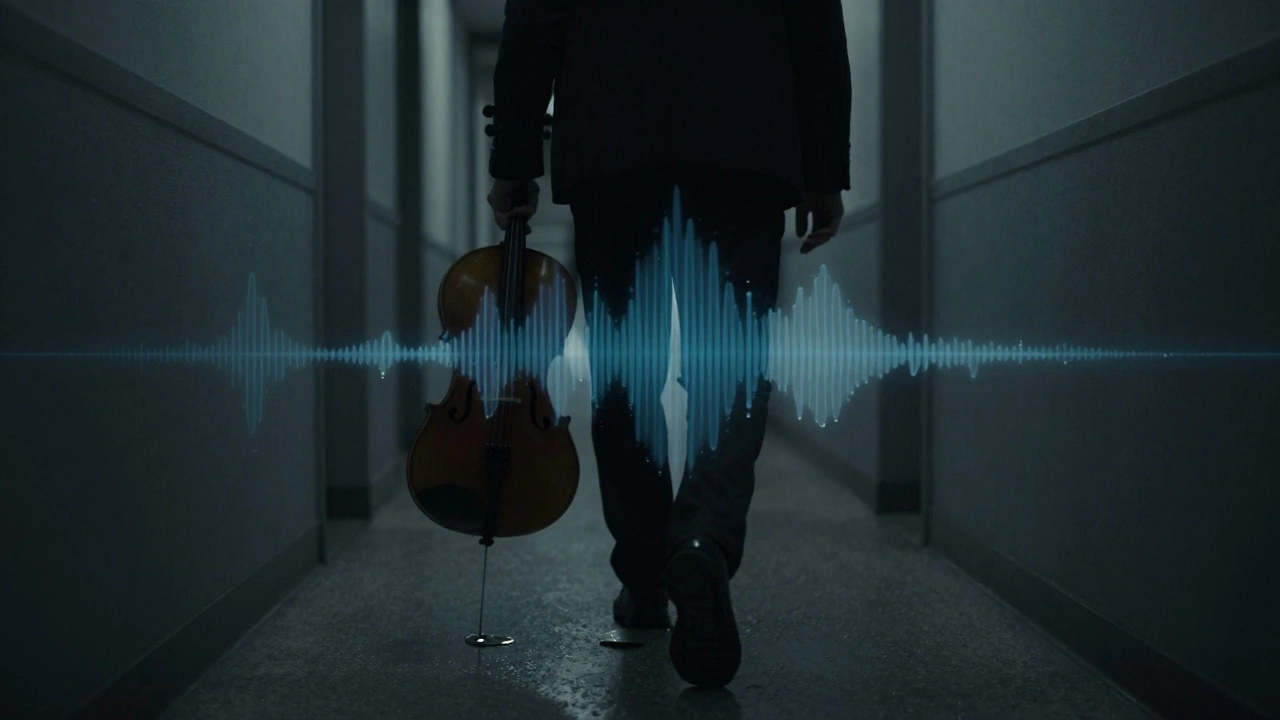
Think about a tense scene in a thriller. The character is walking down a dark hallway. Footsteps echo. A drip falls. Then, a low cello note pulses. It’s not loud. It’s barely there. But it makes your skin crawl. That’s the power of restraint. In contrast, a romantic moment might swell with strings-but only after the dialogue has ended. Never let music overlap with key lines. It’s like trying to read a book while someone sings opera beside you.
Use sidechain compression to duck the music when dialogue enters. It’s a simple trick: when the voice peaks, the music dips slightly-by 2 to 4 dB. It’s automatic, subtle, and keeps the voice clear. Most professional DAWs have this built in. You don’t need fancy plugins. Just set the threshold, attack, and release right. Too fast, and the music pumps unnaturally. Too slow, and the dialogue gets buried.
Also, avoid layering too many instruments. A single cello or piano can be more powerful than a full orchestra if it’s placed well. Less is more. Test your mix on laptop speakers, phone headphones, and car stereos. If the music still feels overwhelming on a $20 pair of earbuds, it’s too loud.
Sound effects ground the world
Sound effects aren’t just background noise. They’re the texture of reality. The rustle of a coat, the clink of a glass, the distant hum of a refrigerator-these details make a scene feel real. But if you overload them, the mix becomes muddy.
Start by separating effects into categories: environmental (wind, traffic), mechanical (doors, engines), and Foley (footsteps, fabric). Each has its own frequency range. Environmental sounds live in the low-mids and highs. Mechanicals sit in the midrange. Foley is often bright and transient.
Use EQ to carve space. Cut low frequencies from footsteps and door slams-there’s no need for rumble there. Boost the presence band (3-5 kHz) on Foley to make it snap. Layer multiple footsteps? Pan them slightly left and right. One footstep per step. No doubling. It sounds fake.
Don’t forget silence. Many new mixers think every moment needs sound. But a 2-second pause with no music, no effects, just the character’s breathing? That’s powerful. Silence gives the audience room to feel. It’s not empty-it’s intentional.
The three-layer rule
Think of your mix as three vertical layers:
- Top: Dialogue - Always audible, always clear. No exceptions.
- Middle: Sound Effects - Support the scene. Don’t compete. Use EQ and volume to place them behind the voice.
- Bottom: Music - Underpin emotion. Stay out of the way unless it’s the focus.
This isn’t a rigid formula. Sometimes the music is the lead-like in a musical. But for 90% of narrative films, this order holds. If you’re unsure, mute one layer at a time. Can you still follow the story if the music is gone? What if the effects disappear? If the answer is no, you’ve got an imbalance.
Try this test: watch your scene with your eyes closed. Can you picture the room? The movement? The emotion? If not, your mix is missing something. If you’re overwhelmed by noise, it’s too busy.
Common mistakes and how to fix them
Here are the top three mistakes filmmakers make when mixing audio:
- Using the same volume for all scenes. A quiet bedroom scene shouldn’t have the same loudness as a car chase. Use loudness normalization (LUFS) to match overall volume. Aim for -23 LUFS for broadcast, -21 for streaming.
- Letting effects compete with dialogue. A door slams right as the main character speaks? That’s a disaster. Delay the door slam by 0.3 seconds. Let the line land first.
- Overusing reverb. Reverb makes things sound big, but too much turns dialogue into a cave echo. Use room tone from the original recording to match the space. If you added reverb, make sure it matches the visual-no cathedral reverb on a kitchen conversation.
Another trap: mixing in a room with bad acoustics. If your studio has hard walls and no treatment, you’ll hear too much bass and miss the high-end clarity. Use headphones for detail work. But always check on speakers too. Headphones lie about stereo width and low end.
Final check: The 30-second test
Before you call it done, play the last 30 seconds of your film. No edits. No skipping. Just play it once, out loud, in the same room you’ll watch it with an audience.
Ask yourself:
- Could someone understand every word?
- Did the music make you feel something, or just distract you?
- Did the sound effects feel real-or like a library sample?
- Did anything feel too loud, too quiet, or just weird?
If you answer "yes" to all of those, you’ve done your job. Audio mixing isn’t about perfection. It’s about invisibility. The best mix is the one the audience never notices-until it’s gone.
What’s the ideal loudness level for film dialogue?
Dialogue should average around -23 LUFS for broadcast and -21 LUFS for streaming platforms like Netflix or YouTube. But loudness isn’t just about numbers-it’s about clarity. Even at the right LUFS, if the dialogue is muddy or masked by effects, it won’t be audible. Always prioritize intelligibility over numbers.
Can I mix audio using just headphones?
You can start mixing on headphones, especially for detail work like cleaning up breaths or fixing clicks. But you can’t finish on them. Headphones don’t simulate room acoustics, stereo imaging, or low-end response the way speakers do. Always check your mix on at least one pair of studio monitors or even decent consumer speakers. If it sounds good on both, you’re safe.
Why does my music sound fine in my studio but too loud on my phone?
Phones and laptops have small speakers that can’t reproduce low frequencies well. They boost midrange to compensate. If your music has a lot of bass, it gets squashed and the mids become overwhelming. Use a spectrum analyzer to check your low-end levels. Cut below 80 Hz on music tracks unless it’s a big explosion or bass-heavy score. Also, test your mix on a phone early-don’t wait until the end.
How do I prevent sound effects from clashing with dialogue?
Use volume automation. When dialogue enters, manually lower the level of nearby sound effects by 3-6 dB. You can also use EQ to cut frequencies that overlap with the human voice (around 300 Hz to 3 kHz). For example, if a car engine rumbles under a line of dialogue, cut the low-mids in the engine track. It still sounds like a car-it just doesn’t fight the voice.
Is it okay to use presets for audio mixing?
Presets are fine for starting points, but never final solutions. A "dialogue preset" might boost mids, but every voice is different. A preset won’t know if the actor whispered or yelled. It won’t know if the room was a bathroom or a warehouse. Use presets to save time, then tweak manually. Your ears are the only tool that matters.


Comments(7)