You have the perfect idea. Maybe it’s a novel you devoured last summer, a magazine article that changed your perspective on urban planning, or even a true crime podcast episode that kept you up until 3 AM. You’re ready to write the screenplay. But before you type "FADE IN," there is a legal landmine waiting to explode in your face if you ignore it: Adaptation Rights. These are not just bureaucratic hurdles; they are the foundation of your project's existence. If you don't secure them correctly, you could spend months writing a script only to find out you can't legally sell it, let alone film it.
Many aspiring screenwriters make the mistake of assuming that if they love a story, they own the right to tell it visually. They don’t. The original author or publisher holds the copyright. To adapt their work into a movie, TV show, or web series, you need permission. This process involves specific legal steps, negotiations, and contracts that can be intimidating if you’ve never done it before. But it doesn’t have to be. Let’s break down exactly what you need to do before you start typing those first scene descriptions.
Understanding What Adaptation Rights Actually Are
First, let’s clear up some confusion. When people talk about "rights," they often mean different things. In the context of screenwriting, Intellectual Property (IP) refers to the legal ownership of creative works. Copyright is the primary form of IP protection for books, articles, and plays. It gives the creator exclusive rights to reproduce, distribute, perform, and display their work, as well as the right to create derivative works-like a film script.
An adaptation is considered a derivative work. This means you cannot legally create a new version of an existing copyrighted work without the original owner's consent. If you write a script based on a book without permission, you are technically infringing on copyright. Even if you change the names and settings, if the core plot and characters are recognizable from the source material, you still need rights.
There are two main ways to secure these rights:
- Purchase: You buy the rights outright. This is expensive and usually reserved for established writers or producers with funding.
- Option Agreement: This is the most common route for independent filmmakers. You pay a smaller fee to "rent" the rights for a set period (usually 12-18 months). During this time, you have the exclusive right to develop the project. If you fail to get the movie made within that window, the rights revert to the owner, and you lose your option fee.
The Option Agreement: Your First Real Step
Since buying rights outright is rarely feasible for indie projects, the Option Agreement is your best friend. Think of it as a reservation. You pay a deposit to hold the table while you try to raise money or polish the script.
When negotiating an option, several key terms will define your relationship with the rights holder. Here is what you need to watch out for:
| Term | Typical Range/Standard | Why It Matters |
|---|---|---|
| Option Fee | $500 - $5,000 (Indie); Higher for big IPs | This is your cost to hold the rights. It is usually non-refundable. |
| Option Period | 12 - 18 Months | The time you have to exercise the purchase option. Often renewable. |
| Purchase Price | 5% - 10% of Production Budget | What you pay if the movie actually gets greenlit. This is the big number. |
| Renewal Fees | Equal to Original Option Fee | Costs to extend the option if you haven't started filming yet. |
Notice the difference between the Option Fee and the Purchase Price. The Option Fee is small because you might not make the movie. The Purchase Price is large because if you pay it, you know the movie is happening. Always negotiate the Purchase Price as a percentage of the budget, not a flat fee. A flat fee of $50,000 sounds great until you realize your budget is $2 million, making the rights 2.5% of your total cost. If your budget is $500,000, that same $50,000 eats up 10% of your funds instantly.
Due Diligence: Checking the Chain of Title
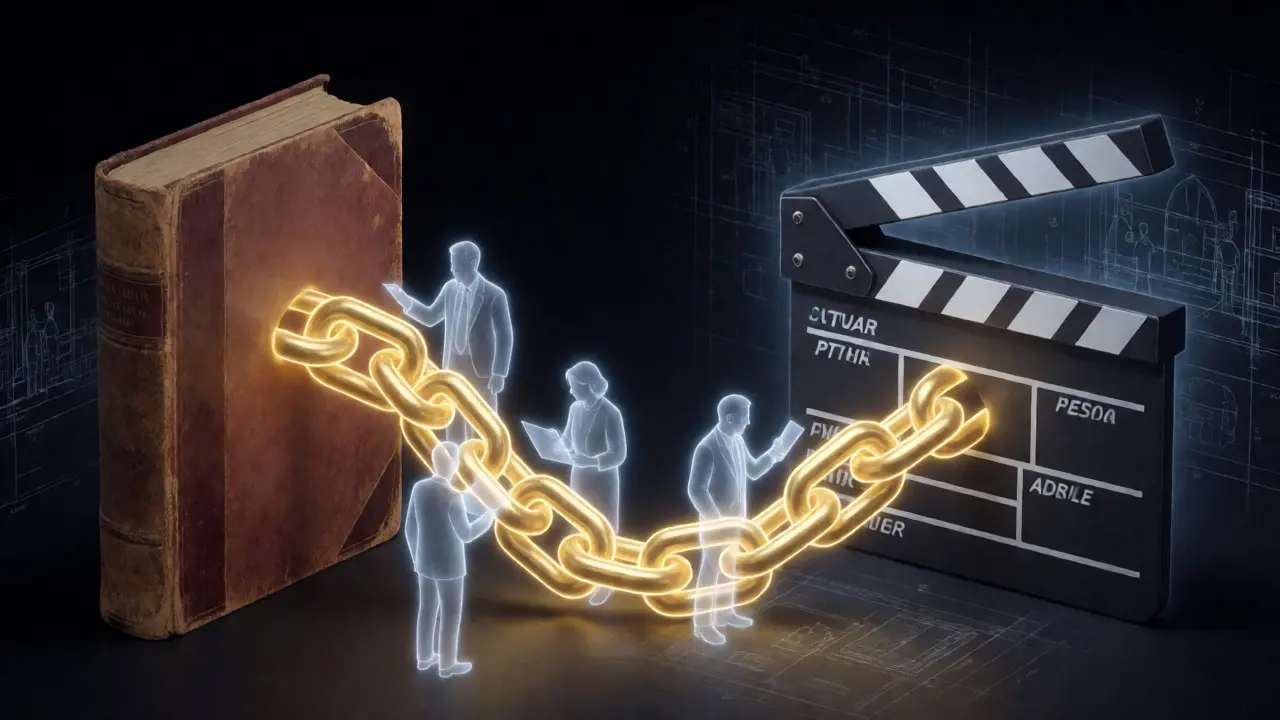
Before you sign anything, you must verify who actually owns the rights. This process is called checking the Chain of Title. It sounds fancy, but it just means tracing the history of ownership to ensure no one else has a claim.
For example, did the author previously sign a publishing deal? Many traditional publishers retain certain rights, such as audio, translation, or sometimes even motion picture rights. If the author sold all rights to a publisher ten years ago, you might need to negotiate with the publisher, not the author. Or worse, the rights might have already been optioned by another production company.
Here is a quick checklist for due diligence:
- Contact the Author: Ask directly if they control the film rights. Be polite and professional.
- Check Public Records: Search the U.S. Copyright Office database to see if any assignments or licenses have been recorded.
- Review Publishing Contracts: If possible, ask the author to share relevant clauses from their publishing agreement. Look for "reserved rights" vs. "granted rights."
- Verify Status: Ensure the work is not in the public domain (unless you want to adapt Shakespeare, where rights are free) and that no other options are currently active.
If you skip this step, you risk spending six months developing a script for a book whose film rights were sold to a major studio three years ago. That is a painful lesson learned too late.
Negotiating Terms Beyond Money
Money is important, but it isn’t the only thing you are negotiating. How you structure the deal can save you headaches later. One critical concept is the "Step Deal." Instead of paying the full purchase price upfront when you exercise the option, you pay it in stages tied to milestones.
A typical step deal looks like this:
- Payment 1: Upon signing the option agreement (Option Fee).
- Payment 2: Upon delivery of the first draft screenplay.
- Payment 3: Upon securing financing or a distribution deal.
- Payment 4: Upon commencement of principal photography.
This structure protects you. If you deliver a bad script and the producer walks away, you haven’t paid the full purchase price. It also aligns incentives: the author wants the script to be good so they get paid, and you want to pay less if the project stalls.
Another crucial term is "Reversion Rights." If the project dies after you’ve bought the rights, can you get them back? Ideally, yes. Negotiate a clause stating that if production hasn’t started within X years of purchasing the rights, the rights revert to the author. This makes authors more willing to work with you because they aren’t locked into a dead project forever.
Common Pitfalls to Avoid
Even experienced writers mess this up. Here are the most frequent mistakes I’ve seen in my years working in the industry:
Assuming "Fair Use" Applies: Fair use is a defense against copyright infringement, typically for commentary, criticism, news reporting, teaching, scholarship, or research. Adapting a novel into a commercial feature film almost never qualifies as fair use. Do not rely on it.
Ignoring Underlying Rights: If you are adapting a non-fiction book that uses many quotes from other sources, interviews, or photos, you may need to clear those underlying rights too. The author might have secured permission for print publication, but those permissions often do not extend to film. Check the footnotes!
Vague Definitions of "Source Material": Be precise in your contract about what you are adapting. Are you adapting the entire book? Just the characters? Just the premise? If you plan to change the ending significantly or add new characters, make sure the agreement allows for "creative liberties." Otherwise, the author could sue you for misrepresentation if they feel you distorted their work.
Not Getting It in Writing: Handshake deals are nice, but they are worthless in court. Always have a written option agreement signed by both parties. Keep copies of everything.

Practical Tips for Independent Writers
If you are working with a limited budget, here are some strategies to make adaptation rights more accessible:
- Look for Indie Authors: Self-published authors often retain all their rights and are more flexible with pricing. They may accept a lower option fee in exchange for a higher backend participation (a percentage of profits).
- Consider Short Stories: Short stories are cheaper to option than novels. You can combine multiple short stories from the same author into one anthology-style film, which can be a compelling pitch.
- Use a "Pay-or-Play" Clause: If you are a writer-director, you might negotiate that your writing fee covers part of the option fee. Some authors will waive the upfront option cost if you guarantee them a credit and a share of net profits.
- Hire an Entertainment Lawyer: Yes, it costs money ($300-$600/hour), but having a lawyer review your option agreement is worth every penny. They can spot traps you missed and help you negotiate better terms. For a standard option, expect to pay $1,500-$3,000 for legal fees. Compare that to losing a $50,000 investment because of a bad contract.
Remember, the goal is to build a partnership with the rights holder. Treat them with respect. Communicate clearly. Show them your vision. If they trust you, they are more likely to agree to favorable terms and support your project through its ups and downs.
Next Steps After Securing Rights
Once you have signed the option agreement and paid the fee, you have a legal basis to proceed. Now you can focus on the craft. Start outlining your screenplay. Decide how to translate internal monologues into visual actions. Determine which subplots to cut and which to expand. With the legal safety net in place, you can write freely, knowing that if you succeed, the rights are yours to leverage.
Keep track of your deadlines. Most option agreements have strict timelines. Set calendar reminders for renewal dates. If you are close to the deadline but haven't finished the script, contact the rights holder early to discuss an extension. Honesty goes a long way.
Do I need to buy the rights before I write the script?
Technically, you can write a spec script without rights, but you cannot sell or produce it legally without them. However, most professionals recommend securing at least an option agreement before investing significant time in writing. This prevents wasted effort if the rights are unavailable or too expensive.
What happens if the author refuses to sell the rights?
If the author retains the rights and refuses to sell or option them, you cannot adapt the work. You would need to look for another source material or consider writing an original screenplay inspired by the themes, but not directly adapted from the text.
How much does an option agreement typically cost?
For independent films, option fees range from $500 to $5,000. For mid-budget films, it might be $10,000 to $25,000. Major studio adaptations can reach six figures. The fee is usually applied toward the final purchase price if the movie gets made.
Can I adapt a book that is in the public domain?
Yes, you do not need to pay for rights to adapt public domain works (e.g., classic literature pre-1928 in the US). However, be careful with modern translations or editions that may have their own copyright protections on the specific wording used.
What is the difference between an option and a license?
An option gives you the exclusive right to purchase the rights within a specific timeframe. A license grants you the right to use the material immediately, often for a specific purpose or duration, without necessarily transferring ownership. Options are more common in film development.
Who pays for the entertainment lawyer?
Typically, each party hires and pays their own lawyer. However, in some deals, the producer agrees to cover the legal costs for drafting the initial agreement, especially if they are initiating the negotiation. Always clarify this in your discussions.