Every year, millions of people tune in to watch the Oscars, but very few know how the winners are actually chosen. It’s not a public vote. It’s not a popularity contest. It’s not even decided by the Hollywood elite in a backroom meeting. The process is complex, secret, and carefully structured - and it’s run by over 10,000 voting members of the Academy of Motion Picture Arts and Sciences. If you’ve ever wondered why a film like Oscar voting ends up winning Best Picture over a bigger box office hit, this is how it happens.
Who Gets to Vote?
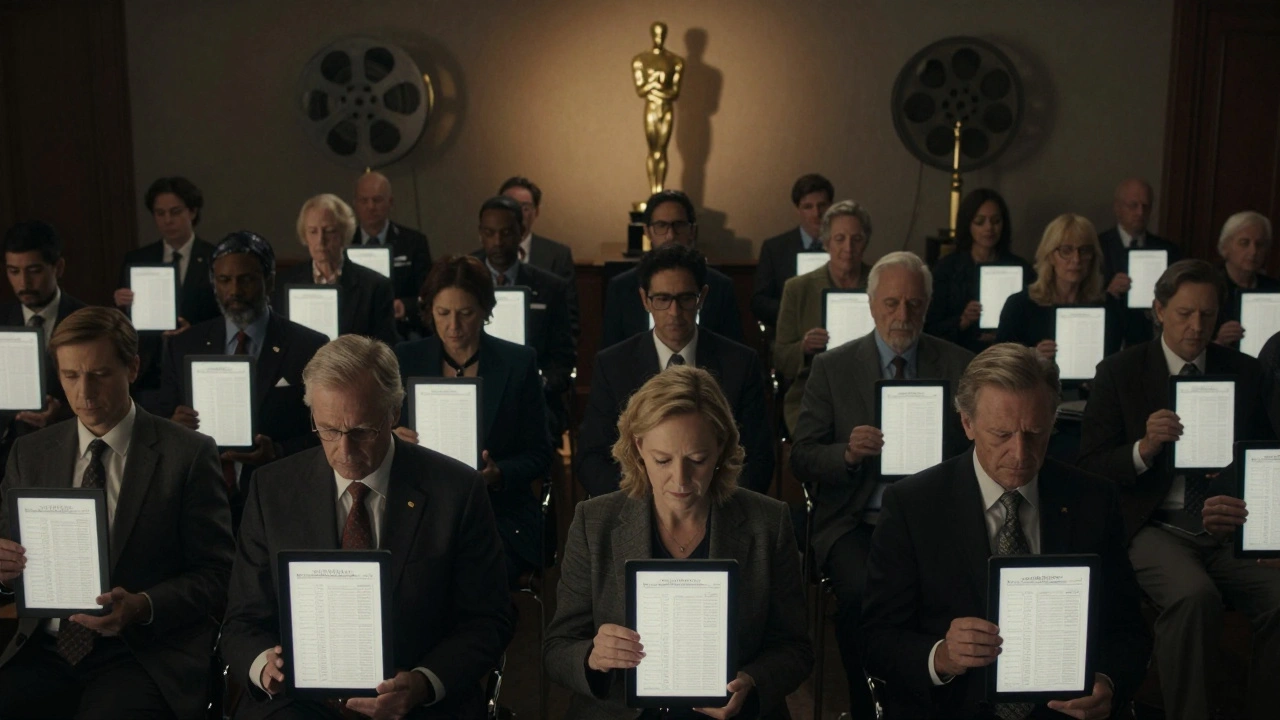
The Academy isn’t open to the public. You can’t sign up. You don’t apply. Membership is by invitation only, and it’s earned through a track record of professional achievement in film. Members come from 17 branches: actors, directors, writers, cinematographers, editors, producers, and more. Each branch votes only in their own category - actors vote for actors, directors for directors, etc. But when it comes to Best Picture, every active member gets a ballot.
Membership isn’t just about fame. You need at least two qualifying credits in the last 10 years, or one credit with exceptional contributions to the industry. Once you’re in, you’re a member for life - unless you’re expelled for serious misconduct. That’s why you see the same names year after year: people who’ve shaped the industry for decades.
The Ballot System: Ranked Choice, Not Popular Vote
For Best Picture, the Academy uses a ranked-choice voting system called the Single Transferable Vote (STV). It’s the same system used in some national elections, like in Ireland and Australia. Here’s how it works:
- Each voter ranks all nominated films from 1 to 10 (or however many are nominated that year).
- First-choice votes are counted. If a film gets more than 50% of first-place votes, it wins outright.
- If no film crosses that threshold, the film with the fewest votes is eliminated.
- The ballots that voted for the eliminated film get redistributed to their next highest-ranked film still in the race.
- This repeats until one film has over 50% of the active votes.
This system rewards broad appeal over niche favorites. A film that’s everyone’s second or third choice can win - even if it wasn’t anyone’s top pick. That’s why a quiet drama like Parasite beat out big-budget blockbusters. It had wide support across many voters, even if it wasn’t the #1 pick for most.
Why Not Just Pick the Most Popular?
Why not make it simple? Why not let the public vote? The Academy doesn’t want the Oscars to be a popularity contest. They want to honor artistic achievement, not box office numbers. A film like Everything Everywhere All at Once made $140 million - impressive for an indie film - but it didn’t win because it had the most tickets sold. It won because it earned deep respect from filmmakers across disciplines.
There’s also a practical reason: the Academy wants to avoid the kind of manipulation you see in public voting. If it were a simple popular vote, studios could buy ads, run social media campaigns, or even pay fans to vote. The ranked-choice system makes that much harder. You can’t just flood the system with one movie - you need real, widespread support across the membership.

How Do Members Actually Vote?
Voting happens in two rounds. First, members vote to determine the nominees. Then, after the nominations are announced, they vote again to pick the winners. Both rounds are done online through a secure voting portal managed by PwC, the accounting firm that’s been overseeing the Oscars since 1935.
Members receive a unique login and ballot. They can vote anytime between the nomination announcement and the voting deadline - usually about two weeks before the ceremony. Votes are encrypted and stored anonymously. PwC doesn’t know who voted for what. They only count the totals. After the ceremony, they destroy the ballots.
There’s no public tally. No leaks. No polls. Even the Academy doesn’t know the results until the envelopes are opened on stage. That’s how they keep the surprise alive.
What About the Other Categories?
For acting, directing, writing, and technical categories, it’s simpler: first-past-the-post. The nominee with the most votes wins. No ranking needed. But even here, the membership matters. An actor’s vote means more if they’re an actor themselves. A cinematographer’s vote carries weight in the cinematography category. That’s why you sometimes see a documentary short win over a flashy animated feature - the voters in that branch know what good documentary storytelling looks like.
For Best International Feature Film, only members who’ve seen all the submitted films can vote. Studios send screeners to voters, but many members still don’t watch them all. That’s why countries with strong submission campaigns - like Italy, France, or South Korea - often win. They invest in getting their films seen.
Why Do Some Films Win Against the Odds?
Every year, there’s a film that wins against the odds. Green Book beat out Black Panther. Spotlight beat The Revenant. Argo beat Lincoln. Why? Because the Academy isn’t just voting on quality - they’re voting on narrative.
There’s a hidden factor: momentum. Campaigns matter. Studios spend millions on screenings, Q&As, and lobbying. They invite voters to private events. They send personalized emails. They make sure their film stays top of mind. A film that’s quietly released in November might fade away - unless it’s pushed hard.
But here’s the catch: a campaign can’t save a film if the voters don’t connect with it. You can’t buy a win. You can only influence the conversation. The final decision still rests with the voters - and their personal taste, biases, and experiences.

What’s Changed Over Time?
The Academy has changed a lot since the 1920s. Back then, membership was mostly white, male, and older. Today, they’ve added more than 1,000 new members since 2016 - more women, more people of color, more international filmmakers. That’s shifted the voting patterns. Films like Minari, Sound of Metal, and RRR got nominated because new voters saw themselves in them.
The number of Best Picture nominees has also changed. From one film to five, then to ten, and now back to a flexible number between 8 and 10. That was done to let more diverse films into the conversation. It worked. You’re now more likely to see a documentary-style film or a foreign-language movie in the Best Picture race than you were 20 years ago.
What Happens If a Voter Doesn’t Vote?
Many members don’t vote. In fact, in recent years, only about 60-70% of eligible voters cast a ballot for Best Picture. That means a film can win with support from just a fraction of the total membership. A well-organized campaign can sway the outcome if it mobilizes even 10-15% of voters.
That’s why some films win despite low public awareness. They don’t need to be popular - they just need to be seen and remembered by enough voters who care.
Why Does This System Still Work?
It’s not perfect. Critics say it’s too insular. Others say it’s too slow to change. But the system has one major advantage: it keeps the Oscars from becoming a marketing spectacle. It protects the award from being bought by the biggest budget. It gives space to films that might not be loud, but are deeply felt.
That’s why, even in the age of TikTok trends and streaming algorithms, the Oscars still matter. Because the people who decide the winners are the people who made the movies - not the people who watch them on their phones.
Can anyone join the Academy to vote for the Oscars?
No. Membership is by invitation only and requires a proven track record in the film industry. You need at least two qualifying credits in the last 10 years, or one credit with exceptional contributions. Even then, you must be sponsored by two existing members and approved by the Academy’s Board of Governors.
Why do some films win Best Picture even if they didn’t win any other Oscars?
Because Best Picture is voted on by the entire Academy, not just one branch. A film can be a favorite among producers, writers, and directors - even if it didn’t stand out in acting or cinematography. The ranked-choice system rewards broad support, so a film that’s everyone’s second choice can still win if it’s consistently ranked high across many ballots.
Do studio campaigns really influence Oscar outcomes?
Yes, but only up to a point. Campaigns get films seen, keep them in conversation, and remind voters to cast their ballots. But you can’t buy a win. A film needs genuine support from voters. A well-funded campaign can help a good film win - but it can’t make a bad film win.
How are the winners kept secret until the ceremony?
PwC, the accounting firm that handles voting, tabulates the results and stores them in secure envelopes. Only two PwC partners know the results before the ceremony. They deliver the envelopes to the presenters moments before they go on stage. The ballots are destroyed after the ceremony, and no digital copies are kept.
Can a film win Best Picture without being nominated for Best Director?
Yes. It’s rare, but it’s happened. Argo won Best Picture in 2012 without Ben Affleck being nominated for Best Director - a decision that sparked major controversy. The Academy’s rules don’t require a Best Director nomination for a film to win Best Picture. The two categories are voted on separately, and the voters don’t have to align their choices.