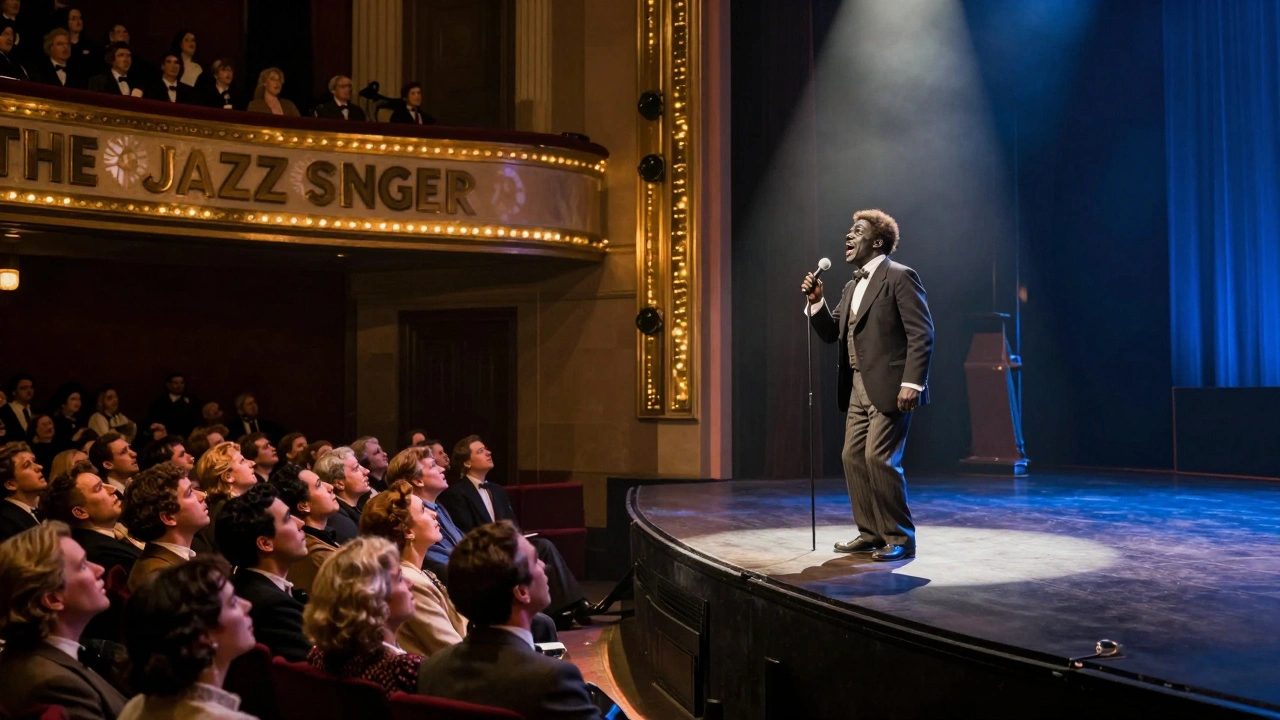
Before 1927, movies didn’t speak. They moved, they gestured, they cried - but they never said a word. Audiences understood stories through title cards, expressive acting, and live piano or orchestra scores. Then, in October of that year, The Jazz Singer is the first feature-length motion picture with synchronized dialogue sequences. Also known as The Jazz Singer (1927), it premiered at Warner Bros. Theatre in New York and changed everything. Suddenly, cinema wasn’t just visual anymore. It had voice. And with that voice came a revolution.
What Exactly Was a 'Talkie'?
A talkie wasn’t just a movie with some lines spoken. It was a full system - microphones, recording equipment, sound stages, new cameras, and even new acting styles. The Vitaphone system used by Warner Bros. recorded sound on wax discs synced to film projectors. It wasn’t perfect. Voices crackled. Background noise crept in. Actors had to stay perfectly still because microphones couldn’t pick up movement. But it worked well enough to convince theaters to install sound systems - and studios to invest billions in the shift.
By 1929, over 400 American theaters had been wired for sound. In just two years, silent films went from dominating the box office to being seen as outdated. Studios that hesitated - like Charlie Chaplin’s - found themselves fighting an uphill battle. Even Chaplin, who famously resisted talkies, released City Lights in 1931 as a silent film. It was a critical success, but audiences had already moved on.
The Silent Era’s Last Stand
Stars of silent cinema had built careers on physical expression. Think of Buster Keaton’s deadpan stunts, Mary Pickford’s wide-eyed charm, or Rudolph Valentino’s romantic intensity. These actors didn’t need words. Their faces told the story. But when sound arrived, many couldn’t adapt.
Some had accents that didn’t fit American audiences. Others had voices that were too thin, too nasal, or too quiet. Clara Bow, the "It Girl," struggled with a high-pitched voice that didn’t match her screen persona. John Gilbert, once MGM’s leading man, saw his career collapse after his first talkie. Critics called his voice "squeaky." Studios stopped casting him. He died in 1936, broke and forgotten.
Meanwhile, actors who had trained in theater - like Al Jolson, who starred in The Jazz Singer - thrived. They knew how to project, how to time lines, how to use silence between words. The transition didn’t just change technology. It changed who got to be a movie star.
How Filmmaking Changed Overnight
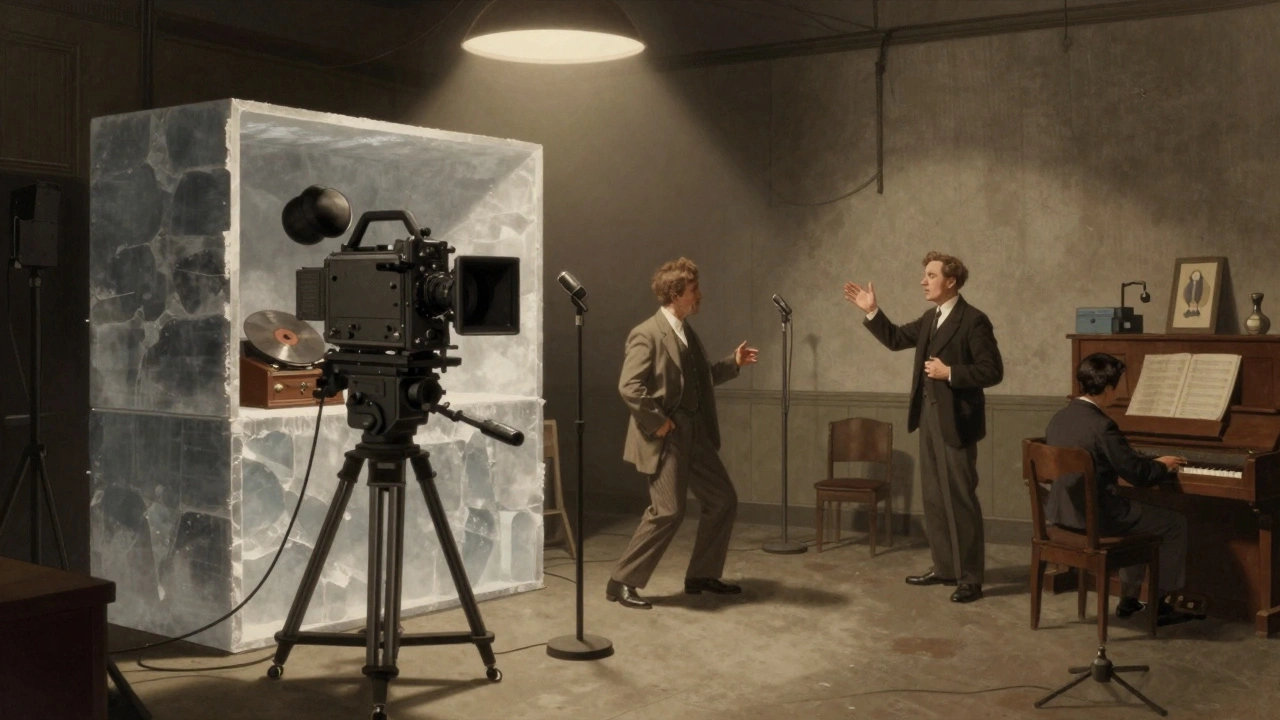
Before sound, cameras could move freely. They rolled on rails, swung on cranes, followed actors through crowded streets. Sound recording forced them to stay locked in place. Cameras were buried inside soundproof booths called "iceboxes." Directors lost the ability to chase action. Scenes became static. Long takes disappeared. Editing slowed down.
Lighting changed too. Early microphones couldn’t pick up sound well unless actors stood near them. That meant lighting had to be brighter to compensate - and those bright lights heated up the set. Actors sweated. Sets melted. Filming became uncomfortable, even dangerous.
Writers became essential. Silent films relied on visual storytelling. Now, scripts mattered. Dialogue had to be sharp, rhythmic, natural. Screenwriters like Dashiell Hammett and William Faulkner jumped into Hollywood. Suddenly, the most valuable people on set weren’t the cinematographers - they were the ones typing the words.
The Global Impact: Hollywood Takes Over
Before talkies, European cinema led the world. French filmmakers like Georges Méliès and Soviet directors like Sergei Eisenstein pushed boundaries in editing and visual metaphor. German Expressionism gave us The Cabinet of Dr. Caligari. But once sound arrived, America’s industrial power took over.
European studios didn’t have the capital to upgrade. France, Italy, and Germany struggled to produce sound films as quickly as the U.S. By 1930, Hollywood was pumping out 500 talkies a year. Foreign films were dubbed - poorly - or subtitled. Audiences in Paris, Berlin, and Tokyo began to prefer American movies with clear, confident voices.
By 1935, over 80% of films shown in Europe were American. The rise of talkies didn’t just change storytelling - it cemented Hollywood’s global dominance.
Genres Were Born in the Noise
Sound didn’t just change how stories were told - it created new kinds of stories.
Musicals exploded. 42nd Street (1933) and The Broadway Melody (1929) turned movie palaces into concert halls. Fred Astaire and Ginger Rogers danced in perfect sync with orchestras. Audiences didn’t just watch - they tapped their feet.
Comedies found new life. The Marx Brothers cracked wise. Mae West delivered double entendres with a purr. Sound made punchlines land harder. Slapstick didn’t disappear - it got smarter.
And then there was the gangster film. The Public Enemy (1931) with James Cagney. The sound of a gun firing. The crunch of a grapefruit in a woman’s face. The hiss of a whispered threat. These moments only worked because you could hear them.
Even horror found its voice. Bela Lugosi’s Dracula didn’t just stare - he spoke in a slow, hypnotic tone. "I never drink... wine." That line wouldn’t have haunted you if it had been written on a card.
The Cost of Progress
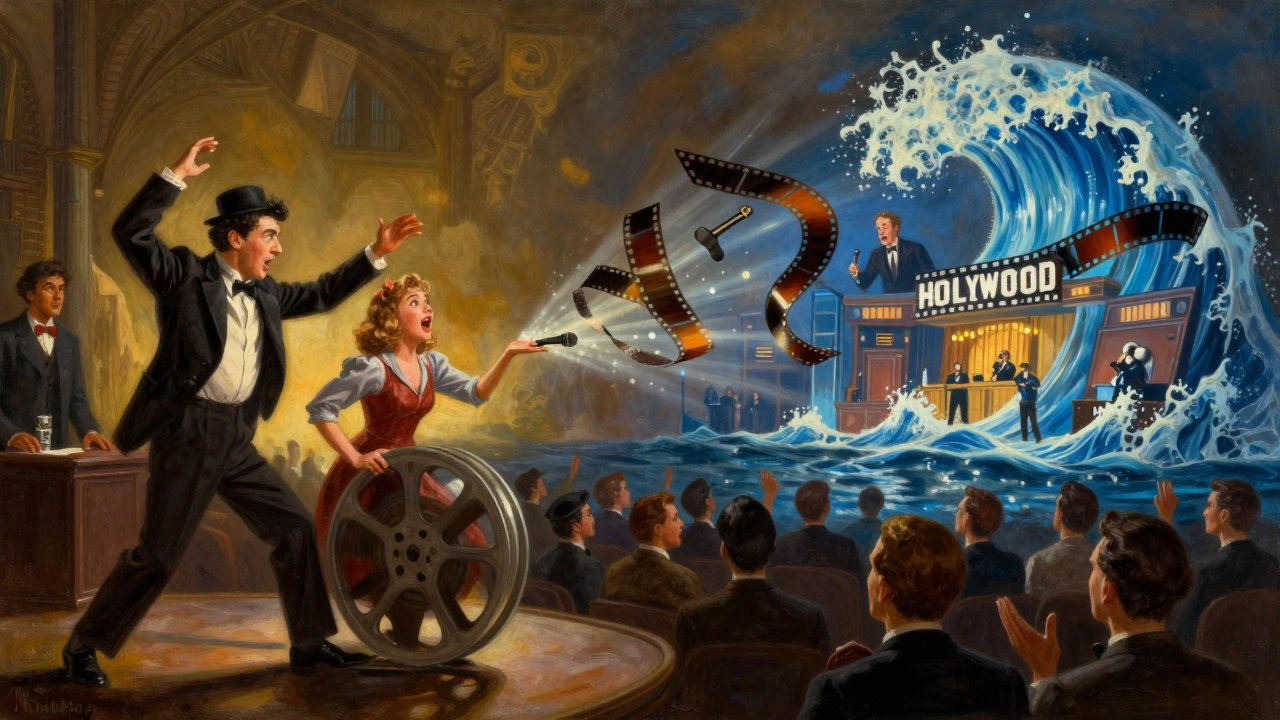
The switch to sound cost studios hundreds of millions. Thousands of jobs vanished. Projectionists who played live music lost their jobs. Set designers had to rebuild entire studios. Camera operators became technicians. Editors had to learn timing based on speech rhythm, not visual flow.
Many theaters couldn’t afford the upgrade. Rural towns in the American South and Midwest kept showing silent films until the mid-1930s. Some small studios went bankrupt. Independent filmmakers were squeezed out. Hollywood became more centralized - more corporate.
And yet, the public didn’t care. They lined up for talkies. They wanted to hear the stars. They wanted to feel like they were in the room. The technology was clunky. The early sound films were often stiff. But the magic was there.
Legacy: The Sound That Still Echoes
Today, we take synchronized sound for granted. But every film you’ve seen with crisp dialogue, layered ambient noise, or a perfectly timed musical cue owes its existence to that moment in 1927. The shift to sound didn’t just modernize cinema - it redefined human connection on screen.
Modern directors like Martin Scorsese and Christopher Nolan still study early talkies to understand how sound can build tension, reveal character, or manipulate emotion. Nolan shot Oppenheimer (2023) without a single piece of digital sound design. He used real microphones on set, just like they did in 1930. Why? Because he knows - the truth of a voice captured live is still unmatched.
The transition to sound was messy, chaotic, and expensive. But it was also the moment cinema stopped being a visual experiment and became a full sensory experience. It didn’t kill silent film - it transformed it. And in doing so, it gave the world a new way to feel stories - not just see them.
What was the first talkie movie?
The first feature-length talkie was The Jazz Singer, released in 1927 by Warner Bros. It featured synchronized singing and a few lines of spoken dialogue, most famously by Al Jolson. While it wasn’t the first film with sound - short films had experimented with it since the 1890s - it was the first to prove that audiences would pay to hear a movie speak.
Why did silent film stars struggle with talkies?
Many silent film stars had built their careers on physical expression - facial gestures, body language, and exaggerated movements. When sound arrived, their voices often didn’t match their image. Some had thick accents, others had weak or unusual vocal tones. Studios quickly realized that acting for sound required different skills: timing, diction, and vocal control. Many silent stars couldn’t adapt, and their careers faded within a few years.
Did Europe fall behind because of the talkie transition?
Yes. European film industries, especially in France and Germany, were artistically ahead of Hollywood before 1927. But they lacked the financial resources to upgrade studios and equipment quickly. American studios, backed by powerful corporations like Warner Bros. and MGM, invested heavily in sound technology. By 1930, Hollywood was producing five times as many sound films as all of Europe combined. This shift allowed American films to dominate global markets, and European cinema never fully regained its pre-sound influence.
How did sound change movie editing?
Before sound, editors could cut quickly - cutting on movement, emotion, or visual rhythm. With synchronized dialogue, cuts had to match speech patterns. A cut mid-sentence could ruin the audio. Editors had to learn to preserve natural speech flow, which slowed down pacing. This led to longer takes and fewer cuts. It also made editing more technical, requiring sound engineers to work alongside editors for the first time.
Were there any films made in both silent and sound versions?
Yes. Many studios released dual versions during the transition. For example, Street Angel (1928) was shot as a silent film but later re-released with a synchronized score and sound effects. Some films even had separate endings - silent versions used title cards, while sound versions added spoken lines. This helped studios hedge their bets during the uncertain early years of sound.



Comments(5)