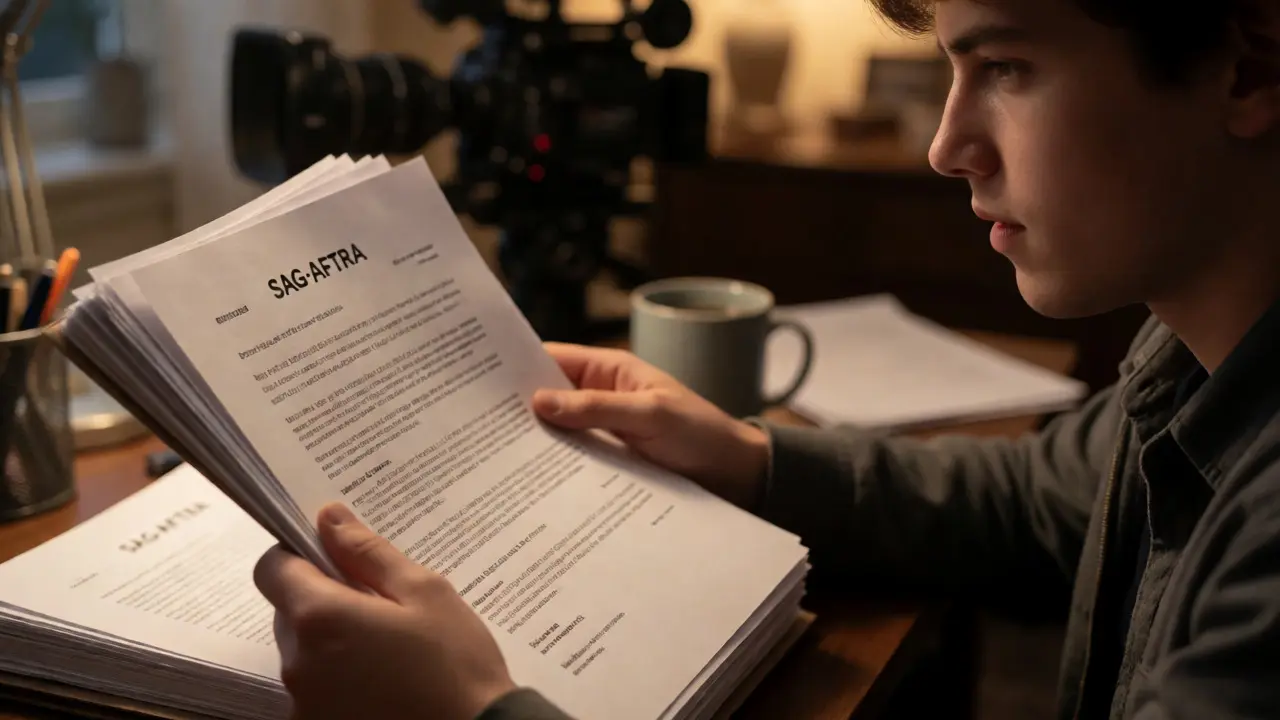
You just booked a role. The script is great, the director seems cool, and the pay looks decent on paper. But then your agent sends over a stack of paperwork labeled "SAG-AFTRA Agreement," and suddenly you’re staring at terms like "Day Player," "Scale," and "Buyout" while wondering if you’re about to sign away your rights or just your weekend.
It’s not just bureaucracy. These agreements determine whether you get paid fairly when that indie flick ends up on Netflix, or if you’ll be eating ramen for three months because the production company decided to skip overtime. Understanding SAG-AFTRA rules isn’t optional if you want a sustainable career; it’s the difference between being a professional and being an unpaid extra with lines.
The Quick Takeaways
- Know Your Tier: Are you working under Standard, Low Budget, or Ultra Low Budget? The contract dictates your floor rate and backend potential.
- Scale is Not Enough: Always negotiate above the minimum (scale) if the budget allows. Scale is the legal floor, not the market rate.
- Residuals Matter: If the project gets distribution, your upfront fee might be tiny compared to what you could earn in streaming royalties.
- Penalties are Real: Late payments incur daily interest penalties. Don’t let them slide.
- Read the Buyout: In low-budget deals, productions often try to buy out your residuals for a flat fee. Calculate if that’s worth it before signing.
Decoding the Contract Types
Not all SAG-AFTRA jobs are created equal. The union has different tiers designed to help smaller films get made without bankrupting the producers, but these tiers come with trade-offs for you. The most common one you’ll encounter as a working actor is the Standard Agreement. This applies to larger budget films where everyone gets paid well, and residuals are calculated based on standard formulas. It’s the gold standard, but fewer projects qualify.
Then there’s the Low Budget Agreement. This is the workhorse of independent cinema. Productions here have budgets typically under $700,000 (though this number adjusts annually). You still get protected rates, but they are lower than Standard. Crucially, you retain residual rights if the film gets distributed widely. The catch? The payment schedules can be slower, and the administrative overhead is higher.
For micro-budget films, you’ll see the Ultra Low Budget (ULB) agreement. This is for movies made for less than $300,000. Here’s the big decision point: ULB often includes a "buyout" option. The producer pays you a flat fee upfront-say, $500 per day-and that’s it. No residuals ever, even if the movie becomes the next Parasite. Is that fair? Sometimes. If the film is truly experimental and unlikely to make money, taking the cash upfront is smart. If it’s a polished drama aiming for Sundance, you might regret selling your future earnings for pocket change.
| Agreement Type | Budget Cap (Approx.) | Residuals? | Overtime Rules |
|---|---|---|---|
| Standard | $700k+ | Yes (Full) | Strict 1.5x after 8 hours |
| Low Budget | $300k - $700k | Yes (Conditional) | Relaxed, but paid |
| Ultra Low Budget | < $300k | Often Bought Out | Flexible, often negotiated |
Negotiating Beyond Scale
Let’s talk about money. When an offer comes in, it usually says "Scale." That means the minimum amount required by the union contract for that specific tier. For a Day Player (someone working less than a week), scale might be around $400-$600 depending on the current year's adjustments. But should you accept it?
If the production has money, absolutely not. Scale is the bare minimum to keep the lights on. Your agent’s job is to push for "Above Scale." How much above? It depends on your leverage. If you’ve got credits, good reviews, or you’re the only person who fits the role perfectly, ask for 20-50% more. If you’re new and just need the reel footage, accepting scale is fine-but try to negotiate other perks instead.
What kind of perks? Ask for travel expenses covered, hotel stays if you’re far from home, or a guaranteed turnaround time (the rest period between wrap and call time). Turnaround is critical. If they schedule you with only 8 hours of rest, you’re legally entitled to penalty pay for every hour short of 12. Producers hate paying this, so they’ll often give you a better rate upfront to avoid the hassle. Use that to your advantage.

The Fine Print: Residuals and Buyouts
This is where actors get burned. Residuals are payments you receive when your work is reused. Think reruns, international sales, streaming licenses, and DVD/Blu-ray sales. Under the Standard Agreement, these add up significantly over time. I know actors who bought their first house thanks to residuals from a show that aired ten years ago.
But in the New Media era, things are trickier. Streaming platforms like Netflix or Amazon Prime don’t always report viewership data transparently, making residual calculations opaque. Some contracts use a "fixed residual" model, where you get a set amount regardless of how many people watch. Others use a percentage-based model. Read which one applies to you.
In Lower Budget tiers, producers often propose a "Global Buyout." They say, "We’ll pay you $1,000 extra now, and you waive all future residuals." Do the math. If the film makes $1 million, your 0.5% share might be $5,000. Taking $1,000 now is bad business. But if the film likely won’t make $50,000, take the cash. There’s no crystal ball, so look at the track record of the producer and director. Have their previous films actually made money? If not, take the buyout.
Working Conditions and Safety
Money isn’t everything. The union also protects your physical safety and dignity. The agreement mandates strict limits on working hours. A typical shooting day is 10-12 hours, including lunch. If you go over, overtime kicks in. Double-time starts after certain thresholds (usually 12+ hours).
Don’t be shy about enforcing this. I’ve seen assistants directors try to pressure actors into staying late by saying, "We’re almost done." If you stay past your scheduled wrap time, ensure it’s documented. Without documentation, you might never see that overtime check. Also, check the "Turnaround" clause. If you finish at 10 PM and are called back at 6 AM, that’s only 8 hours. You’re owed a penalty for those missing 4 hours. Most productions will pay this automatically, but verify it on your timesheet.
Stunts require special attention. If you’re doing anything beyond walking and talking-like falling down stairs or getting splashed with water-you need a stunt coordinator. Never attempt stunts yourself unless you’re trained and the contract explicitly covers it. Injury claims outside of union coverage can be messy and expensive.

Common Pitfalls to Avoid
One major mistake actors make is assuming verbal promises count. If the director says, "We’ll figure out the bonus later," write it down. Get it in an email. SAG-AFTRA contracts are binding documents; side conversations aren’t enforceable unless added as an addendum.
Another pitfall is ignoring the "Signatory Status." Before you commit, check if the production company is actually signed with SAG-AFTRA. You can look this up on the union’s website. If they aren’t, you might be working non-union, which means no protections, no residuals, and potentially no recourse if they stiff you on pay. Occasionally, a non-signatory producer will promise to sign *after* filming starts. Be wary. If they haven’t signed by the time you start, you’re in limbo.
Finally, keep copies of everything. Your contract, your call sheets, your timesheets, and any emails regarding changes. If a dispute arises, these documents are your evidence. Digital scans are fine, but organize them by project date. When you’re juggling five gigs a year, finding that one email from six months ago can be a nightmare.
FAQ
What happens if a production fails to sign the SAG-AFTRA agreement before filming?
If a production hasn't signed the agreement, you are technically working non-union. This puts you at risk for unpaid wages and lack of benefits. Ideally, do not start work until the signatory status is confirmed. If you've already started, notify your agent immediately so they can file a grievance or negotiate retroactive coverage.
Can I negotiate my rate if the contract says 'Scale'?
Yes, absolutely. Scale is the minimum required by law, not a fixed price. You can negotiate for "Above Scale." Factors influencing this include your experience, the production's budget, and how essential your role is to the story. Even in low-budget films, there is often room to move slightly above the floor.
How do residuals work for streaming services like Netflix?
Streaming residuals vary by contract type. Some agreements provide a fixed lump sum per year the title remains available, while others offer a percentage of licensing fees. Reporting can be delayed, sometimes by 6-12 months. Ensure your contract specifies the calculation method and reporting timeline to manage expectations.
What is a 'Buyout' in an Ultra Low Budget agreement?
A buyout is a one-time payment that replaces all future residual payments. You receive a flat fee upfront, and the producer retains full rights to reuse the content without paying you again. This is common in ultra-low-budget films where predicting revenue is difficult. Evaluate if the immediate cash outweighs potential long-term gains.
Do I get paid for self-tapes?
Generally, no. Self-tapes are considered part of the audition process and are unpaid. However, some high-profile casting calls or specific agency agreements may offer a small stipend for extensive self-tape requirements. Always clarify this with your agent before submitting.