Every major studio meeting starts with the same question: "Do we own it?" In the current landscape of Hollywood, the answer determines whether a project moves forward or dies on the table. We are no longer just buying scripts; we are acquiring underlying literary properties that serve as the bedrock for multi-decade franchise ecosystems. The shift from standalone films to interconnected universes has changed how studios value source material. It is no longer about the story alone; it is about the legal architecture that allows you to expand, shrink, and remix that story across film, television, and merchandise.
The Economics of Ownership vs. Optioning
There is a massive difference between holding the full rights to a book and simply having an option on it. An option gives you the right to buy the property within a specific timeframe (usually 18 months to two years) for a small fee, often ranging from $5,000 to $50,000 depending on the author's fame. If you don't exercise that option, the rights revert back to the author. This creates a ticking clock for producers who need to secure financing and attach talent quickly.
However, true franchise building requires permanent ownership or long-term exclusive control. When a studio purchases the underlying rights outright, they gain the ability to create sequels, prequels, spin-offs, and derivative works without negotiating with the original creator every single time. This is why you see so many big-budget adaptations coming from estates or publishers rather than individual authors. The estate of J.R.R. Tolkien, for example, controls the vast majority of Middle-earth related media, allowing New Line Cinema and Warner Bros. to develop multiple projects simultaneously without legal friction.
Why Books Still Beat Original Screenplays
You might wonder why studios pay millions for books when they can hire top-tier writers to create original stories. The data suggests that adapted material has a higher success rate at the box office. A report by the Motion Picture Association noted that in recent years, more than half of the top-grossing films were based on existing intellectual property (IP), including novels, comics, and video games. But literary adaptations hold a unique advantage: built-in audience recognition.
When a reader picks up a novel, they have already formed emotional connections with the characters. They know the world. They care about the outcome. By adapting this work, filmmakers inherit that loyalty. This reduces marketing costs because the title itself acts as a teaser. Think of the buzz around Dune. Denis Villeneuve didn't just release a sci-fi movie; he released a visual interpretation of Frank Herbert's iconic text. The marketing campaign leaned heavily on the source material, attracting both die-hard fans and curious newcomers who had only heard of the book through word-of-mouth.
Navigating the Rights Web: Copyright and Estate Management
One of the biggest hurdles in modern franchise development is navigating complex copyright laws. In the United States, copyright protection lasts for the life of the author plus 70 years. For corporate works, it’s 95 years from publication. This means many classic public domain works are becoming available again, but most contemporary bestsellers remain locked down for decades.
For authors who pass away before their works enter the public domain, their estates take over management. These estates can be powerful entities. Consider the estate of Stephen King. He actively collaborates with studios, often serving as an executive producer on his adaptations. This ensures fidelity to the source but also adds a layer of creative oversight that can slow down production. On the other hand, estates like that of Agatha Christie have been very protective, limiting the number of adaptations to maintain exclusivity and brand value.
Producers must also watch out for "work-for-hire" clauses. If a screenwriter was hired specifically to adapt a book, the studio usually owns the screenplay automatically. But if the writer retained some rights, those can become a headache later when trying to sell the project to a different network or streamer. Clear chain-of-title documentation is essential. Without it, investors will walk away.

The Rise of Transmedia Storytelling
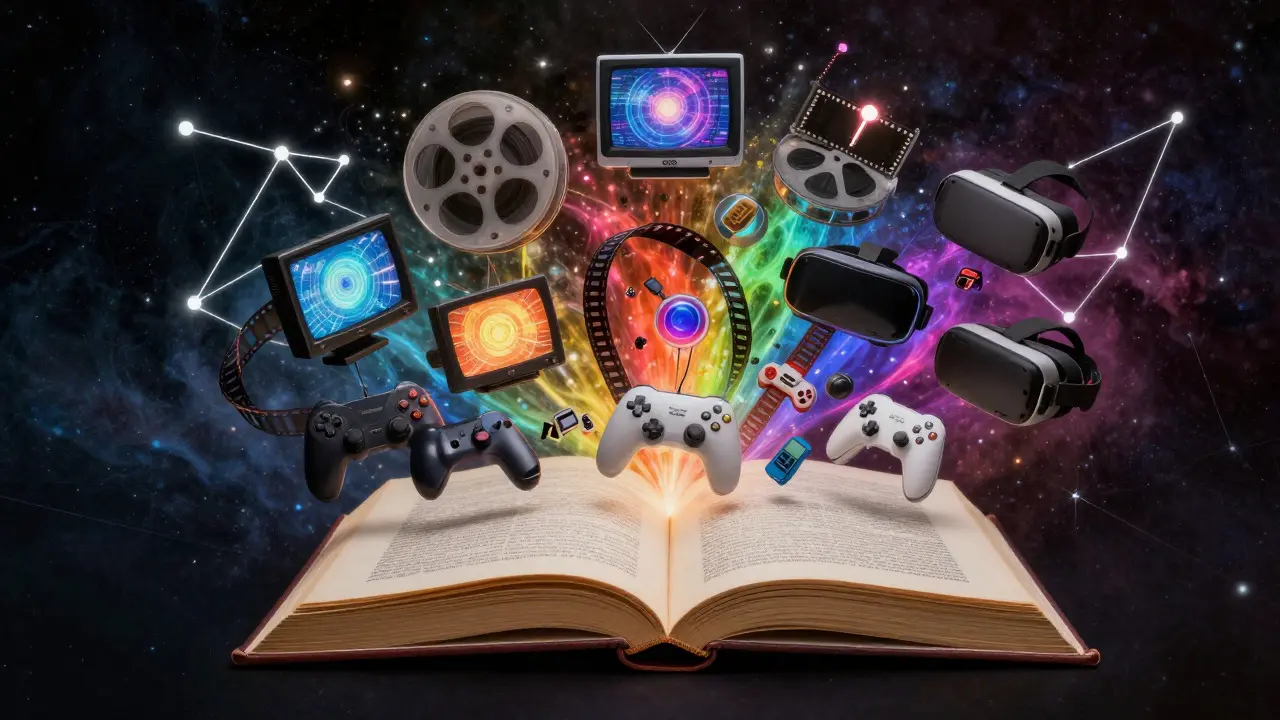
Modern franchises aren't just movies anymore. They are transmedia experiences. This means the underlying literary property needs to be broad enough to support multiple platforms. A novel with a richly detailed world offers more opportunities than a simple plot-driven thriller. You can pull subplots for TV series, character backstories for comic books, and side characters for animated shorts.
Take the Marvel Cinematic Universe (MCU) as a prime example. While started with comics, the expansion into novels, video games, and TV shows required deep control over the underlying IP. Disney acquired Marvel Entertainment in 2009, securing not just the film rights but the broader universe. This allowed them to cross-pollinate content. A character introduced in a Netflix series could appear in a theatrical release, creating a seamless narrative loop that keeps audiences engaged year-round.
This strategy relies on what industry insiders call "world-building rights." It’s not just about the main plot; it’s about owning the geography, the history, and the rules of the fictional world. If you want to make a spin-off about a villain’s origin, you need the rights to that specific aspect of the lore. This is why studios are increasingly hiring dedicated IP managers whose sole job is to track these granular rights.
Valuation Metrics for Literary Properties
How do you price a book? It’s not just about sales numbers. While a million-copy bestseller looks attractive, its value depends on several factors:
- Genre Trends: Is the genre currently hot? Fantasy and romance have seen spikes in adaptation interest recently due to streaming demand.
- Character Depth: Do the characters feel three-dimensional? Can they carry a sequel?
- Visual Potential: Can the scenes be translated visually without excessive CGI costs? High-concept sci-fi is expensive; grounded dramas are cheaper.
- Audience Demographics: Does the book appeal to a target demographic that studios are currently chasing, such as Gen Z or older adults?
Studios use comparative analysis to set prices. If a similar book sold for $3 million last year, the current asking price will likely be higher unless the market has cooled. Additionally, the presence of attached talent can inflate the perceived value. If a famous director wants to adapt a specific novel, the publisher knows they can charge a premium because the project is already half-sold.
Pitfalls to Avoid in Acquisition
Even with a great book, deals can fall apart due to overlooked details. Here are common traps:
- Vague Scope Definitions: Did you buy the rights to the entire series or just the first book? Always specify if you are acquiring "all rights to the [Series Name] series" or just "the first installment."
- Termination Clauses: Check for clauses that allow the author to reclaim rights if the film isn't made within a certain period. This can force rushed productions.
- Merchandising Rights: Sometimes, toy companies or game developers hold separate merchandising rights. Ensure your deal includes these if you plan to build a full franchise.
- Cultural Sensitivity Reviews: Some older literary works contain elements that may need significant rewriting for modern audiences. Factor in the cost of additional screenwriting time to address these issues.
Future Trends: AI and Interactive Media
As technology evolves, so does the definition of an adaptation. With the rise of AI-generated content, questions are emerging about how much human creativity is required to claim new copyrightable works derived from a source text. Meanwhile, interactive storytelling platforms like Netflix’s Black Mirror: Bandersnatch show that static novels can be transformed into branching narratives. This opens up new revenue streams where users choose paths, requiring even more detailed underlying lore to support multiple outcomes.
Studios are beginning to explore virtual reality (VR) adaptations of literary worlds. Imagine walking through the streets of Harry Potter’s London or exploring the dunes of Arrakis in VR. These experiences require high-fidelity 3D assets, which are easier to create if the source material provides detailed descriptions. The underlying literary property becomes a blueprint for immersive tech, not just a script for a linear film.
| Strategy | Cost | Control Level | Risk | Best For |
|---|---|---|---|---|
| Option Agreement | Low ($5k-$50k) | Temporary | High (rights can lapse) | Early-stage development |
| Full Purchase | High ($1M+) | Permanent | Low (once paid) | Major franchise builds |
| Licensing Deal | Medium (Royalties) | Limited | Medium (renewal issues) | TV series adaptations |
Frequently Asked Questions
What is the average cost to buy film rights to a bestselling novel?
For a current bestseller, upfront fees typically range from $1 million to $5 million, often accompanied by backend royalties of 5-10% of net profits. For mid-list authors, the cost can be significantly lower, sometimes under $500,000, depending on negotiation leverage.
Can I adapt a book if the author is still alive and doesn't agree?
Generally, no. You need permission from the copyright holder, which is usually the author or their publisher. However, if the work is in the public domain (author died over 70 years ago), you can adapt it freely without permission or payment.
Why do studios prefer established franchises over original ideas?
Established franchises come with pre-existing fan bases, reducing marketing risk. Investors view them as safer bets because there is proven demand. Original ideas require significant capital to build awareness from scratch, making them harder to finance for large-scale productions.
What happens if a film adaptation fails at the box office?
The rights usually remain with the studio unless the contract specifies a reversion clause. However, a failed film can tarnish the brand, making it harder to sell future adaptations of the same property. Studios may shelve the project for a decade or more before attempting a reboot.
How do streaming services change the value of literary properties?
Streaming services often look for content that drives subscription retention. They may value slower-burn literary sagas that encourage binge-watching over quick-turnaround blockbusters. This shifts the focus from box office potential to long-term engagement metrics, potentially increasing the value of complex, multi-part novels.