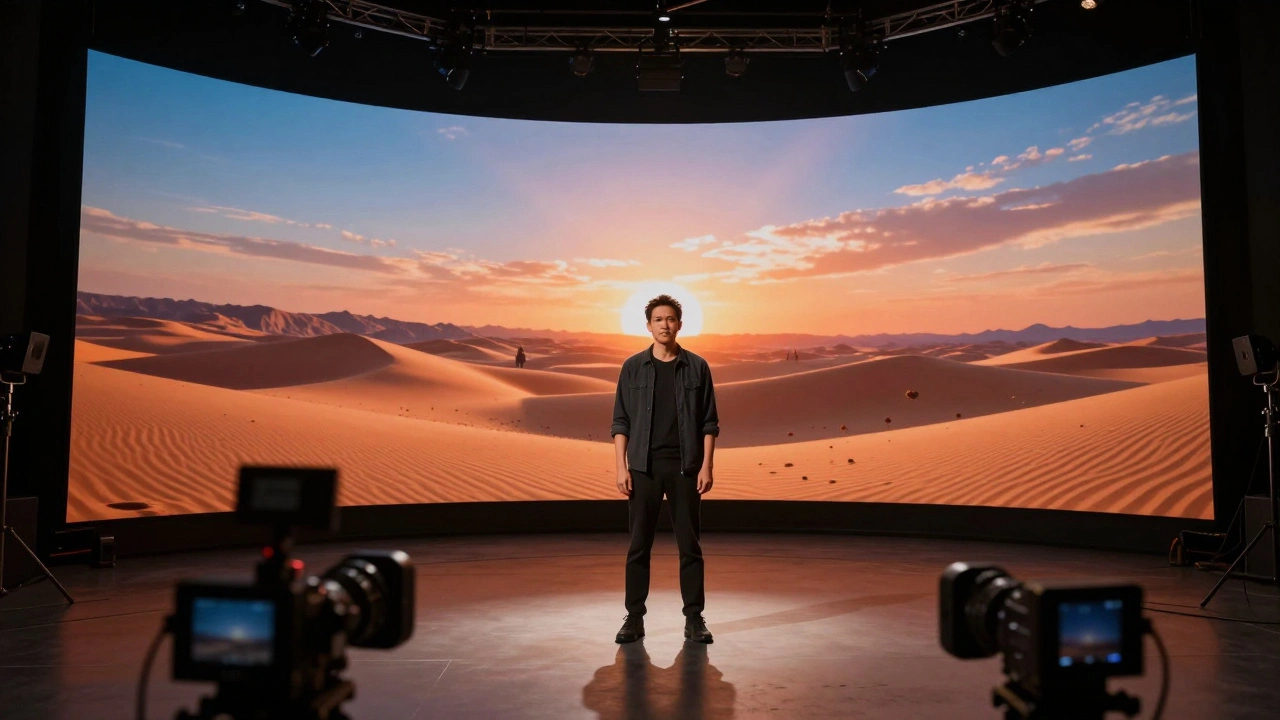
Imagine standing on a set where the background isn't just a green screen or a static painting, but a living, breathing digital world that reacts to your every move. For actors, this shifts the game entirely. You aren't guessing at the scale of a monster or the depth of a void; you are interacting with it in real time. This is the promise of real-time previs, defined as the use of immediate visual feedback and pre-visualization tools during filming to guide actor performance and camera placement. It bridges the gap between the director's vision and the actor's reality.
In traditional filmmaking, actors often perform against empty space or placeholders. With modern on-set performance aids, that disconnect vanishes. The technology allows performers to see their final environment-minus the post-production polish-as they act. This doesn't just help with eyelines; it fundamentally changes how emotional beats land when grounded in a visible context.
The Evolution from Green Screen to Virtual Production
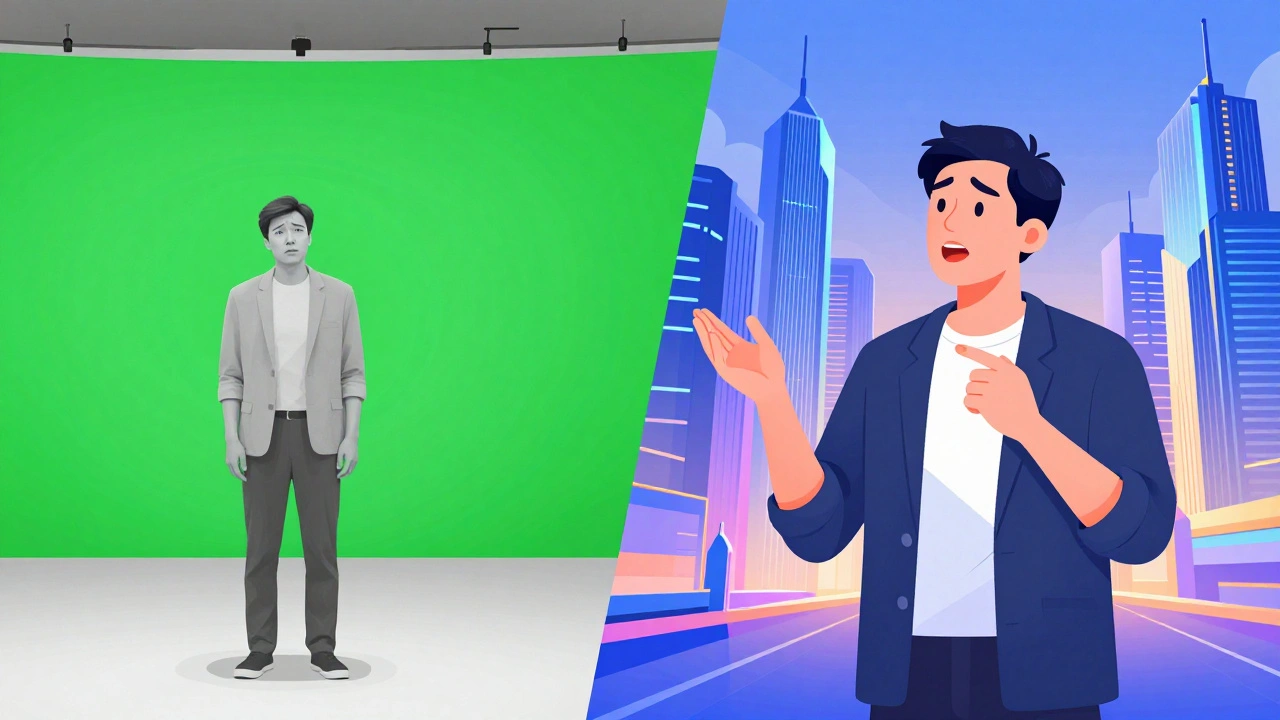
To understand why real-time previs matters, we have to look at what came before. For decades, the standard was chroma keying, commonly known as green screening. Actors would stand in front of a bright green wall, imagining a spaceship or a battlefield. Directors would give notes like "look up" or "react to something off-camera." It was an exercise in abstract trust.
Pre-visualization (previs) originally referred to creating rough animated versions of scenes before shooting began. This helped directors plan shots and editors cut sequences without wasting expensive film stock or crew hours. However, previs was historically a pre-production tool. It happened weeks or months before the cameras rolled. Actors rarely saw these animatics, let alone interacted with them.
The shift occurred with the advent of game engines like Unreal Engine. Suddenly, high-fidelity graphics could be rendered in milliseconds. This speed allowed previs to move from the editing room to the soundstage. Now, the same assets used for planning can drive massive LED walls, providing actors with immersive backgrounds that change dynamically based on camera movement.
How Real-Time Previs Works On Set
The core of real-time previs lies in tracking data. Cameras equipped with sensors send information about their position, angle, and lens focal length to a central computer running the rendering engine. As the camera moves, the digital background adjusts its perspective instantly, maintaining perfect parallax. This means if an actor walks past a window, the view outside shifts naturally, just as it would in real life.
For the actor, this integration creates several tangible benefits:
- Contextual Grounding: Instead of acting in a vacuum, performers react to lighting changes, weather effects, or architectural constraints displayed on the LED volume.
- Eye-Line Accuracy: When interacting with CGI characters or objects, seeing even a low-poly placeholder helps maintain consistent focus points.
- Emotional Authenticity: Fear, awe, or wonder are easier to portray when the stimulus is visually present, however stylized.
Directors benefit too. They can make creative decisions on the day of shooting. Want to change the time of day? Adjust the color temperature of the LED wall. Need a storm? Trigger the rain effect in the simulation. These choices affect the lighting on the actors' faces immediately, reducing the need for extensive VFX cleanup later.
Key Technologies Driving On-Set Visualization
Several technologies work together to make real-time previs possible. Understanding these components helps clarify why this approach is becoming the industry standard for major productions.
| Technology | Function | Impact on Actor Performance |
|---|---|---|
| LED Volume Walls | Large curved screens displaying real-time rendered environments | Provides immersive lighting and spatial awareness |
| Camera Tracking Systems | Sensors that monitor camera position and orientation | Ensures accurate perspective matching for realism |
| Game Engines (e.g., Unreal Engine) | Software that renders graphics in real time | Allows dynamic changes to environment and lighting |
| Motion Capture (MoCap) | Recording actor movements for digital characters | Enables interaction with CGI entities via avatars |
LED volumes, popularized by shows like The Mandalorian, represent the most visible aspect of this tech stack. But the magic happens behind the scenes with software pipelines that sync camera data with rendering outputs. Latency-the delay between camera movement and screen update-must be near zero. Even a slight lag can break immersion for both the actor and the crew.
Benefits for Actors: Beyond Technical Precision
While technical accuracy is crucial, the human element remains paramount. Real-time previs offers psychological advantages for performers. Acting requires vulnerability. Asking someone to pretend they are falling into a black hole while standing on a flat floor is challenging. Seeing a swirling vortex, even if simplified, triggers a more genuine physical response.
Consider a scene involving a chase through a futuristic city. In a traditional setup, the actor might run on a treadmill with wires attached, focusing on staying upright rather than conveying urgency. With real-time previs, they can run across a stage surrounded by towering skyscrapers that rush past them. The sense of speed becomes visceral. Their body language adapts naturally to the perceived danger.
This approach also aids collaboration. Actors can provide feedback on timing and pacing based on visual cues. If a door opens too slowly in the simulation, they can note it. This iterative process fosters a deeper connection between the performer and the material, leading to more nuanced performances.
Challenges and Limitations
Despite its advantages, real-time previs isn't without hurdles. Cost is the first barrier. Setting up an LED volume requires significant investment in hardware, software licenses, and specialized personnel. Not every production has the budget for such infrastructure.
Technical complexity poses another challenge. Rendering photorealistic environments in real time demands powerful computing resources. Artifacts, glitches, or incorrect reflections can distract actors and ruin takes. Additionally, the sheer brightness of LED walls can cause eye strain over long shooting days.
There’s also the issue of creative flexibility. Once an environment is locked into the render pipeline, making drastic changes mid-shoot can be difficult. While minor adjustments are easy, rebuilding entire sets digitally on the fly requires skilled artists working overtime.
Case Studies: Success Stories in Film and TV
Several high-profile projects have demonstrated the power of real-time previs. Dune utilized virtual production techniques to create vast desert landscapes that felt authentic despite being largely synthetic. Actors reported feeling immersed in the alien world, which translated to more convincing interactions with the environment.
In television, The Witcher employed LED volumes for battle sequences. Performers could see enemy forces approaching, allowing for reactive combat choreography. This level of detail enhanced the intensity of fights, making them feel less staged and more spontaneous.
Documentary filmmakers are also adopting these methods. Recreating historical events with digital crowds and settings provides viewers with unprecedented access to the past. Actors portraying historical figures benefit from seeing period-accurate surroundings, aiding their research and embodiment of roles.
The Future of On-Set Performance Aids
As technology advances, we can expect even greater integration between physical and digital realms. Haptic suits may soon allow actors to feel wind resistance or impact forces corresponding to on-screen actions. Augmented reality headsets could overlay additional elements not visible on LED walls, expanding the creative palette further.
Artificial intelligence will likely play a bigger role in generating content dynamically. Imagine AI-driven NPCs (non-player characters) responding intelligently to actor dialogue, creating unpredictable yet coherent interactions. This would blur the line between scripted performance and improvisation, opening new avenues for storytelling.
Moreover, accessibility will improve. Smaller studios may adopt scaled-down versions of virtual production setups, democratizing access to these tools. Independent filmmakers could leverage cloud-based rendering solutions to achieve cinematic quality without massive budgets.
Practical Tips for Implementing Real-Time Previs
If you're considering integrating real-time previs into your workflow, here are some actionable steps:
- Start Small: Begin with pilot episodes or short films to test the technology and train your team.
- Collaborate Early: Involve VFX supervisors and virtual production teams during pre-production to align expectations.
- Train Your Crew: Ensure everyone understands how the system works, from camera operators to lighting technicians.
- Prioritize Comfort: Monitor actor well-being regarding eye strain and fatigue caused by prolonged exposure to bright screens.
- Plan for Contingencies: Have backup plans in case of technical failures, such as reverting to traditional methods temporarily.
By addressing these considerations proactively, you can maximize the benefits of real-time previs while minimizing potential pitfalls.
What is real-time previs?
Real-time previs refers to using immediate visual feedback systems during filming to display digital environments and effects to actors and crew. Unlike traditional pre-visualization done before shooting, real-time previs integrates with live camera feeds and LED displays to provide dynamic, interactive backgrounds that enhance performance and decision-making on set.
How does real-time previs help actors?
It provides contextual grounding by showing actors their environment, including lighting, weather, and spatial relationships. This reduces the cognitive load of imagining invisible elements, allowing them to focus on delivering authentic emotional responses. Eye-lines become clearer, and reactions to CGI elements feel more natural because there's a visual reference point.
Is real-time previs only for big-budget movies?
Not necessarily. While large-scale productions like The Mandalorian showcase its full potential, smaller setups exist. Cloud-based rendering services and modular LED panels are making virtual production more accessible. Indie filmmakers can start with limited implementations, focusing on specific scenes that benefit most from environmental immersion.
What are the main challenges of using real-time previs?
Key challenges include high initial costs, technical complexity requiring specialized skills, and potential issues like latency or visual artifacts. Actor comfort must also be managed due to screen brightness. Additionally, rapid changes to digital sets can strain resources if not planned carefully. Proper training and contingency planning mitigate many of these risks.
Can real-time previs replace traditional green screen techniques?
In many cases, yes, especially for complex environments needing realistic lighting and interaction. However, green screen still has utility for simple composites or when budget constraints prevent investing in LED volumes. The choice depends on project needs, desired outcome fidelity, and available resources. Often, hybrid approaches combine both methods effectively.