
There is a specific texture to reality that digital pixels often struggle to replicate. When an actor reaches out and touches a wooden table, the grain under their fingertips changes their performance in ways a green screen cannot capture. Yet, when that same scene requires a skyscraper to collapse or a spaceship to fly through an asteroid field, Computer-Generated Imagery (CGI) is a digital technique used to create visuals that are not physically present on set. The debate between building things for real versus creating them digitally is no longer about which is "better." It is about which tool solves the specific problem of the shot most effectively.
Production designers today operate in a hybrid landscape. You do not choose one side and stick to it. You assess the budget, the schedule, the physics required, and the emotional weight of the moment. Understanding the distinct strengths of physical artifacts and digital constructs allows you to make decisions that serve the story rather than just the technology.
The Tangible Power of Physical Objects
Physical props provide immediate feedback. This is known as haptic interaction. When an actor holds a heavy sword, they feel its weight. When they grip a fragile glass cup, they move with caution. These micro-movements communicate authenticity to the audience without a single word of dialogue. Digital objects lack this resistance. An actor acting against a marker ball for a giant hammer will rarely match the timing and effort of someone actually swinging a weighted prop.
Lighting also behaves differently with real objects. Practical light sources, like a candle or a neon sign, cast dynamic shadows that change in real-time. This creates a naturalistic look that is expensive and complex to simulate accurately in post-production. If a scene relies heavily on intimate lighting, practical elements often save thousands of dollars in render time and artist hours.
- Tactile Feedback: Actors interact more naturally with physical items, leading to more believable performances.
- Real-Time Lighting: Practical lights create authentic shadows and reflections instantly on set.
- Durability Constraints: Physical sets can be damaged by weather, actors, or crew, requiring careful maintenance.
The Limitless Canvas of Digital Environments
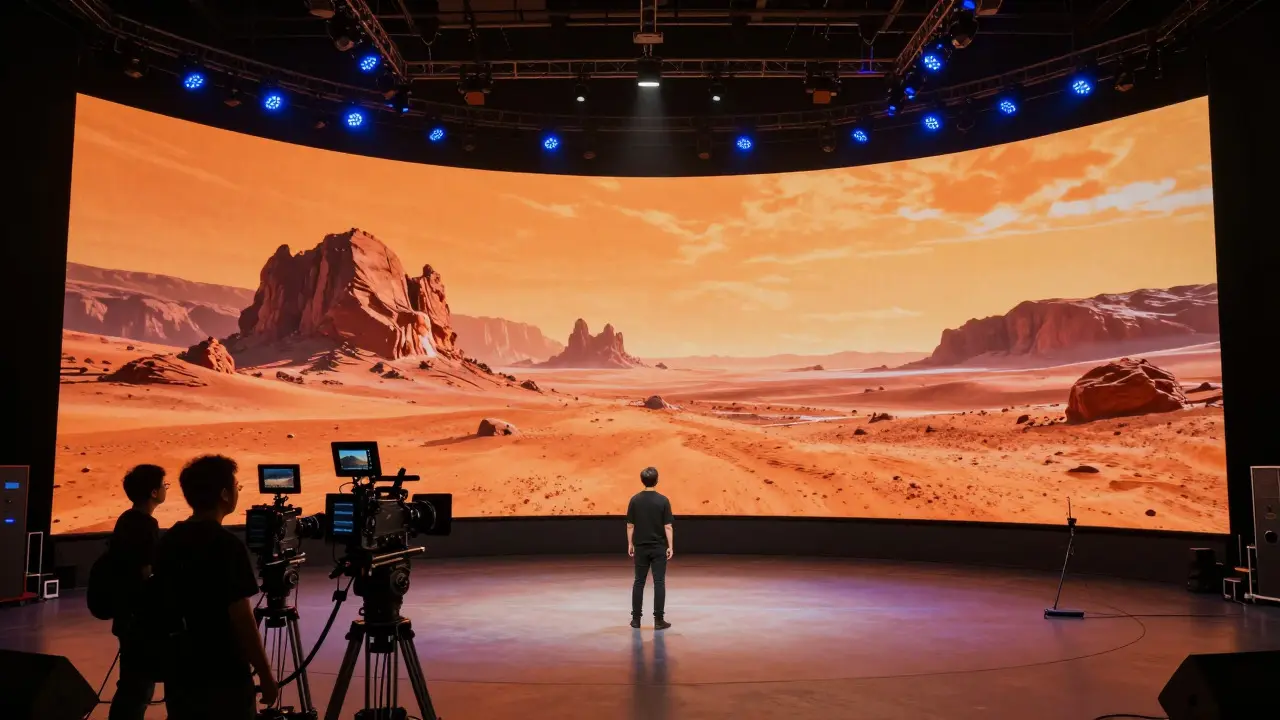
While physical sets have limits, VFX (Visual Effects) is the process of creating artificial imagery for film and television using digital tools. CGI allows you to place characters in locations that do not exist. You can shoot an actor in a soundstage in London while placing them on a Martian surface. This flexibility is crucial for genres like sci-fi, fantasy, or disaster films where building a full-scale volcano would be impossible.
Digital environments also offer perfect control. In a physical location, you cannot stop the wind from blowing a tree branch into frame. In a digital environment, you can freeze time, adjust the color of the sky, or remove background noise entirely. This level of control is invaluable for matching shots across different days of filming or ensuring continuity in long-term series productions.
| Feature | Practical Props/Sets | CGI Environments |
|---|---|---|
| Actor Interaction | High realism due to physical touch | Limited; relies on markers or imagination |
| Cost Structure | High upfront build cost, low post-cost | Low upfront cost, high post-production cost |
| Flexibility | Fixed once built; hard to modify | Highly adjustable in post-production |
| Lighting Consistency | Natural but unpredictable | Perfectly controlled and consistent |
| Scale | Limited by physical space and budget | Unlimited scale (cities, planets, oceans) |
Budget Dynamics and Timeline Pressures
Money talks in production design, but it whispers differently depending on your choice. Building a physical set is a linear expense. You pay for materials, labor, and construction before the camera rolls. Once built, the daily cost is relatively low, mostly covering maintenance and crew. However, if you need to change the set after principal photography begins, the cost becomes prohibitive. You essentially have to tear it down and rebuild it.
CGI works inversely. The on-set cost is minimal because you are often shooting against a green screen or a simple volume stage. The expenses accumulate during post-production. VFX artists spend hundreds of hours modeling, texturing, and rendering. If a director decides to change the background from a desert to a forest in week twelve of editing, the VFX team must redo significant work. This makes CGI risky for projects with tight post-production schedules.
A common heuristic for producers is the "80/20 rule" of hybrid design. Build 80% of the environment practically to give actors something to react to, and use CGI for the remaining 20% to extend the horizon or add magical elements. This approach balances performance quality with creative freedom.
Technical Integration and On-Set Workflows
The line between practical and digital has blurred with technologies like LED volumes. Instead of a green screen, actors perform in front of massive curved screens displaying real-time rendered backgrounds. This provides both the lighting benefits of practical sets and the visual flexibility of CGI. Companies like Unreal Engine is a real-time 3D creation tool widely used for game development and cinematic previsualization. have made these systems accessible to mid-budget productions.
However, integrating these systems requires specialized talent. You need motion capture technicians, virtual production supervisors, and VFX artists who understand camera tracking. If your crew lacks this expertise, the transition from practical to digital can result in mismatches. For example, if the perspective of the digital background does not align perfectly with the camera lens, the illusion breaks. This technical precision is why many smaller productions still prefer traditional methods.

Decision Framework for Designers
How do you decide what to build and what to render? Start with the script. Identify scenes where character interaction is paramount. If a character spends ten minutes in a kitchen, build the kitchen. The details matter. The chipped paint, the worn counter, the specific brand of coffee mug-these textures ground the story. If the character merely walks past a window looking at a city skyline, render the skyline. No one notices the individual windows if the focus is on the character's face.
- Analyze Actor Needs: Does the actor need to touch, smell, or hear the environment? If yes, go practical.
- Evaluate Scale: Is the environment larger than a soundstage? If yes, consider CGI extensions.
- Check Budget Phases: Do you have funds for post-production VFX? If not, prioritize practical builds.
- Consider Continuity: Will the scene be reshoots or edited from multiple angles? CGI offers easier fixes for continuity errors.
- Assess Weather/Location: Are you shooting outdoors where conditions are uncontrollable? Virtual production may offer more stability.
Remember that audiences are increasingly sophisticated. They can spot cheap CGI textures or unnatural lighting. Conversely, they appreciate the tactile richness of well-crafted physical sets. The goal is not to hide the method but to ensure the method serves the emotion. If the audience forgets whether the dragon was animatronic or digital, you have succeeded.
Frequently Asked Questions
Is CGI always more expensive than practical sets?
Not necessarily. Simple CGI backgrounds can be cheaper than building large physical sets. However, complex interactions, like water simulations or crowd dynamics, become exponentially more expensive in CGI. Practical sets have a fixed cost, while CGI costs scale with complexity and iteration count.
Do actors prefer working with practical props or green screens?
Most actors prefer practical elements because they provide reference points. Green screens require strong imaginative skills. That said, experienced actors can perform well in either condition. The key is giving them clear direction and context, regardless of the visual medium.
What is the biggest risk of relying too heavily on CGI?
The main risk is a disconnect in performance. Without physical constraints, actors may overplay or underplay movements. Additionally, there is a risk of "uncanny valley" effects if the digital assets are not high-quality enough, which can distract viewers from the narrative.
Can small independent films afford virtual production setups?
It is becoming possible. Modular LED wall systems are now available for rent at lower rates. However, the software licensing and technical staff costs remain high. For very low budgets, a hybrid approach with a small practical set and extensive CG extensions is usually more feasible.
How does lighting differ between practical and digital environments?
Practical lighting is physical and interactive. Light bounces off surfaces and casts shadows in real-time. Digital lighting is simulated. While modern engines like Unreal Engine handle this well, subtle imperfections in reflection or shadow softness can sometimes reveal the digital nature of the scene if not carefully tuned.





Comments(9)