Have you ever sat down to watch a "movie" on a streaming service, only to realize halfway through that it’s actually the first part of a two-part story? Or perhaps you finished a gripping drama, checked the credits, and saw "Part One" listed under the title. This isn’t a glitch in the matrix; it’s the new normal for streaming originals. We are living in an era where the line between a feature film and a limited series has blurred into something unrecognizable to traditional Hollywood executives. These hybrid projects-often called limited-series films or episodic movies-are reshaping how we consume narrative content.
In 2026, this trend is more pronounced than ever. Major platforms like Netflix, Amazon Prime Video, and Apple TV+ are investing billions into these high-budget, cinematic experiences that don't fit neatly into the 90-minute movie box or the standard 45-minute TV episode slot. But why are they doing it? And what does it mean for you as a viewer?
The Death of the Runtime Boundary
Traditionally, storytelling had strict time limits. A theatrical movie was roughly 90 to 120 minutes. A television hour was about 42 to 45 minutes of actual content, padded with commercials. These constraints dictated pacing, character development, and plot complexity. If you wanted to tell a sprawling epic, you made a trilogy. If you wanted deep character studies, you waited for Season Two.
Streaming platforms removed these artificial barriers by adopting a subscription model based on engagement rather than ad slots or ticket sales. The goal shifted from "filling a runtime" to "maximizing retention." If a story needs three hours to land its emotional punch, but feels too short for a five-episode season, the platform creates a two-part special. Each part runs 90 to 120 minutes. It looks like a movie. It acts like a mini-series.
This format allows writers to explore themes that would be rushed in a single film but dragged out over a full season. Think of it as the "Goldilocks" zone of storytelling: not too short, not too long, just right for a weekend binge. For viewers, this means denser narratives. You aren't getting filler episodes designed to pad a season order. Every minute serves the central plot.
Why Platforms Love the Hybrid Model
From a business perspective, limited-series films are a win-win for streaming giants. First, they solve the "prestige" problem. In the early days of streaming, platforms needed big names to attract subscribers. Getting A-list actors like Brad Pitt or Meryl Streep to commit to a six-month shoot for a weekly TV show was difficult. Asking them to do two 100-minute shoots back-to-back is much easier. It feels more like a movie role, which carries higher cultural cachet and often better pay.
Second, this format optimizes production costs. Producing a full season of high-end drama can cost upwards of $10 million per episode. By condensing the story into four or five "movie-length" episodes, studios control the budget while maintaining cinematic quality. The production value remains high-expensive locations, top-tier cinematography, complex VFX-but the total runtime is manageable.
Third, it aids in marketing. It is easier to sell a "movie event" than a "TV series." When Netflix announces a new project with a famous director and star, branding it as a film-like experience generates more buzz. People talk about movies differently than they talk about TV shows. They review them, debate their endings, and treat them as cultural events. Limited-series films borrow this prestige.
How to Spot a Limited-Series Film
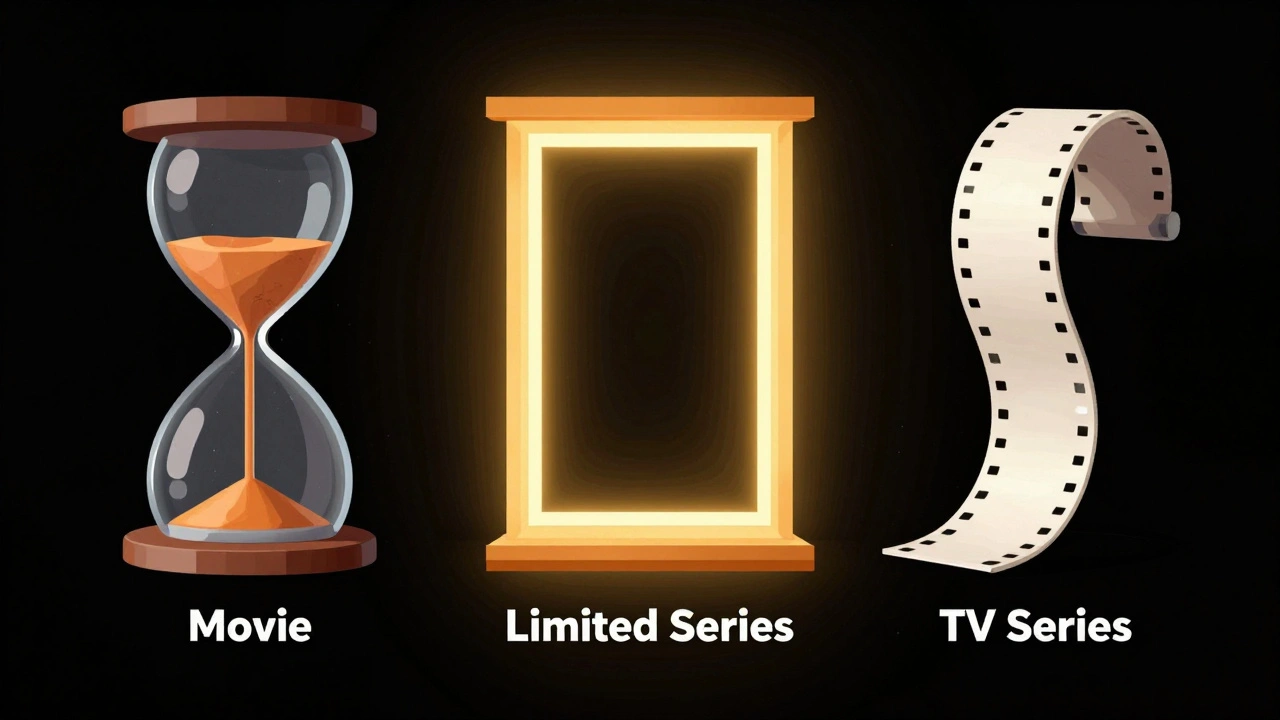
If you're trying to distinguish between a standalone movie, a traditional TV series, and this new hybrid, look for specific cues. Here is a quick checklist:
- Episode Count: Look for seasons labeled as "Limited Series" with only 4 to 8 episodes. If each episode is over 60 minutes, you're likely watching a hybrid.
- Runtime Consistency: Traditional TV episodes vary slightly in length. Movie-length episodes are often uniform, hovering around 80-100 minutes.
- Cinematography Style: Notice the aspect ratio. Many streaming hybrids use widescreen formats (like 2.39:1) typically reserved for theaters, rather than the standard 16:9 TV format.
- No Commercial Breaks: Since there are no ads, the pacing is continuous. Scenes flow into one another without the jarring cuts associated with network TV.
- Single Narrative Arc: Unlike ongoing series that introduce subplots for future seasons, limited-series films have a definitive beginning, middle, and end. There is no "to be continued" cliffhanger meant to drag on for years.
Case Studies in Storytelling Innovation
To understand the impact of this format, let's look at some real-world examples that defined the genre. These aren't just random picks; they represent different ways platforms have used this structure to tell unique stories.
The Queen's Gambit A seven-part limited series that felt like a biographical epic rather than a weekly soap opera. Released by Netflix, it ran for roughly 500 minutes total. That’s nearly nine hours of content. If this were a movie, it would need to be cut in half, losing crucial character development. If it were a standard TV show, it might have dragged with unnecessary subplots. Instead, it moved with the precision of a thriller and the depth of a novel. Ananya Taylor’s performance anchored the entire run, proving that a lead actor could carry a massive narrative load without fatigue.
Then there is Maid An eight-part limited series exploring domestic abuse and poverty, structured to mirror the protagonist's slow climb out of despair. Each episode focused on a specific hurdle-legal battles, housing insecurity, child custody. The movie-length format allowed each hurdle to feel like a distinct act in a play, giving viewers time to breathe and process the emotional weight before moving to the next challenge. This pacing is impossible in a fast-paced action movie but essential for realistic drama.
On the sci-fi front, Severance A psychological thriller that uses its limited format to build mystery without rushing explanations. demonstrates how suspense works better when you aren't forced to resolve every plot point in 90 minutes. The ambiguity lingers across episodes, creating a communal water-cooler effect that drives social media engagement-a key metric for platforms.
The Viewer Experience: Binge Culture Evolved
For us, the audience, this shift changes how we plan our entertainment. The concept of "binge-watching" has matured. It’s no longer just about consuming as much content as possible in a weekend. It’s about immersion. Limited-series films invite you to step into a world for a few days, live there, and then leave. It’s a vacation for your brain.
This format also reduces decision fatigue. With thousands of titles available, choosing what to watch is exhausting. Limited-series films offer a clear promise: "Start this, finish this, move on." There is no commitment to Season Three. No fear of missing out if you take a break. This clarity is refreshing in an age of endless scrolling.
However, there is a downside. The sheer volume of content means many good stories get buried. Algorithms prioritize completion rates, so shorter, punchier content often gets recommended over slower-burn limited series. You have to actively seek out these titles. Don't rely solely on the homepage suggestions. Search for "limited series" or check curated lists from critics who understand the nuance of this format.
Production Challenges and Creative Risks
While the format sounds ideal, it’s not without challenges. Directors and writers must balance the intimacy of television with the scale of cinema. Too much focus on dialogue can make it feel like a talky TV show. Too much spectacle can make it feel like a bloated blockbuster. Finding the right tone is a tightrope walk.
Additionally, the pressure to deliver a complete story in a short window can lead to rushed endings. Writers may feel compelled to tie up all loose knots by the final episode, sacrificing subtlety for closure. Some viewers find this satisfying; others miss the open-ended nature of traditional TV, which allows characters to evolve over years.
There is also the risk of homogenization. As more platforms adopt this model, we may see fewer experimental formats. If everything becomes a six-episode, 90-minute-per-episode drama, where do the weird, niche, or unconventional stories go? Independent creators may struggle to find funding for non-standard structures, leading to a landscape dominated by safe, formulaic hybrids.
Future Trends: What Comes Next?
Looking ahead to the rest of 2026 and beyond, we expect to see even more blurring of lines. Interactive storytelling, once a novelty, may integrate into limited-series films, allowing viewers to choose paths within the movie-length episodes. Virtual production techniques, popularized by *The Mandalorian*, will become standard, reducing costs and enabling more ambitious visuals for mid-budget projects.
We may also see the rise of "micro-limited" series-three-part sagas released monthly. This keeps the momentum of a weekly show while maintaining the cinematic quality of a film. Platforms are experimenting with release strategies, dropping all episodes at once versus weekly rollouts, to maximize subscriber retention. Your viewing habits will increasingly dictate how these stories are told.
Ultimately, limited-series films represent a democratization of storytelling. They allow creators to tell the stories they want, in the way they want, without being constrained by outdated industry norms. For viewers, it means richer, more immersive experiences that respect our time and intelligence. Embrace the hybrid. Watch the whole thing. And enjoy the ride.
What is the difference between a limited series and a miniseries?
Technically, there is no difference. Both terms refer to a television series with a predetermined number of episodes and a definitive ending. "Miniseries" is the older term, often used for adaptations of novels, while "limited series" is the modern industry term preferred by streaming platforms to emphasize the finite nature of the story. In practice, they mean the same thing: a self-contained narrative arc.
Are limited-series films considered movies or TV shows?
They are legally and industrially classified as television programs because they are distributed via streaming platforms or broadcast networks. However, they are produced with cinematic budgets, crews, and aesthetics. Awards bodies like the Emmys categorize them as Limited Series, separate from both Movies of the Year and Regular Dramatic Series. So, while they feel like movies, they are officially TV.
Why do streaming services prefer limited series over ongoing shows?
Limited series reduce long-term financial risk. Ongoing shows require multi-year commitments, casting contracts, and set maintenance. If a show loses popularity after Season 2, the platform is stuck paying for more. Limited series have a built-in end date, allowing platforms to allocate budgets efficiently. They also attract top talent who prefer finite commitments over decade-long roles.
Can limited-series films get renewed for a second season?
Yes, though it is less common. Some limited series, like *Fargo* or *True Detective*, are anthology series where each season tells a new story with different characters. Others, like *The Queen's Gambit*, conclude their narrative definitively. Occasionally, if a limited series is a huge hit, platforms may spin off prequels, sequels, or companion pieces, but the original story arc is usually closed.
How does the pacing of a limited-series film compare to a regular TV show?
Limited-series films typically have faster pacing and higher stakes per episode. Because the story must conclude within a set number of episodes, there is less room for filler or slow-burn subplots. Each episode advances the main plot significantly, similar to chapters in a novel. Regular TV shows often have more breathing room, allowing for character exploration and episodic stories that don't always drive the main narrative forward.