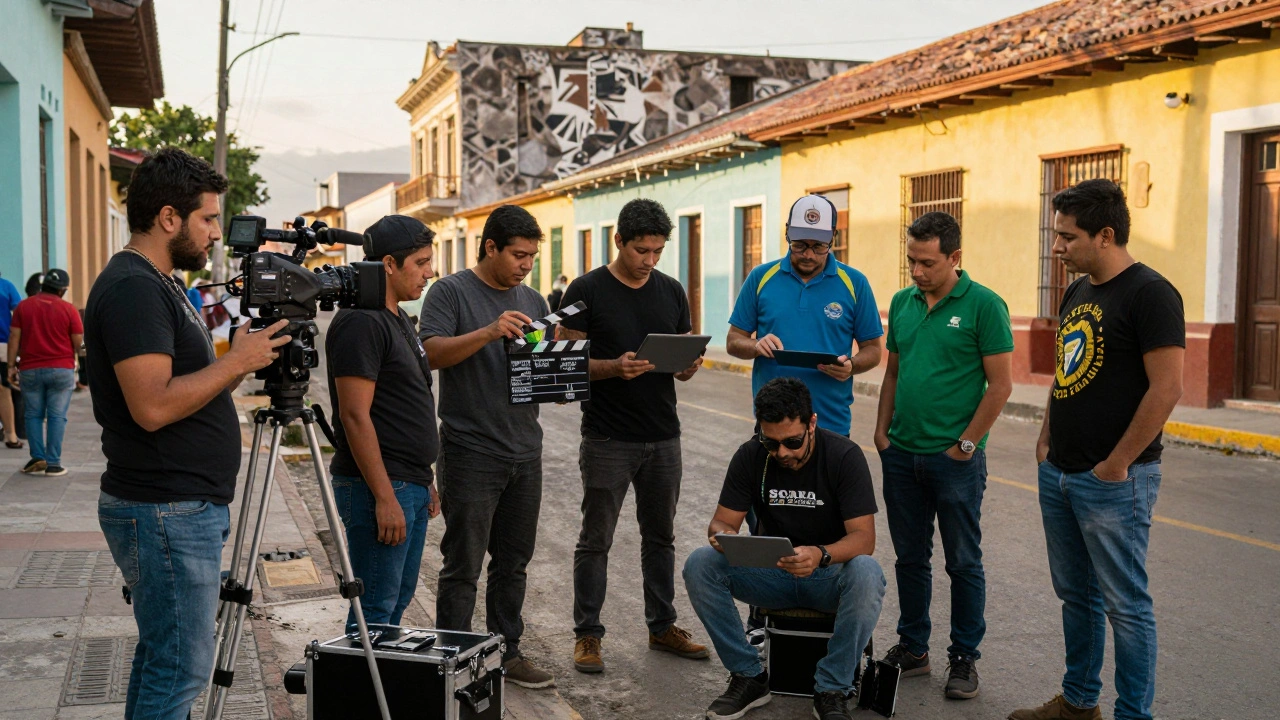
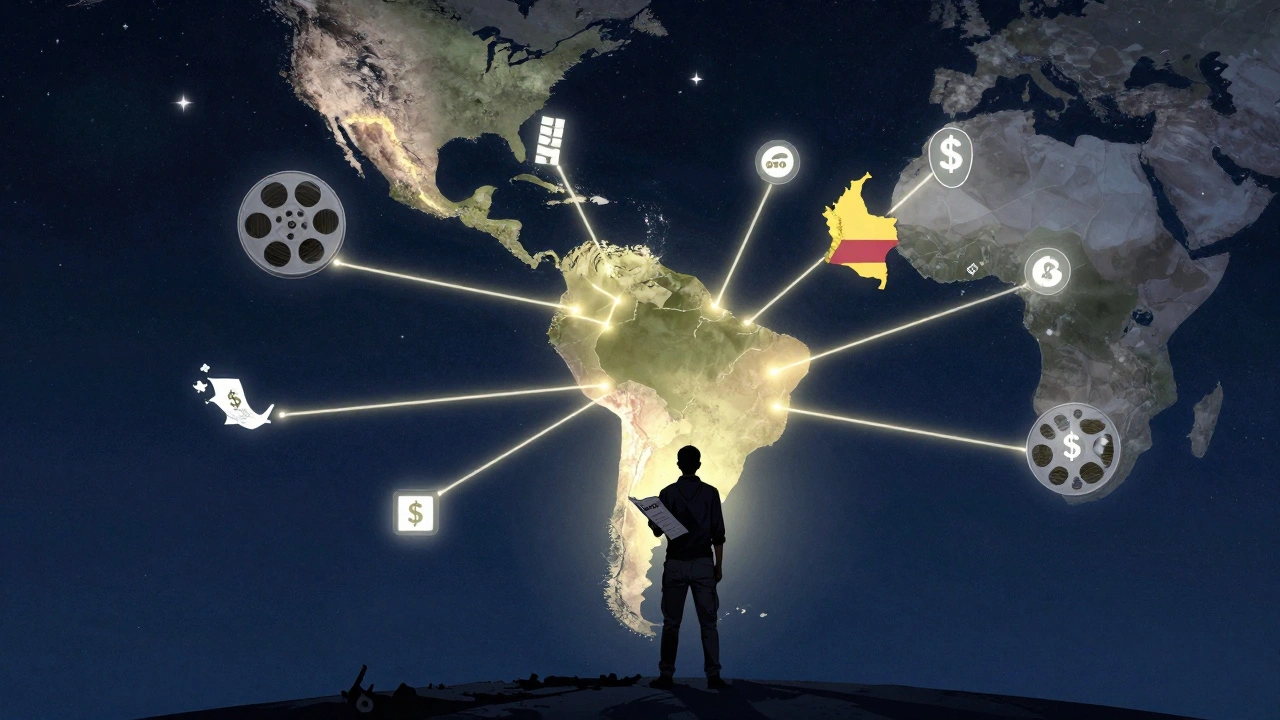
When a filmmaker in Mexico wants to make a movie with a Brazilian actor, a Colombian crew, and a French distributor, they don’t just need a script-they need a legal tool that makes the whole thing work. That tool is a co-production treaty. These aren’t just paperwork; they’re the hidden engines behind some of Latin America’s most successful films. From Parasite-style global hits to intimate indie dramas, co-production treaties unlock funding, tax breaks, and access to markets that would otherwise be out of reach.
What Exactly Is a Co-Production Treaty?
A co-production treaty is a formal agreement between two or more countries that lets filmmakers combine resources-money, talent, equipment, and locations-across borders while treating the final film as if it were made in each country. It’s not a handshake deal. These are legally binding documents signed by national governments, often through ministries of culture or film commissions.
For example, if Brazil and Argentina have a co-production treaty, a film shot 40% in São Paulo and 40% in Buenos Aires, with 20% of the crew from each country, can be officially recognized as both a Brazilian and Argentine film. That means it qualifies for public funding, tax credits, and broadcast quotas in both nations. Without the treaty, the film might only be eligible for support in one country-or none at all.
The first major co-production treaty in Latin America was signed between Brazil and Argentina in 1985. Since then, over 20 such agreements have been established across the region. Today, countries like Chile, Colombia, Mexico, and Uruguay all have active treaties with European nations, Canada, and even Australia.
Why Do These Treaties Exist?
Small film industries can’t compete with Hollywood on budget or marketing power. But by pooling resources, Latin American countries create films that look bigger than they are. A $2 million film funded by three countries can feel like a $6 million project. The treaties also help filmmakers meet local content quotas. In Brazil, TV networks must air a minimum percentage of domestic films. A co-produced film counts as domestic in multiple countries, making it easier to get on air.
These treaties also solve a real problem: distribution. A film made only in Peru might struggle to find a distributor outside its borders. But if it’s labeled as a co-production with Spain, it automatically gains access to European film markets, festivals, and broadcasters. That’s why films like The Tribe (Ukraine/Spain) and Miss Juneteenth (USA/Canada) found international audiences-they were built to cross borders from day one.
How Do You Qualify for a Co-Production?
It’s not enough to just have a foreign partner. Each treaty has strict rules. Here’s what most require:
- Minimum contribution percentage-Each country must contribute at least 15-30% of the total budget. Some treaties, like Mexico-Spain, require 25% from each.
- Key creative roles-At least one director, one screenwriter, and two key crew members (like cinematographer or production designer) must be from each participating country.
- Principal photography-Filming must occur in at least two treaty countries. Some allow studio work in one country if location shooting happens in another.
- Language and culture-The film must reflect the cultural identity of the participating nations. This doesn’t mean speaking multiple languages, but the story, themes, or setting should resonate with each country’s audience.
For example, the 2023 film La Vida Inesperada, a co-production between Colombia and France, met all criteria: 30% of the budget came from France, the lead actress was French, half the crew was Colombian, and the story centered on a Colombian immigrant in Paris. It qualified for tax rebates in both countries and was selected for Cannes.
Which Countries Have the Best Treaties?
Not all treaties are equal. Some are outdated. Others are too rigid. The most useful ones today are:
| Country | Key Treaty Partners | Max Budget Support | Creative Flexibility |
|---|---|---|---|
| Chile | France, Spain, Germany, Canada | $1.2M USD | High-allows digital effects, post-production abroad |
| Mexico | Spain, France, Brazil, Argentina | $1.5M USD | Medium-requires 50% filming in Mexico |
| Colombia | France, Spain, Canada, Italy | $800K USD | High-allows remote pre-production |
| Brazil | Argentina, Portugal, France, Canada | $2M USD | Low-strict crew quotas |
| Uruguay | Argentina, Brazil, Spain, France | $500K USD | High-low bureaucracy, fast approvals |
Chile and Uruguay are often the go-to choices for indie filmmakers because they approve applications in under 30 days. Brazil and Argentina offer more money but require more paperwork and longer wait times. Mexico’s treaty with Spain is especially powerful-Spanish public broadcasters like RTVE often co-fund films that meet the criteria, giving filmmakers guaranteed TV airtime.
Real-World Impact: What Films Have Been Made?
Co-production treaties didn’t just help films-they changed the industry. Here are three standout examples:
- The Year My Parents Went on Vacation (Brazil, 2006)-A co-production with France that won the Grand Prix at Cannes. It became Brazil’s official Oscar submission and was sold to over 30 countries.
- Embrace of the Serpent (Colombia, Venezuela, USA, France, 2015)-A visually stunning film shot in the Amazon. The French co-producer helped secure funding from Arte, and the film was nominated for an Oscar. Without the treaty, it wouldn’t have been made.
- Paradise (Mexico, Spain, 2024)-A thriller that used the Mexico-Spain treaty to access both countries’ tax credits. The film’s budget was $1.3 million, but after tax rebates, the producers kept $400,000 in net funding.
These films didn’t just make money-they proved that Latin American stories can travel. And they did it because they were designed from the start to cross borders.

What Are the Downsides?
It’s not all smooth sailing. Co-production treaties come with trade-offs:
- Slower process-Applications can take 3-6 months. Many indie filmmakers give up and self-fund instead.
- Loss of creative control-Some treaty partners demand script changes to fit their cultural expectations. A Chilean director once had to rewrite a scene to include a Spanish character just to satisfy the Spain-Chile treaty.
- Legal complexity-Each country has different tax laws, union rules, and copyright systems. One mistake can void the entire treaty status.
Many filmmakers now hire specialized co-production consultants-people who know the treaty rules inside out. These consultants charge $5,000-$15,000, but they cut approval time in half and avoid costly errors.
How to Get Started
If you’re planning a film that crosses Latin American borders, here’s how to begin:
- Identify your target countries-Pick partners with treaties you qualify for. Use the Coproduction Office database (no link) to check current treaties.
- Map your budget-Break down costs by country. Make sure each partner contributes at least 15%.
- Recruit key talent-Hire at least one director, writer, and two crew members from each country.
- Apply early-Start the application process 8-10 months before shooting. Some countries require pre-approval of the script.
- Work with a consultant-Even a $3,000 consultation can save you $50,000 in lost funding.
The biggest mistake? Waiting until filming starts to think about funding. By then, it’s too late. The treaty is your foundation-not an afterthought.
What’s Next for Latin American Film?
Streaming platforms like Netflix and Amazon are now partnering directly with co-production offices. In 2025, Netflix signed a deal with Chile’s film commission to fund 10 co-productions a year. This means more money, more distribution, and more global visibility for Latin American stories.
Meanwhile, new treaties are being negotiated-with Japan, South Korea, and even South Africa. The goal isn’t just to make films. It’s to build a network of creative partnerships that outlast any single movie.
For filmmakers, this isn’t about politics. It’s about access. Access to money. Access to audiences. Access to a world beyond your own borders. And in Latin America, the treaties are what make that possible.
Can a U.S. filmmaker use Latin American co-production treaties?
Yes-but only if the Latin American country has a treaty with the United States. As of 2026, only Mexico and Brazil have active co-production treaties with the U.S. Other countries like Chile and Colombia don’t have direct agreements with the U.S., so American filmmakers must partner through a third country like Canada or Spain that does have a treaty with them.
Do co-production treaties guarantee funding?
No. Treaties only give you access to funding opportunities-like government grants, tax credits, or public broadcaster investments. You still need to apply for them, pitch your project, and prove it meets the criteria. Many applications are rejected for weak scripts or mismatched budgets.
Can a film be part of more than two countries?
Yes. Some treaties allow multi-national co-productions. For example, the 2022 film La Llorona was officially recognized as a co-production between Guatemala, Mexico, Spain, and France. Each country contributed at least 15% of the budget and met creative quotas. Multi-country treaties are rare but possible if all parties agree.
What happens if a co-production breaks the rules?
If a film doesn’t meet the treaty requirements-say, if too much of the budget comes from one country or if key crew aren’t from the right nations-the government can revoke its co-production status. That means losing tax credits, public funding, and eligibility for national film awards. In extreme cases, producers may be required to repay all received funds.
Are co-production treaties only for feature films?
No. Many treaties now cover documentaries, short films, and even animated series. Chile’s treaty, for example, explicitly includes documentaries with a runtime of 40 minutes or more. Colombia also supports co-productions of web series. The rules vary by country, so check each treaty’s scope before applying.







Comments(10)