
When you walk into an IMAX theater and the screen fills your entire field of vision, the sound hits you like a wave, and every grain of dust on an actor’s face is visible-that’s not magic. It’s engineering. IMAX and large-format cinematography aren’t just bigger screens. They’re a completely different way of capturing and showing film, with technical demands that most digital cameras can’t meet. If you’re trying to shoot for IMAX, you need to know what hardware, lighting, and workflow choices actually matter-because guessing will ruin your footage before it even reaches the theater.
What Makes IMAX Different From Regular Film?
Most theaters show movies shot on 35mm film or digital sensors around 4K resolution. IMAX uses 70mm film, but not just any 70mm. It’s the 15-perf 70mm format, meaning each frame is 15 perforations tall instead of the standard 4. That gives you a frame size of about 70mm by 52.6mm-nearly 10 times the area of a standard 35mm frame. This isn’t just a bigger picture. It’s a massive increase in detail, dynamic range, and color depth. The resolution equivalent? Around 12K. That’s why you can zoom in on a character’s eye in an IMAX theater and still see individual lashes.
But here’s the catch: you can’t just shoot with a regular cinema camera and call it IMAX. The film stock, the camera, the projector, and even the theater’s screen are all part of a closed system designed to work together. If you shoot with a RED or ARRI camera and try to blow it up to IMAX specs, you’ll get a blurry, pixelated mess. IMAX doesn’t upscale well. It demands native capture.
The Cameras: Only a Few Can Do It
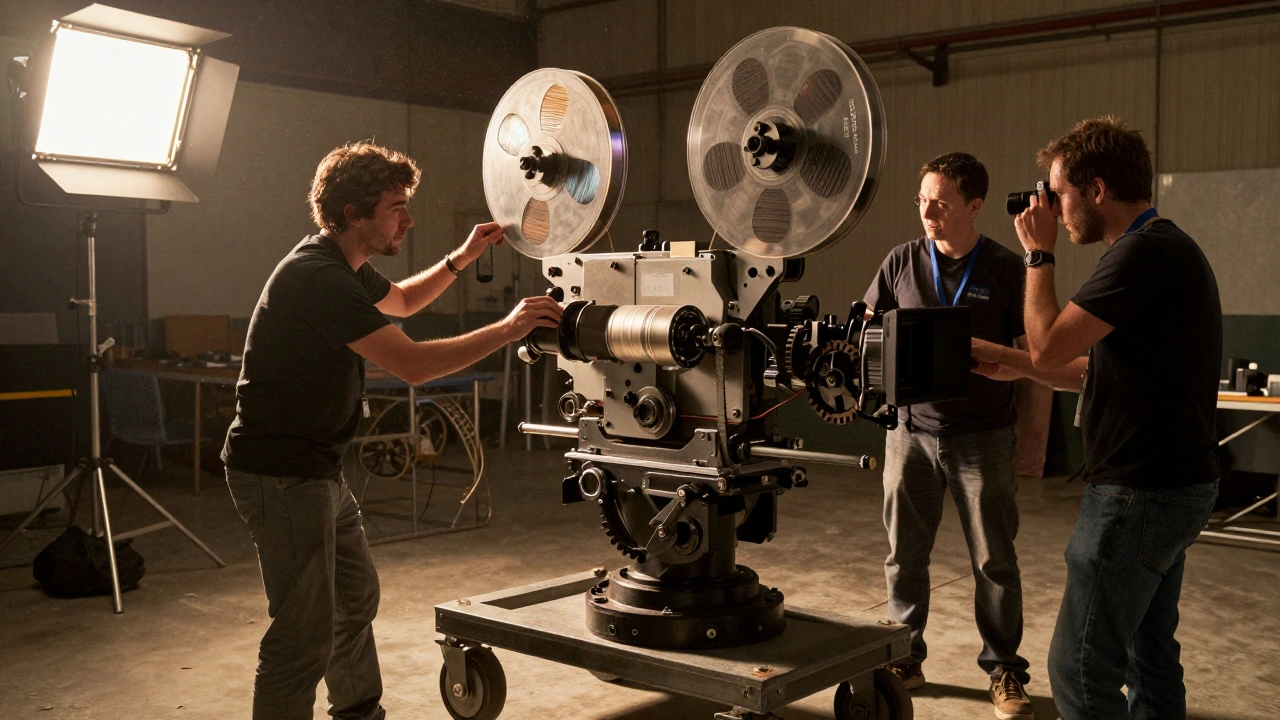
There are only two cameras that shoot native IMAX 15/70mm film: the IMAX MSM 9802 and the newer IMAX Digital 3D (used for hybrid shoots). The MSM 9802 is a mechanical beast-weighing over 70 pounds, running at 24fps, and requiring a team of three just to operate. It uses a belt-driven film transport system to reduce vibration, and its magazine holds only 3 minutes of footage. You can’t just hand it to a camera operator and expect them to track a moving subject. It needs a dolly, a crane, or a specially designed rig.
For digital shoots, IMAX partnered with Sony to create the IMAX Digital Camera (based on the Sony F55). But even this camera doesn’t shoot true IMAX resolution. It captures 4K and then uses proprietary upscaling to match IMAX’s aspect ratio and brightness targets. That’s why most modern IMAX films are hybrid: some scenes shot on 15/70mm film, others on digital, then stitched together in post. Directors like Christopher Nolan and Denis Villeneuve use this approach to get the best of both worlds-film’s organic texture and digital’s flexibility.
Lighting: You Can’t Just Turn Up the Brightness
Large-format film has a much lower sensitivity to light than digital sensors. The 15/70mm film stock-like Kodak Vision3 500T-has an ISO of 500, which sounds high, but because of the massive frame size and the need for extreme sharpness, you still need more light than you think. A scene that takes 1,200 watts on a digital shoot might need 3,000 watts for IMAX film. Why? Because the lens has to stop down to f/8 or f/11 to keep the entire frame in focus. Wider apertures blur the edges on large-format film due to the extreme resolution.
That means lighting setups are bigger, slower, and more complex. You can’t rely on natural light unless you’re shooting in broad daylight. Even then, you’ll need reflectors and diffusers the size of small cars. On Interstellar, the crew used 20-foot-wide diffusion frames to soften sunlight for the desert scenes. They couldn’t use LED panels because they don’t match the color temperature stability of tungsten or HMI lights over long exposures. Consistency is everything.
Aspect Ratio and Framing: The Screen Isn’t Just Bigger-It’s Different
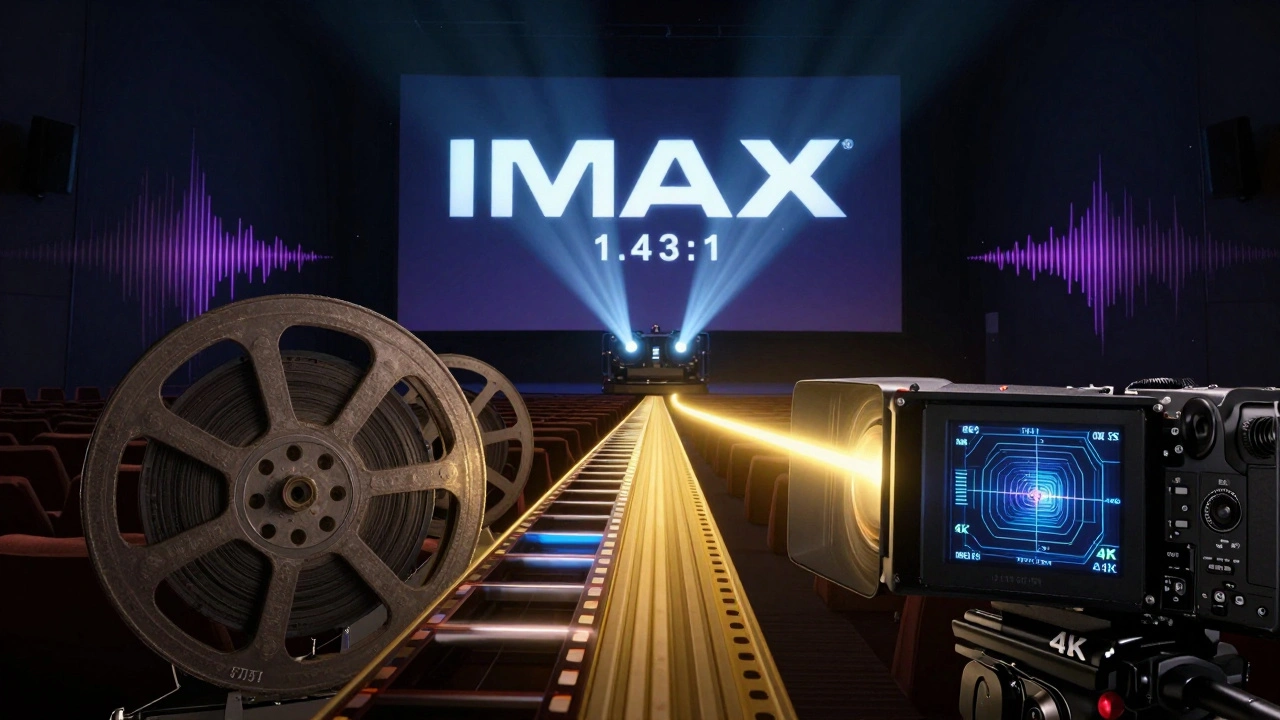
IMAX theaters use a 1.43:1 aspect ratio for native film. That’s taller than standard cinema (2.39:1) and even wider than traditional 70mm (2.2:1). If you shoot for IMAX, you can’t frame for a 16:9 or 2.39:1 screen. You have to compose for a vertical canvas. That means more sky, more floor, more headroom. Directors often shoot with IMAX framing in mind from the start. In Dune: Part Two, the sandworm scenes were framed so the creature’s full body filled the tall screen, making it feel massive and real.
But here’s the trick: most theaters don’t have IMAX 1.43:1 screens. Only about 100 theaters worldwide do. The rest use a 1.9:1 cropped version. So if you shoot in 1.43:1, you’re giving up 25% of your image in most theaters. That’s why many filmmakers shoot in 1.9:1 for digital IMAX and reserve 1.43:1 for key sequences. It’s a trade-off: maximum impact in a few elite theaters versus consistent quality everywhere else.
Projection: It’s Not Just a Bigger Projector
IMAX projection isn’t about throwing more light-it’s about precision. The 15/70mm film projector uses a dual-blade shutter to reduce flicker and a vacuum system to flatten the film against the gate, eliminating any movement. The lens is custom-ground to handle the massive image without distortion. And the sound? A 12-channel system with speakers behind the screen and in the ceiling. The sound doesn’t come from the sides-it comes from everywhere.
For digital IMAX, the projector is a dual 4K laser system. It’s brighter than any other commercial projector-14,000 lumens versus the standard 12,000. That brightness matters because IMAX screens are reflective, not emissive. They’re made of a special perforated fabric that allows sound to pass through, but it also absorbs light. So without that extra brightness, the image would look dim and washed out.
Post-Production: No Room for Compromise
When you shoot on 15/70mm film, you’re dealing with 1.5TB of data per minute. That’s not a typo. Scanning that film requires a 6K or 8K scanner, and the color grading has to be done with extreme care. The color science is different. IMAX film has a unique contrast curve that preserves shadow detail without crushing blacks. If you grade it like a digital film, you’ll lose the texture.
Even the final deliverable is different. IMAX requires a DCP (Digital Cinema Package) with specific bitrate, color space, and frame rate standards. For 15/70mm film, it’s 48fps at 1.43:1. For digital, it’s 48fps at 1.9:1. If your DCP doesn’t match, the theater won’t play it. There’s no fallback. The system is locked.
Why Do Filmmakers Still Use This? It’s Expensive and Hard
It costs $50,000 just to rent an IMAX camera for a week. Film stock runs $3,000 per 3-minute magazine. Processing and scanning adds another $20,000 per hour of footage. Most studios won’t go full IMAX unless they have a $100 million budget.
But the payoff is unmatched. When Oppenheimer opened in IMAX theaters, audiences reported feeling like they were inside the test site-seeing the heat waves, the dust, the shadows in the desert. That’s not just good cinematography. That’s the result of every technical choice working together: the right camera, the right film, the right lighting, the right projection. There’s no plugin, no filter, no AI upscaler that can replicate that.
Large-format cinematography isn’t about being flashy. It’s about immersion. It’s about making the audience forget they’re watching a movie. And to do that, you need to respect the system. You can’t cut corners. You can’t fake it. You have to build it right.
Can you shoot IMAX with a regular digital camera?
No. Regular digital cameras like the ARRI Alexa or RED Komodo capture 4K or 6K footage, which is too low-res for native IMAX 15/70mm film. Some digital cameras can shoot for IMAX’s digital 1.9:1 format, but they still need to meet IMAX’s brightness, color, and bitrate standards. You can’t just shoot on a Sony FX6 and call it IMAX.
Is IMAX better than 4K or 8K digital?
For native 15/70mm film, yes. The 12K equivalent resolution, combined with the film’s dynamic range and grain structure, creates an image that digital sensors still can’t fully match. But for digital IMAX (1.9:1), the difference between 8K and IMAX is minimal. The real advantage of IMAX is the projection system-brighter, sharper, with better sound. It’s the whole package.
How much does it cost to shoot on IMAX film?
Renting an IMAX camera costs $40,000-$50,000 per week. Each 3-minute magazine of 15/70mm film costs $3,000. Processing and scanning can run $20,000 per hour of footage. For a 90-minute film with 20 minutes of native IMAX footage, expect to spend $1.2 million just on film capture and processing-before editing or VFX.
Do all IMAX theaters show the same image?
No. Only about 100 theaters worldwide have the 1.43:1 screen and 15/70mm projector. The rest use a 1.9:1 cropped version, often with digital projection. Even then, the brightness and sound quality vary by location. IMAX-certified theaters meet strict standards, but not all are created equal.
Why don’t more filmmakers use IMAX?
It’s expensive, slow, and logistically difficult. The cameras are heavy, the film is limited, and the workflow is rigid. Most productions use digital for flexibility and cost. Only directors who prioritize immersive visuals-like Nolan, Villeneuve, or Chazelle-go full IMAX. It’s a creative choice, not a technical necessity.
What’s Next for IMAX?
IMAX is slowly moving toward laser projection and hybrid digital-film workflows. Newer cameras like the RED V-RAPTOR 8K VV can be calibrated to meet IMAX’s digital standards, and some studios are experimenting with AI-assisted upscaling for non-native footage. But the core truth remains: if you want the full IMAX experience, you need to shoot with the system, not around it. The future isn’t about replacing film-it’s about making the technology more accessible without losing the quality.
For now, if you’re serious about large-format cinematography, you still need to understand the rules. The screen is bigger. The frame is taller. The light is harsher. The film is fragile. And the audience? They’ll notice every mistake-or every triumph.




Comments(10)