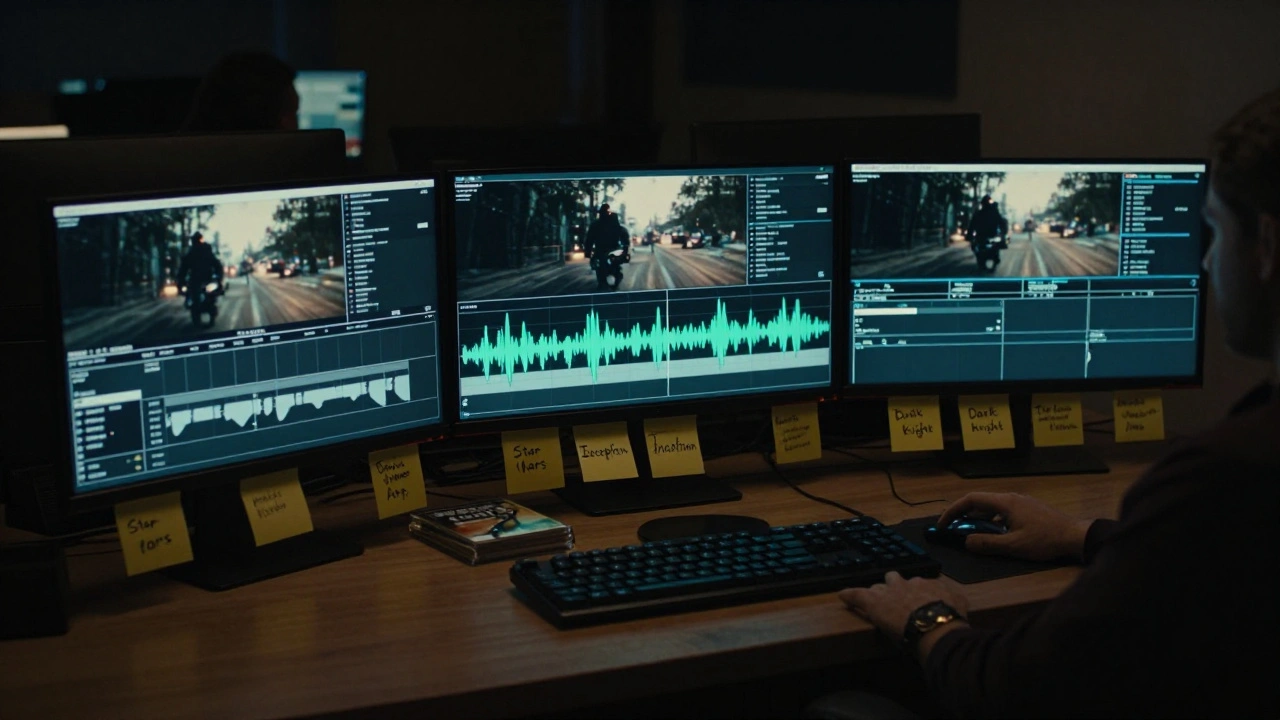
Ever wonder why a movie’s final score sounds so much like the placeholder music used during editing? It’s not a coincidence. Temp tracks-temporary music added by editors to guide emotion and pacing-don’t just help shape the edit. They often end up shaping the final score itself.
What Exactly Is a Temp Track?
A temp track is any piece of pre-existing music used during the editing process to give a sense of tone, rhythm, or emotional weight. It could be a cue from John Williams’s Star Wars over a hero’s entrance, a Hans Zimmer pulse from Inception during a chase scene, or even a pop song from the 80s to underline nostalgia. Editors slap these in because they need something to react to-something to make the scene feel alive before the composer even gets involved.
It’s not just convenience. Temp tracks help directors and producers communicate what they want. Saying "I want it to feel like this" while playing a clip from The Dark Knight is way clearer than saying "make it intense but not cheesy."
Why Composers Get Stuck in the Temp Track Trap
Here’s the problem: once a temp track is locked into a scene, it becomes the emotional blueprint. Audiences-directors, producers, studio executives-start to associate that specific sound with that moment. When the composer delivers something original, even if it’s better, it often feels wrong.
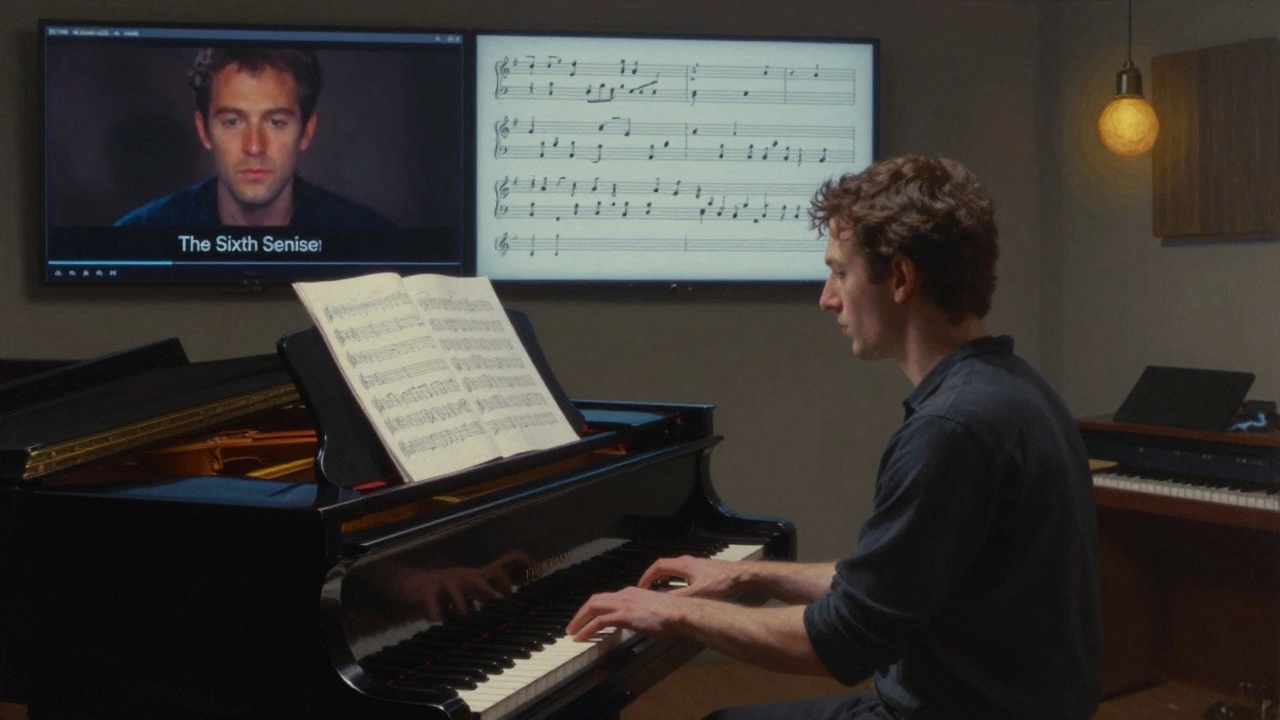
There’s a well-known story about James Newton Howard working on The Sixth Sense. He wrote a delicate, minimalist score. The director loved it-but the studio executives kept asking, "Where’s the temp track?" They missed the eerie, swelling strings from the temp cue they’d been watching for months. The final score ended up borrowing the temp’s pacing, dynamics, and even orchestration, just with new notes.
It’s not about copying. It’s about expectation. The temp track trains the brain. When the music shifts, even slightly, it breaks the emotional flow. That’s why many composers don’t fight it-they adapt.
The Domino Effect on Orchestration and Structure
Temp tracks don’t just influence mood-they dictate structure. If the temp uses a 16-bar loop with a crescendo every 32 seconds, the composer often feels pressured to match that rhythm. Why? Because the edit is locked to that timing. If the new music doesn’t hit the same beats, the scene feels off-even if the new music is more artistic.
Take Blade Runner 2049. The temp track used a lot of ambient drones and sparse piano motifs from Vangelis’s original. When Hans Zimmer and Benjamin Wallfisch composed the final score, they didn’t copy Vangelis. But they mirrored the pacing, the silence between notes, the way tension built in slow, deliberate waves. The result? A score that felt fresh but still belonged to the same sonic universe.
Temp tracks also influence instrumentation. If the temp uses cellos for sadness, producers start assuming cellos = emotional weight. That means even if a composer wants to use a theremin or a prepared piano, they might be told, "It doesn’t feel sad enough."
When Temp Tracks Kill Creativity
Not all temp tracks are helpful. Some are lazy. Some are overused. A director might use Two Steps From Hell for every action scene because it’s loud and dramatic. But that kind of temp doesn’t serve the story-it just screams "epic."
Composers like Max Richter have openly said they refuse to watch temp tracks for certain projects. He worked on Arrival without hearing the temp, relying only on the script and the director’s vision. The result? A score that felt alien, haunting, and completely original-because it wasn’t filtered through someone else’s musical taste.
But that’s rare. Most studios won’t let a composer work blind. The temp track is part of the pitch. It’s how they sell the movie to investors. So composers often have to work within its constraints.
How Top Composers Break Free
The best composers don’t ignore temp tracks-they reframe them. They treat them as a mood board, not a blueprint.
Michael Giacchino talks about using temp tracks as a "starting point for rebellion." On Up, the temp used a romantic orchestral cue. Giacchino knew that wouldn’t work for a film about an old man floating away in a house. He replaced it with a simple, bittersweet piano theme that became iconic. But he kept the emotional arc-the temp’s journey from hope to loss-just with new tools.
Randy Newman does something similar. He’ll take a temp track’s structure and strip it down to its emotional core. If the temp uses a full orchestra to convey loneliness, he might use a solo accordion. Same feeling. Different voice.
The trick? Understand what the temp track is doing emotionally-and then find a new way to do it.
The Industry’s Growing Awareness
More studios are starting to realize the problem. Some now use "temp-free" editing sessions early in post-production. Others bring composers in during pre-production, so they’re part of the story-building process, not just the cleanup crew.
Netflix and Amazon have experimented with giving composers early access to rough cuts-sometimes even before the temp track is added. That’s how Trent Reznor and Atticus Ross created the unsettling, synthetic score for Mindhunter. They didn’t hear any temp. They built the sound from scratch, based on the show’s tone.
But change is slow. Temp tracks are still the default. They’re fast. They’re familiar. They’re safe.
What Filmmakers Should Do Instead
If you’re a director or editor, here’s a better approach:
- Use temp tracks to guide pacing, not emotion.
- Avoid using music from iconic films-it sets impossible expectations.
- When you bring in the composer, say: "This is the temp. Don’t copy it. But here’s what it made you feel. Can you make us feel that in a new way?"
- Give the composer space to experiment. Let them try wild ideas before locking anything.
Temp tracks aren’t evil. They’re tools. But like any tool, they’re only useful if you know how to use them-and when to put them down.
Final Thought: The Score Should Feel Inevitable, Not Familiar
The best film scores don’t remind you of something you’ve heard before. They make you feel like you’ve always known this music. That’s the goal. Not to replicate a temp track, but to create something that feels just as necessary.
When the temp track fades out and the original score takes over, it shouldn’t feel like a replacement. It should feel like the truth the temp was only hinting at.
Can a film score be successful without using any temp tracks?
Yes. Films like Arrival, Mindhunter, and The Lighthouse have highly acclaimed scores that were composed without any temp track influence. These scores succeeded because the filmmakers trusted the composer’s vision and gave them space to explore. The key isn’t avoiding temp tracks-it’s avoiding letting them dictate the emotional language of the film.
Why do studios insist on using temp tracks if they limit creativity?
Temp tracks are a communication tool. Most producers and studio executives aren’t musicians. They can’t describe what they want in musical terms. A temp track gives them something concrete to react to. It’s easier to say "make it like this" than to explain tempo, key, orchestration, and emotional arc. The problem arises when they mistake the temp for the final product instead of a rough draft.
Do temp tracks affect the budget of a film’s score?
Indirectly, yes. If a temp track is too specific-say, a complex orchestral cue from a blockbuster-the studio may expect the final score to match that level of detail. That means hiring a larger orchestra, more recording sessions, and more time in the studio. Composers often end up spending extra hours recreating the feel of the temp, which drives up costs. In some cases, studios have rejected scores simply because they didn’t sound "big enough" compared to the temp.
Can a temp track become the final score?
Yes, and it’s happened more than you think. The iconic theme from The Lion King was originally a temp track composed by Hans Zimmer himself during early editing. The studio loved it so much they asked him to turn it into the final cue. Similarly, the main theme from Mission: Impossible (1996) was a temp cue from a previous film that was kept because it fit perfectly. Sometimes, the temp isn’t just a guide-it’s the answer.
What should a composer do if the director insists on keeping the temp track?
Don’t fight it head-on. Instead, ask: "What part of this temp makes it work?" Is it the rhythm? The instrumentation? The silence between notes? Then build a new piece that matches that emotional DNA but uses original material. Most directors don’t want the exact music-they want the feeling. A skilled composer can deliver that feeling without copying.
Temp tracks are the invisible hand behind most film scores. They’re not the enemy. But they shouldn’t be the boss. The best music doesn’t echo what came before-it reveals what was always meant to be heard.




Comments(8)