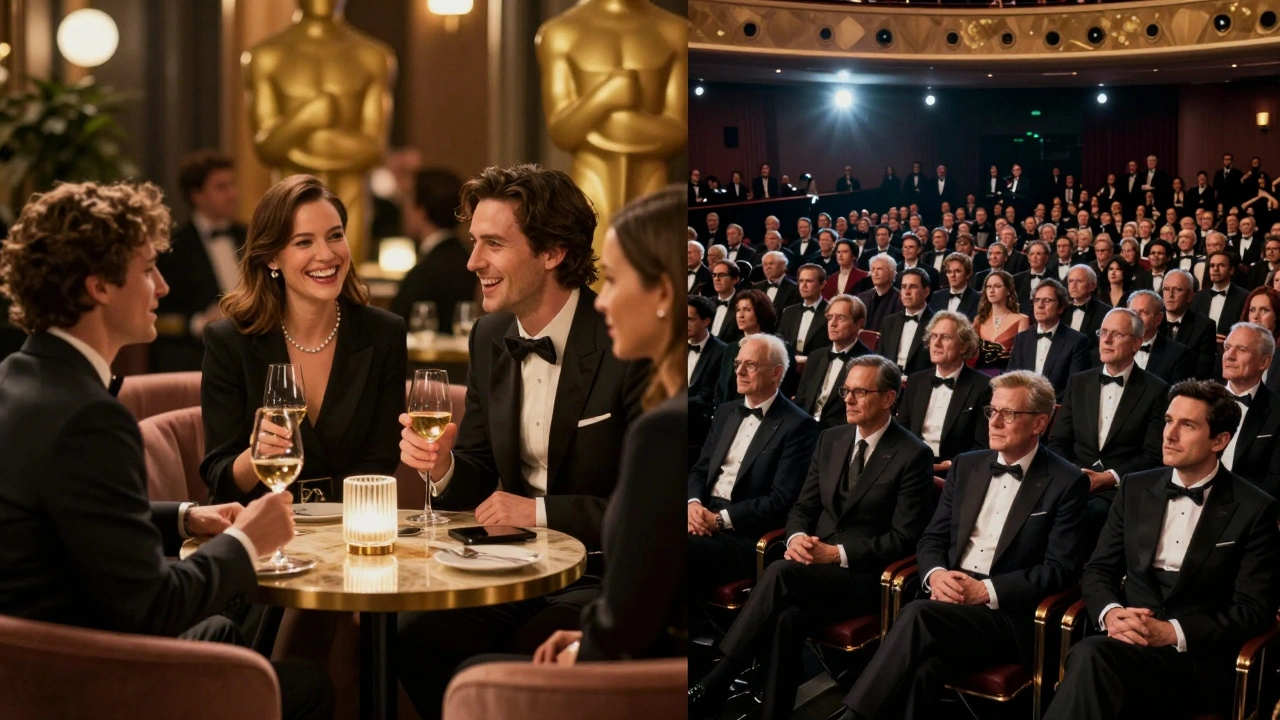
It’s awards season, and the headlines are everywhere. You see the red carpets, the tearful speeches, and the endless debates about who deserved what. But if you look closely, you’ll notice something odd: the Golden Globe Awards is an annual award ceremony honoring achievements in filmmaking and television since 1944 often hands its top prizes to completely different movies than the Academy Awards is the most prestigious award ceremony in the motion picture industry, administered by the Academy of Motion Picture Arts and Sciences. Why does a movie win big in January but get ignored in March? It’s not random. It comes down to who votes, what they value, and how the rules work.
Understanding these differences isn’t just for trivia buffs. If you’re trying to predict winners, understand industry trends, or just make sense of the noise, knowing the mechanics behind these two giants changes everything. Let’s break down why these ceremonies diverge so sharply.
The Voters: Critics vs. Peers
The biggest difference lies in who holds the power. The Golden Globes are voted on by the Hollywood Foreign Press Association (HFPA), which consists of approximately 90-100 international journalists based in Los Angeles who cover Hollywood for publications outside the United States. These are critics. They watch films as part of their job, write about them, and form opinions quickly. Their tastes tend to lean toward entertainment, star power, and broad appeal. Because the group is small, individual preferences can sway results more easily.
In contrast, the Academy of Motion Picture Arts and Sciences is a professional honorary organization with 10,000+ voting members representing all disciplines of filmmaking, including actors, directors, writers, editors, and technicians. These are peers-people who actually do the work. A sound mixer votes alongside an actor; a visual effects supervisor sits next to a director. This massive, diverse body tends to reward craft, technical excellence, and artistic merit over pure box-office charm. When the Academy speaks, it’s usually speaking from inside the machine.
| Feature | Golden Globes (HFPA) | Academy Awards (AMPAS) |
|---|---|---|
| Voter Composition | International entertainment journalists | Film industry professionals (peers) |
| Number of Voters | ~90-100 active members | 10,000+ voting members |
| Primary Focus | Entertainment value, star performance, broad appeal | Artistic merit, technical craft, peer recognition |
| Voting Structure | Plurality voting (simple majority wins) | Preferential ballot for Best Picture; plurality for others |
| Genre Categories | Splits into Drama and Musical/Comedy | No genre splits; single category for acting/films |
The Genre Split: Drama vs. Comedy
This is where things get really interesting. The Golden Globes separate acting categories and Best Picture into Drama and Musical or Comedy. The Oscars do not. This simple rule creates a massive strategic advantage for certain types of films at the Globes.
Consider a witty, well-acted comedy that might lose to a heavy historical epic in a general Best Actor race. At the Oscars, it’s fighting against everyone. At the Globes, it only competes against other comedies. This split allows lighter, funnier, or more commercially viable films to shine without being overshadowed by solemn dramas. It’s why you often see a beloved comedy sweep the Globes only to fade away before Oscar night. The HFPA loves a good laugh; the Academy prefers gravity.
This also means that "Best Actor" at the Globes is essentially two different awards. One goes to the serious dramatic turn, the other to the charismatic comedic performance. For actors, this doubles the chances of recognition early in the season. For studios, it provides a crucial boost for mid-budget comedies that wouldn’t otherwise be considered Oscar contenders.

Timing and Momentum
The calendar matters more than you think. The Golden Globes typically take place in early January, right after the holiday release window. This timing makes them the first major awards ceremony of the year. They set the tone. A win here generates immediate press coverage, social media buzz, and renewed interest in a film that might have been slipping out of public consciousness.
The Oscars arrive in late February or early March, serving as the final verdict. By then, campaigns have spent millions, audiences have seen the films, and critical consensus has solidified. The Globes are about momentum; the Oscars are about legacy. A Globes win can launch a campaign, but it doesn’t guarantee an Oscar. In fact, history shows us that Globes favorites often stumble in the final weeks, while dark horses emerge from nowhere to claim the top prize.
Think of it like a marathon. The Globes are the first checkpoint-you need to pass it to stay in contention. The Oscars are the finish line. Many runners start strong but fade out. Others conserve energy and surge at the end.
Television Crossover
Here’s another key distinction: the Golden Globes honor both film and television. The Oscars focus exclusively on cinema. This crossover effect influences how voters perceive prestige. A TV star winning a Golden Globe carries weight because the award acknowledges their work across mediums. An actor might transition from a hit series to a film role, using the Globes to signal their readiness for cinematic recognition.
For example, when a popular streaming series dominates the Globes, it brings attention to the platform’s original content strategy. The Oscars don’t offer this bridge. They remain firmly rooted in theatrical exhibition and traditional filmmaking values. This separation keeps the Oscars feeling more exclusive, while the Globes feel more inclusive of modern entertainment habits.

What Each Award Signals
If you’re watching to predict outcomes, pay attention to what each award represents. A Golden Globe win suggests cultural relevance, audience enjoyment, and critical favor among international press. It signals that a film resonates emotionally and entertains broadly. Think of it as the people’s choice filtered through expert eyes.
An Oscar win indicates industry validation, technical mastery, and artistic innovation. It signals that a film pushed boundaries, executed complex crafts flawlessly, and earned respect from those who build movies every day. It’s less about popularity and more about craftsmanship. That’s why documentaries, foreign language films, and experimental narratives often fare better at the Oscars-they appeal to specialists, not just mass audiences.
When a film wins both, it’s rare and significant. It means the movie achieved both emotional impact and technical brilliance. Films like *Parasite* or *Everything Everywhere All at Once* did exactly that, bridging the gap between crowd-pleaser and critic darling.
How Campaigns Exploit the Differences
Studios know these distinctions well. They tailor their marketing strategies accordingly. For the Golden Globes, campaigns emphasize star interviews, fun moments, and accessible screenings. They target journalists directly, hosting lavish events and sending personalized gifts. The goal is visibility and goodwill.
For the Oscars, campaigns shift gears. They host private screenings for guild members, distribute screener copies widely, and hire lobbyists to remind voters of specific achievements-editing, sound design, costume work. They play the long game, building case studies around artistic intent and technical execution. It’s less about charm and more about persuasion.
This dual approach explains why some films seem to disappear after the Globes. Their campaign was built for early hype, not sustained endurance. Others appear out of nowhere in February because they waited patiently, letting word-of-mouth and peer recommendations do the heavy lifting.
Why do Golden Globes winners often differ from Oscar winners?
The main reason is the voter base. The Golden Globes are decided by a small group of international journalists who prioritize entertainment value and star performances. The Oscars are voted on by thousands of industry peers who value technical skill, artistic depth, and peer recognition. Additionally, the Globes split categories by genre, allowing comedies to win separately, while the Oscars combine all genres, favoring dramatic works.
Do Golden Globe wins predict Oscar success?
Not always. While a Globe win can generate momentum and keep a film in the conversation, it’s not a reliable predictor. Many films dominate the Globes but fail to gain traction with Academy voters. Conversely, several Oscar winners received no Globes nominations. The Globes reflect early-season enthusiasm; the Oscars reflect final industry consensus.
Who votes for the Golden Globes?
The Golden Globes are voted on by members of the Hollywood Foreign Press Association (HFPA), a group of roughly 90-100 international journalists based in Los Angeles who report on Hollywood for outlets outside the U.S. Unlike the Oscars, which involve tens of thousands of industry professionals, the Globes rely on a much smaller, journalist-focused electorate.
Why do the Golden Globes have separate categories for Drama and Comedy?
The HFPA created this split to ensure that lighter, comedic films aren’t overshadowed by heavier dramas in acting and Best Picture races. This structure gives comedies a fair chance to win major awards, reflecting the Globes’ emphasis on entertainment value and broad audience appeal. The Oscars do not use this system, combining all genres into single categories.
Can a film win both the Golden Globe and the Oscar for Best Picture?
Yes, though it’s relatively uncommon. Films like *Parasite*, *Everything Everywhere All at Once*, and *Green Book* have won both. Achieving this requires balancing mass appeal with critical acclaim, satisfying both international journalists and industry peers simultaneously. Most films excel in one area but not both.