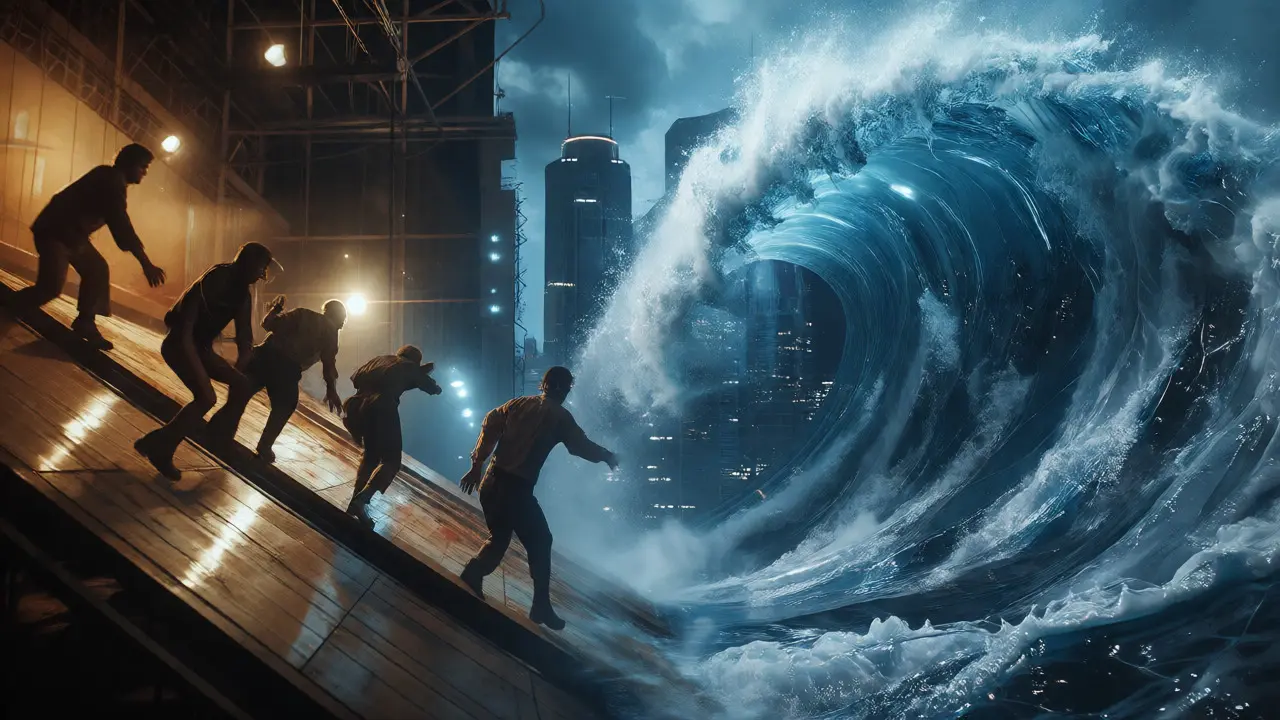
You know that feeling when the screen goes dark, then suddenly explodes into a tsunami swallowing a city? That visceral jolt isn't just luck. It's the result of years of digital engineering, physics simulations, and sheer stubbornness by artists who spend months making water look wet. Disaster films are more than just explosions; they are high-stakes experiments in large-scale visual effects and narrative tension. They push technology to its breaking point, forcing studios to rethink how we simulate reality.
The Evolution of Catastrophe on Screen
Think back to the 1970s. When you watched The Poseidon Adventure, you were looking at physical sets tilting on gimbals. The fear was real because the actors were actually sliding down polished floors. Fast forward to today, and the threat is often invisible until it hits your eyes. Modern disaster cinema relies heavily on Computer-Generated Imagery (CGI) to create events that would be physically impossible or too dangerous to film practically. This shift hasn't just changed what we see; it has changed how stories are told. Directors no longer ask "How do we build this?" but rather "How do we render this?"
This transition created a new kind of pressure. In the past, budget constraints meant smaller casts and tighter locations. Now, the sky is literally the limit, but so is the compute time. A single frame of a collapsing skyscraper can take hours to render. If you've ever wondered why some recent blockbusters feel slightly weightless, it’s often because the balance between practical effects and digital augmentation tipped too far toward the latter. Audiences have become savvy. We spot fake fire instantly. We notice when debris doesn’t react correctly to gravity. The challenge for filmmakers is no longer just creating spectacle, but maintaining believability within that spectacle.
Why Water and Fire Are the Final Bosses of VFX
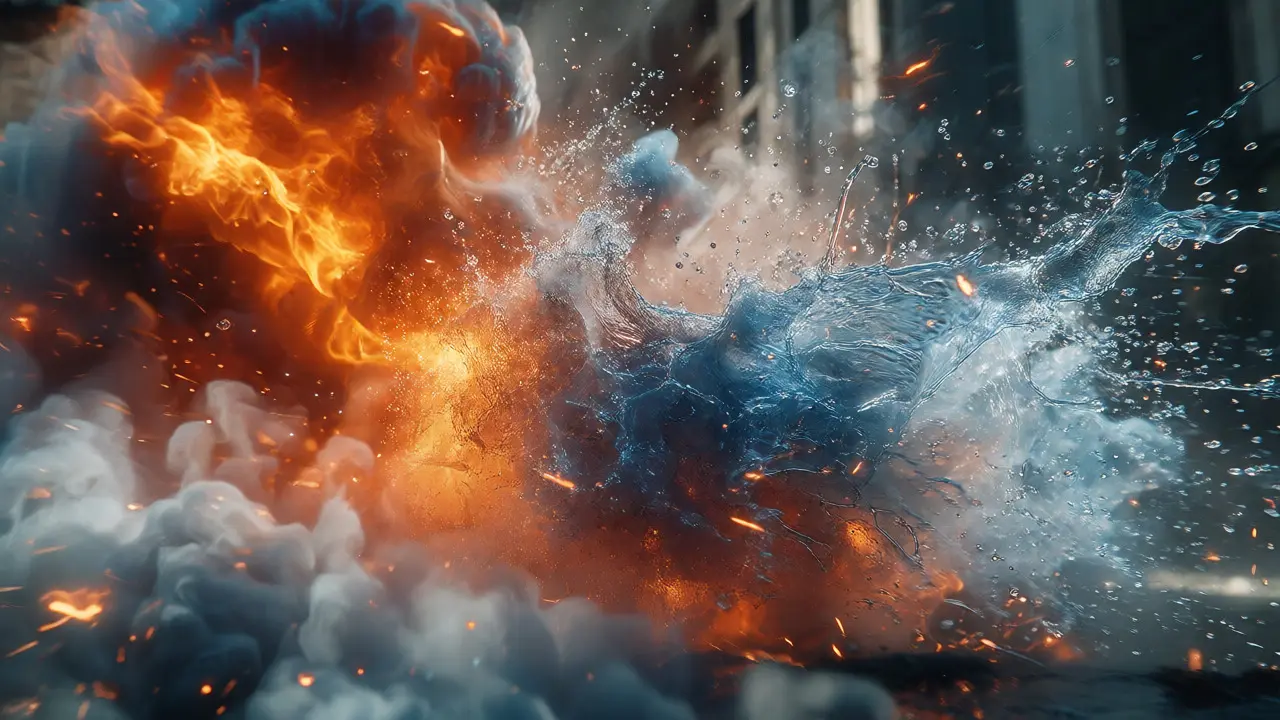
If you ask any visual effects supervisor about their nightmare fuel, they’ll likely say two words: water and fire. These elements are chaotic, translucent, and interact with light in complex ways. Simulating a tidal wave isn't just about moving blue pixels; it requires solving fluid dynamics equations for millions of particles. Each particle interacts with others, with air, and with solid objects like buildings or cars. Get one variable wrong, and the water looks like gelatin instead of liquid.
| Element | Primary Challenge | Technical Solution | Film Example |
|---|---|---|---|
| Water | Fluid dynamics and refraction | SPH (Smoothed Particle Hydrodynamics) solvers | Interstellar, The Impossible |
| Fire/Explosions | Turbulence and heat distortion | Voxel-based volumetric rendering | 2012, Independence Day |
| Destruction | Rigid body simulation of debris | Fracture algorithms and physics engines | San Andreas, Pacific Rim |
| Weather | Lighting consistency in storms | HDRI lighting maps and atmospheric scattering | The Day After Tomorrow |
Take The Impossible (2012), which depicted the 2004 Indian Ocean tsunami. The team didn't just use one big water model. They used different techniques for different distances. Distant waves might be simple textures on geometry, while close-up splashes involved full fluid simulations. This hybrid approach saves computational power but requires seamless integration. If the texture doesn't match the simulation perfectly, the illusion breaks. You notice the seam, and suddenly you're not watching a family survive a natural disaster; you're watching a computer render a family survive a natural disaster.
The Physics of Believability
Here’s a controversial idea: most people don't care if the physics are accurate. They care if they *feel* right. Newtonian physics dictates that an object in motion stays in motion unless acted upon by an external force. But in movies, we often bend these rules for dramatic effect. A car flipping through the air needs to rotate at a specific speed to look cinematic, even if that speed defies the torque generated by the impact.
This is where Rigid Body Dynamics comes into play. Software like Houdini or Maya allows artists to assign mass, friction, and elasticity to digital objects. When a building collapses, every beam, pane of glass, and chunk of concrete must behave according to its material properties. Concrete shatters differently than steel bends. If a director wants a building to fall slowly for emotional impact, the VFX team has to cheat gravity. They reduce the gravitational constant in the simulation from 9.8 m/s² to something lower, then adjust the scale of the debris to compensate. It’s a delicate dance between science and storytelling.
Consider the earthquake scenes in San Andreas. The ground doesn't just shake; it liquefies. Simulating soil liquefaction-where saturated soil temporarily loses strength and acts like a liquid-is incredibly resource-intensive. It affects how foundations sink and how cars slide. Getting this wrong makes the scene feel static, like a bad video game cutscene. Getting it right creates a sense of dread that resonates long after the credits roll.
Budget vs. Brilliance: The Cost of Chaos
Let’s talk money. A typical blockbuster budget ranges from $150 million to $300 million. Visual effects can consume up to 30-40% of that total. For disaster films, this percentage is often higher because the entire environment is potentially destroyed. Every background building, every street, every cloud might need to be digitally replaced or augmented.
- Pre-visualization: Before cameras roll, directors use virtual cameras to plan shots. This helps estimate how much CG will be needed later.
- On-set data capture: LiDAR scans and HDRI photos are taken daily to ensure digital assets match the real-world lighting and geometry.
- Render farms: Thousands of computers work simultaneously to process frames. A single second of footage can take days to render.
Studios constantly weigh the cost of shooting practical stunts against the cost of replacing them with CG. Shooting a real car crash is expensive and dangerous. Filming a green-screen car and adding the crash in post-production is also expensive, but safer and more controllable. The trend in recent years, led by directors like Christopher Nolan, is a return to practical effects where possible. Why? Because actors perform better when they’re reacting to something real. And audiences respond to tangible textures. A real explosion has a unique light flicker that is hard to replicate perfectly in software.

Emotional Anchors in a Sea of Pixels
Here is the trap many modern disaster films fall into: they prioritize spectacle over story. You’ve seen it happen. The plot pauses so the audience can watch a mountain explode. While visually stunning, these moments can disconnect viewers emotionally. The best disaster films, like Contagion or Chernobyl (the series), keep the camera close to the human experience. The VFX serves the character, not the other way around.
In Gravity, the space debris isn't just a threat; it’s a ticking clock that mirrors Dr. Stone’s psychological state. The silence of space contrasts with the chaos outside her helmet. This juxtaposition is achieved through careful sound design and minimal, precise VFX. The debris moves slowly, eerily, emphasizing the vacuum. Compare this to Armageddon, where noise and chaos reign supreme. Neither is inherently better, but they serve different emotional goals. One induces anxiety through isolation; the other through sensory overload.
To succeed, filmmakers must anchor the audience in the characters' fears. If we don't care about the protagonist, the destruction of Los Angeles means nothing. We need to see the human face behind the panic. Close-ups on sweat, trembling hands, and wide eyes remind us that beneath the digital avalanche, there is still flesh and blood. This grounding technique prevents the "uncanny valley" of emotion, where the visuals are perfect but the feelings feel hollow.
The Future of Catastrophe: AI and Real-Time Rendering
Where do we go from here? Two technologies are poised to change disaster filmmaking forever: Artificial Intelligence and real-time rendering engines like Unreal Engine. Traditionally, VFX was a post-production task. You shot the movie, then spent six months fixing it. With real-time engines, directors can see the final image while filming. If they want the volcano to erupt earlier, they can change the timing on set and see the result immediately.
AI is already helping with tasks like rotoscoping (cutting out characters from backgrounds) and upscaling resolution. Soon, AI might generate entire crowd simulations or predict how fire will spread based on wind speed inputs. This could democratize high-quality VFX, allowing smaller independent films to tackle disaster scenarios without needing Marvel-sized budgets. Imagine a low-budget indie film with Hollywood-level tsunami effects. That future is closer than you think.
However, technology alone won't save the genre. As VFX becomes cheaper and easier, the bar for novelty rises. We've seen cities fall before. We've seen asteroids hit Earth. To captivate audiences in 2026 and beyond, filmmakers need to find new angles on old fears. Climate change provides endless material. Psychological disasters-like societal collapse-might offer more resonance than physical ones. The next great disaster film might not feature a single explosion, but a silent, creeping dread amplified by subtle visual cues.
Why are water effects so difficult to create in movies?
Water is challenging because it is transparent, reflective, and highly dynamic. Simulating realistic water requires calculating the interaction of millions of particles with light and each other. Unlike solid objects, water changes shape continuously, requiring complex fluid dynamics equations that demand significant computational power to render accurately.
Do disaster films always rely entirely on CGI?
No, many modern disaster films use a hybrid approach. Practical effects, such as real explosions, rain towers, and mechanical sets, are often combined with CGI. This blend helps maintain realism and gives actors tangible elements to react to, while CGI handles large-scale destruction or impossible scenarios.
What is the role of pre-visualization in disaster films?
Pre-visualization involves creating rough 3D animations of scenes before filming begins. It helps directors plan camera angles, stunts, and VFX requirements. This step ensures that the practical and digital elements align correctly during production, saving time and money in post-production.
How does audience skepticism affect VFX quality?
Audiences are more visually literate than ever. They can easily spot unrealistic physics or poor compositing. This scrutiny forces studios to invest more in research and development to achieve photorealism. Poorly executed VFX can damage a film's reputation, leading to higher standards for future productions.
Can AI replace human VFX artists in the future?
AI is unlikely to replace human artists entirely but will significantly augment their workflow. AI can handle repetitive tasks like cleanup, upscaling, and basic simulations, freeing artists to focus on creative decisions and artistic nuance. Human oversight remains crucial for maintaining emotional impact and stylistic consistency.





Comments(6)