Ever watched a movie scene where the camera glides through a crowded street without a single shake? That smoothness isn't magic; it's engineering. Whether you are shooting a blockbuster or a local wedding, camera stabilization is the invisible hand that keeps your audience focused on the story instead of the jitters in the frame. But with so many tools available, how do you know which one fits your shot? The answer lies in understanding the distinct physics behind each device.
Choosing between a motorized rig, a rolling track, or a body-mounted vest is not just about preference. It dictates the movement vocabulary of your film. A wrong choice can make a dynamic action sequence look clumsy or a quiet dialogue scene feel sterile. Let's break down exactly how these three pillars of motion work, when to use them, and what they cost you in terms of time and budget.
Understanding the Physics of Smooth Motion
Before picking a tool, you need to understand why cameras shake. Human hands have micro-tremors. Walking creates vertical oscillations. Running adds rotational wobble. Stabilization works by decoupling the camera from these inputs. However, "smooth" means different things in different contexts. A static tripod is stable but lacks energy. A handheld shot is energetic but unstable. The goal is controlled instability-movement that feels intentional rather than accidental.
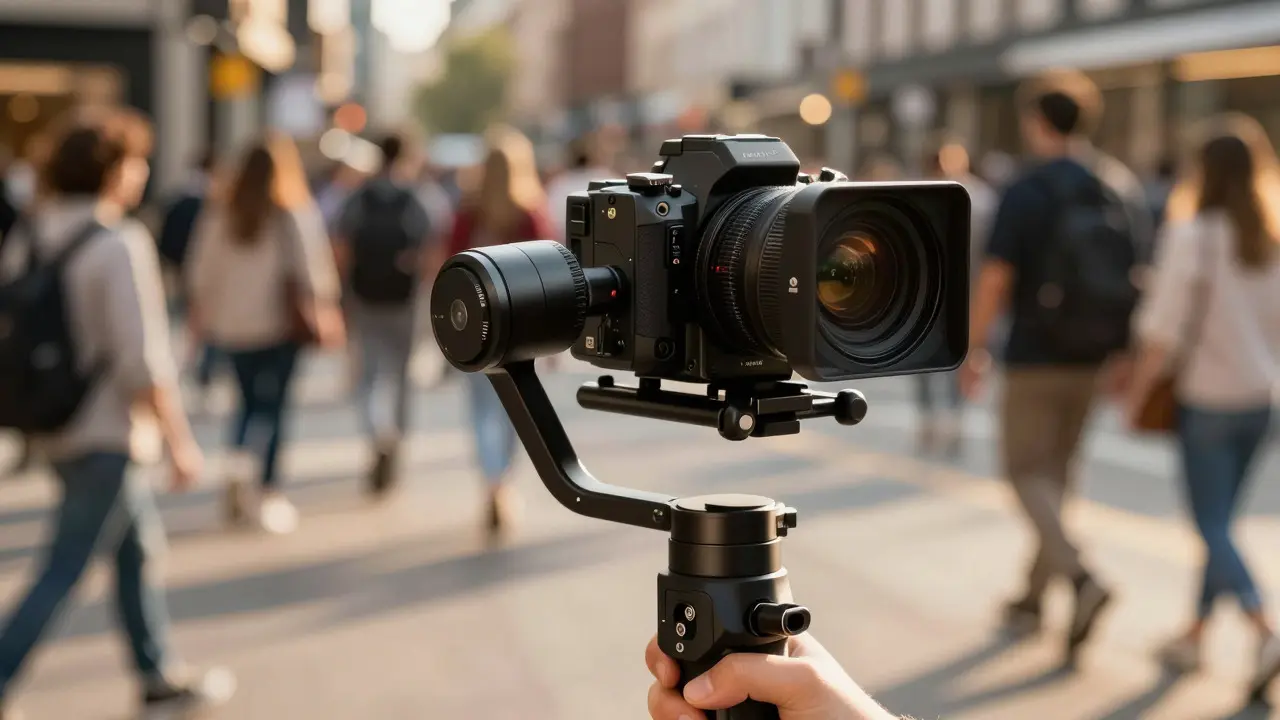
Gimbals are motorized stabilizers that use gyroscopes to counteract movement across three axes: pitch, roll, and yaw. They act like an anti-gravity system for your lens. On the other hand, Dollies are wheeled platforms that move the entire camera along a physical path, usually rails. Finally, a Steadicam is a mechanical arm system worn by the operator that isolates the camera from the operator's body movements. Each solves the problem of shake differently: electronically, mechanically via tracks, or physically via suspension.
Gimbals: The Digital Counterbalance
Gimbals have revolutionized independent filmmaking because they offer professional stability at a fraction of the cost of traditional rigs. Modern consumer models start around $300, while pro-grade units used in feature films can exceed $1,500. The key attribute here is responsiveness. When you turn left, the gyroscope detects the change in angular velocity and commands a brushless motor to turn the camera head right at the exact same speed, keeping the horizon level.
The biggest advantage of a gimbal is its versatility in tight spaces. You can walk through a narrow hallway, step over obstacles, or even ride in a car (with proper mounting). However, gimbals have a blind spot: long, continuous tracking shots over uneven terrain. If you hit a pothole, the motors will correct, but there might be a slight lag or overshoot that looks unnatural. For this reason, gimbals excel in medium-paced movements, such as walking interviews, product reveals, or slow orbits around a subject.
- Best Use Case: Dynamic, unpredictable environments where space is limited.
- Limitation: Battery life typically lasts 12-14 hours, requiring swaps during long shoots.
- Cost Factor: Low entry barrier, high maintenance if dropped.
Dollies: Precision on Rails
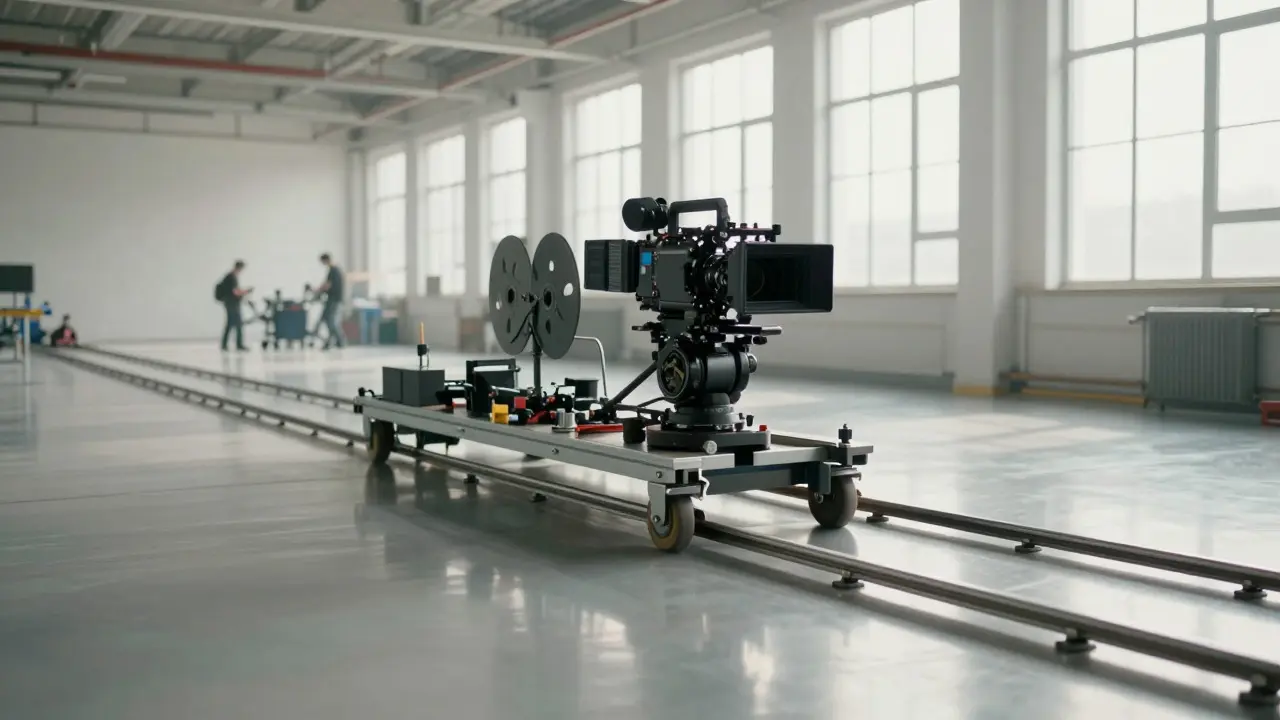
If you want movement that looks like it was painted onto the screen, you need a dolly. This is the gold standard for linear movement. A dolly consists of a heavy platform with four wheels that rolls on aluminum or steel rails. Because the camera moves on a fixed path, the perspective changes in a mathematically perfect way. There is no up-and-down bobbing, no side-to-side sway. Just pure, clean translation.
However, dollies demand preparation. You must lay out the track, ensure the floor is flat, and clear the path of any debris. This makes them ideal for controlled sets: indoor scenes, studio backlots, or open fields where you can install tracks. They are less useful in chaotic, real-world locations unless you bring a lot of crew to manage the logistics. The sound of the wheels can also be an issue; rubber tires help, but on hard surfaces, you might still pick up rumble in your audio recording.
Professional dollies often come with a "dolly grip" position-a person who operates the platform independently from the camera operator. This separation allows for complex choreography where the camera angle stays locked while the position shifts, or vice versa. For a solo shooter, a simple slider or a small rail set is a practical alternative, offering the same aesthetic benefit in a portable package.
Steadicam: The Human Shock Absorber
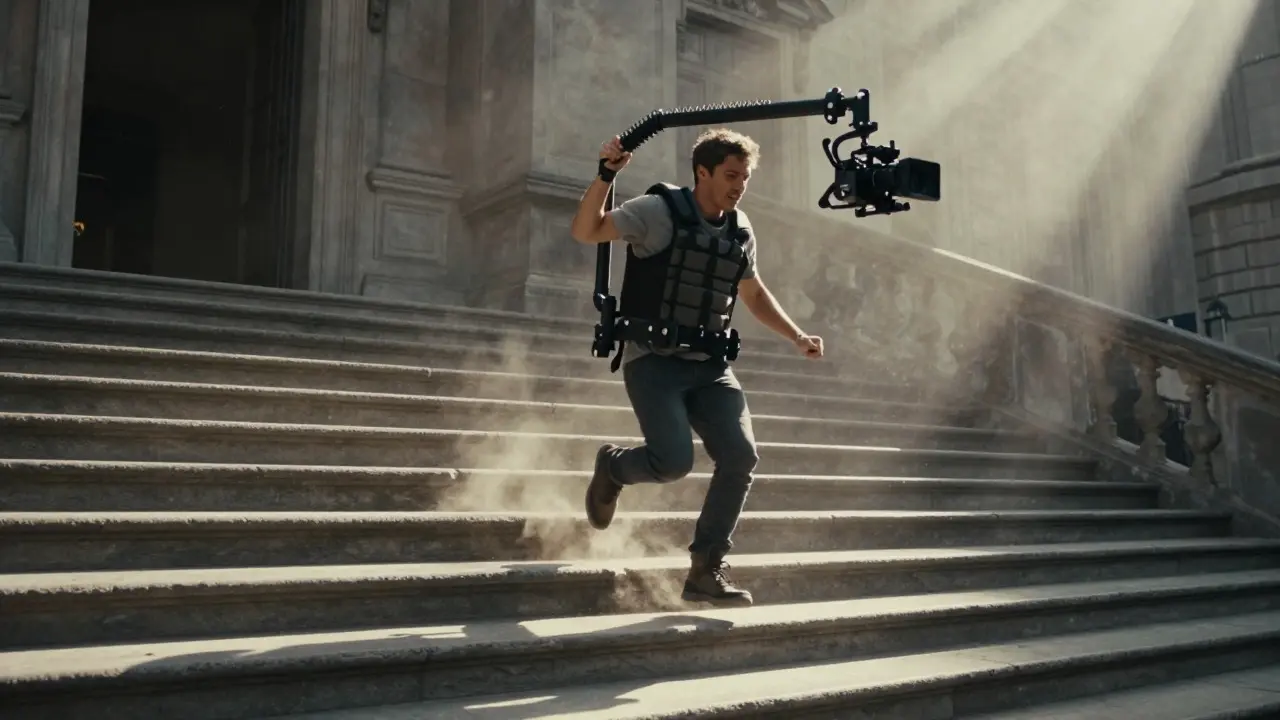
The Steadicam is a piece of elegant mechanical engineering. It uses a spring-loaded arm to balance the weight of the camera against the operator's body. The operator wears a vest with a belt that distributes the weight across their hips. As they walk, run, or jump, the camera remains suspended in mid-air, isolated from the impact forces hitting the operator's feet.
This setup allows for incredibly fluid, organic movement. Unlike a dolly, which is restricted to straight lines or curves laid out on the ground, a Steadicam operator can navigate stairs, climb hills, and weave through crowds. The movement has a unique "float" quality that audiences associate with high-end cinema. Think of the famous hallway chase in *The Shining* or the sweeping shots in *Saving Private Ryan*. These were achieved using variants of this technology.
The downside? It requires skill. Operating a Steadicam is a full-body workout. You need core strength to hold the balance and coordination to keep the framing tight. It is also heavier than a gimbal setup, which can tire out an operator faster over a long day. Furthermore, it doesn't correct for all types of movement. If you turn your head quickly, the camera turns with you. It stabilizes vertical shock, not horizontal rotation, unless you add a panning head.
| Feature | Gimbal | Dolly | Steadicam |
|---|---|---|---|
| Movement Type | Electronic correction | Mechanical track-based | Physical suspension |
| Setup Time | Low (minutes) | High (hours) | Medium (15-30 mins) |
| Terrain Flexibility | High | Low (flat only) | Very High |
| Operator Skill Required | Low to Medium | Medium (Grip needed) | High |
| Ideal Shot Length | Short to Medium | Long, Linear | Medium to Long, Complex |
| Approximate Cost (Entry) | $300 - $500 | $500 - $2,000 | $1,000 - $3,000 |
Choosing the Right Tool for Your Scene
You don't always need all three. In fact, mixing them poorly can create visual inconsistencies. The decision should start with the script. Ask yourself: What is the emotional tone of this scene? Is it frantic and chaotic, or calm and contemplative?
If the scene involves a character running away from danger, a Steadicam is often the best choice. It captures the breathless, human effort of the movement. The slight imperfections in the motion mirror the panic of the character. If the scene is a slow reveal of a landscape or a product, a Dolly provides that sense of grandeur and precision. The movement is so smooth it feels timeless. If you are shooting a vlog, a documentary interview, or a quick B-roll clip in a city, a Gimbal is your workhorse. It gets you in and out fast, and it handles the unpredictable nature of urban environments well.
Budget also plays a huge role. If you are just starting out, invest in a good gimbal first. It covers 80% of most indie needs. Once you have the capital and the crew size, look into renting a dolly for specific hero shots. Steadicams are often rented per day because maintaining the equipment and hiring a trained operator is expensive. Don't buy a Steadicam until you have hired a professional to train you on it; otherwise, you'll end up with a very expensive paperweight.
Common Pitfalls and How to Avoid Them
Even with the right tool, bad technique ruins the shot. One common mistake with gimbals is holding the handle too tightly. This transfers vibration from your arms into the rig. Keep your grip relaxed, like you're holding a bird. With dollies, the biggest pitfall is uneven tracks. Even a millimeter difference in height causes the camera to tilt slightly, which looks like a camera error rather than a stylistic choice. Always check your levels before rolling. For Steadicams, the issue is usually fatigue. If the operator is tired, their form breaks down, and the camera starts to drift. Schedule breaks every hour. Also, watch out for wind. Since the Steadicam arm is exposed, strong gusts can push the camera off-axis. In windy conditions, a gimbal or a dolly might be safer bets. Finally, consider the lens focal length. Wide-angle lenses (like 24mm) exaggerate parallax and movement. A small shake becomes a big swing. Telephoto lenses (like 85mm or 135mm) compress depth and hide minor imperfections. If you are struggling with stabilization, switch to a longer lens. It’s a cheap fix that often saves the shot.
Frequently Asked Questions
Can I use a gimbal for running shots?
Yes, but with caution. Modern gimbals have high torque motors that can handle jogging speeds. However, for sprinting or jumping, a Steadicam is superior because it absorbs impact physically rather than trying to correct it electronically. If you must use a gimbal for running, keep your stride short and steady to minimize sudden shocks.
What is the main difference between a dolly and a slider?
A dolly moves the camera over a long distance (feet to hundreds of feet) using wheels on rails. A slider moves the camera a short distance (usually 2 to 4 feet) on a stationary base. Sliders are great for subtle pans or tilts combined with movement, while dollies are for significant positional changes in the frame.
Do I need a separate operator for a Steadicam?
Ideally, yes. The person wearing the vest (the Steadicam operator) focuses entirely on balancing the rig and moving smoothly. The camera operator sits on top and focuses on framing and focus. Trying to do both simultaneously leads to shaky footage because your attention is split between balancing and composing.
Which stabilization method is cheapest to start with?
A gimbal is the most affordable entry point. You can find high-quality 3-axis gimbals for under $500. Dollies require buying rails and a platform, which adds up quickly. Steadicams involve buying the vest, arm, and head, plus potentially hiring a trainer, making them the most expensive initial investment for a beginner.
Does camera stabilization affect audio recording?
Indirectly, yes. While the camera itself doesn't record audio, the movement affects how you place boom mics. On a dolly, you can mount the mic to the rig for consistent distance. On a Steadicam, the mic must be handheld or wireless because the rig vibrates. Gimbals allow for compact mic mounts, but you must ensure the motor noise doesn't bleed into sensitive lav mics.



Comments(8)