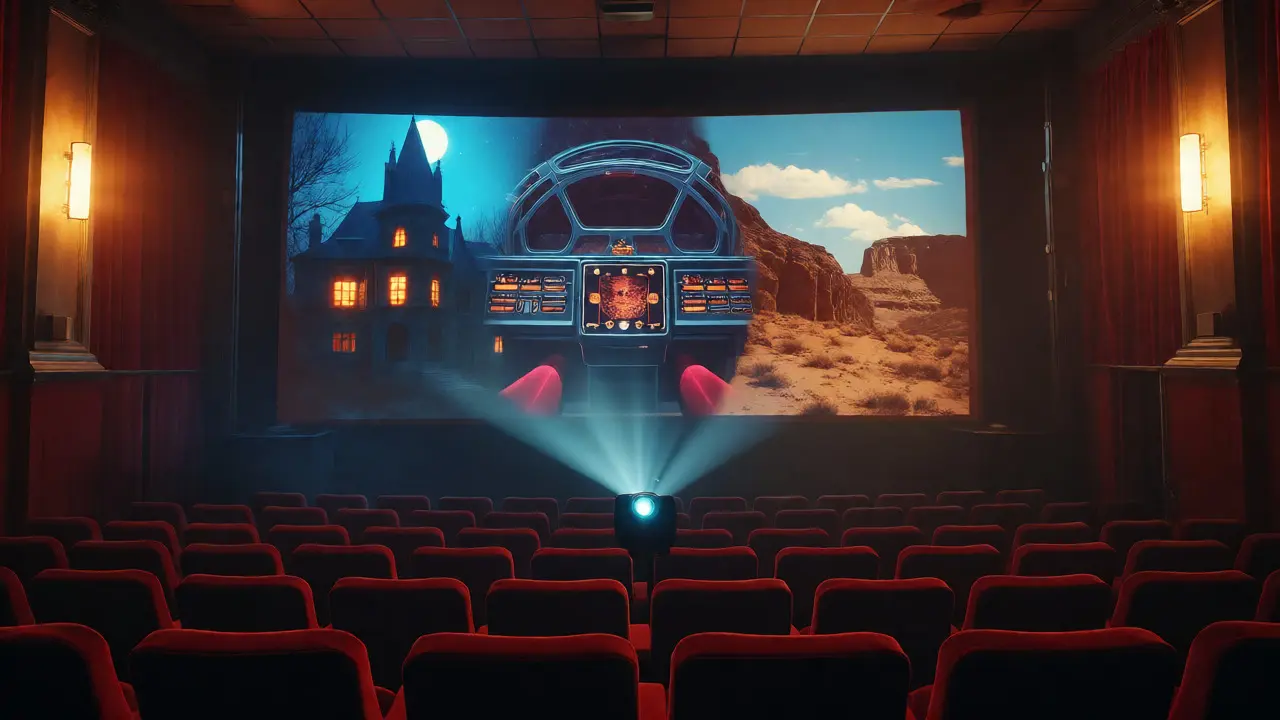
You’ve probably watched a movie that felt like three or four different movies stitched together. Maybe one segment was terrifying, the next was heartbreaking, and the last left you confused about what you just saw. That’s an anthology film. It is a type of motion picture composed of several distinct segments, each usually directed by a different filmmaker or based on a separate source material. While some are original screenplays, many of the most memorable ones come from short story collections. Why do filmmakers love turning these books into movies? And why do they sometimes fail so spectacularly?
Why Short Stories Are Perfect for Anthologies
Think about the structure of a short story. It has a beginning, a middle, and an end, but it lacks the sprawling subplots of a novel. This makes it ideal for a film segment. A director gets to focus on one specific idea, character, or twist without worrying about pacing issues that plague feature-length adaptations of novels. When you take a collection of stories-like those by Stephen King, Richard Matheson, or Roald Dahl-and adapt them into a single film, you get variety within unity. You get multiple genres in one runtime.
This format allows studios to take risks. If one segment flops, the others might still save the box office numbers. For audiences, it offers a cinematic sampler platter. You don’t have to commit two hours to one genre; you can taste horror, sci-fi, drama, and comedy all in one sitting. But this convenience comes with a major pitfall: consistency. The tone often shifts wildly between segments, which can jar the viewer out of the experience.
The Classic Era: Horror and Twilight Zone Roots
Most people associate anthology films with horror, and for good reason. The genre thrives on isolated scares and quick payoffs. In the 1960s and 70s, British studio Hammer Films dominated this space with titles like Tales of Mystery and Imagination (1962) and Asylum (1972). These films often adapted Edgar Allan Poe or generic Gothic tales. They weren’t always faithful to the text, but they captured the mood perfectly.
Then came the television influence. The Twilight Zone proved that short, punchy narratives worked beautifully on screen. When Hollywood tried to bring this TV success to the big screen, results were mixed. Take Creeepshow (1982), written by Stephen King and directed by George A. Romero. It’s a direct adaptation of King’s short stories, structured like a comic book flipping through pages. It works because it leans into the campy, pulpy nature of the source material rather than trying to be serious prestige cinema.
| Film Title | Release Year | Source Material | Genre Focus |
|---|---|---|---|
| Creeepshow | 1982 | Stephen King Short Stories | Horror/Comedy |
| Three Stories About Fear | 2023 | Various Authors | Psychological Horror |
| The Ballad of Buster Scruggs | 2018 | Original Screenplay (Novel-like) | Western/Drama |
| Black Mirror: Bandersnatch | 2018 | Original Concept | Sci-Fi/Interactive |
| V/H/S | 2012 | Found Footage Originals | Horror |
The Modern Renaissance: High-Budget Prestige
In recent years, anthology films have moved beyond low-budget horror. We’re seeing high-profile directors tackling complex literary sources. The Coen Brothers’ The Ballad of Buster Scruggs (2018) is a prime example. While not strictly a short story adaptation, it mimics the structure of a western novella collection. Each segment stands alone, exploring themes of death, justice, and fate in the Old West. Brad Pitt starred in one segment, showing how star power can anchor disparate parts.
Netflix and Amazon have also jumped in. Their algorithms favor content that keeps viewers engaged across different tastes. An anthology series or film allows platforms to serve multiple subscriber preferences simultaneously. For instance, Guillermo del Toro’s Cabinet of Curiosities (2022) on Netflix adapts various classic horror tales. Del Toro acts as the host, guiding viewers through stories ranging from Lovecraftian cosmic horror to modern psychological thrillers. The production value here rivals any major blockbuster, proving that short-form storytelling can look expensive and polished.
Challenges in Adapting Short Stories
Adapting a short story is harder than adapting a novel. With a novel, you cut things out. With a short story, you often have to add things. Directors must expand internal monologues into visual actions. They need to create backstory where none existed. This expansion process can dilute the original impact. A short story relies on suggestion; film relies on explicit visuals. Sometimes, showing too much kills the mystery.
Another issue is tonal whiplash. Imagine watching a segment that ends in a tragic suicide, followed immediately by a slapstick comedy bit. Without a strong framing device-like a narrator or a shared location-the audience feels unmoored. Successful anthologies use connective tissue. In Creeepshow, the haunted bookstore serves as the bridge. In Paris, je t’aime (2006), the city itself connects twenty short films by different directors. Without that glue, the movie feels like a YouTube playlist rather than a cohesive work.
How to Spot a Good Anthology Adaptation
Not all anthologies are created equal. If you’re looking for your next watch, consider these factors:
- Unified Theme: Do the segments share a central idea? Whether it’s “fear,” “love,” or “technology gone wrong,” a common thread helps tie the narrative together.
- Distinct Voices: Are the directors clearly different? Part of the fun is seeing how different filmmakers interpret similar prompts. If every segment looks and feels the same, the anthology format loses its purpose.
- Strong Framing Device: Is there a host, a setting, or a plotline connecting the stories? This provides context and gives the audience a reason to stay seated after the first segment.
- Pacing Balance: Does the film know when to stop? Bad anthologies drag segments out past their expiration date. Great ones know exactly when to cut to black and move on.
The Future of Literary Anthologies
We are likely heading toward more interactive and serialized anthologies. Video games like Black Mirror: Bandersnatch blurred the line between film and game, offering choose-your-own-adventure narratives based on short-story logic. Streaming services are experimenting with shorter episode counts that mimic the density of short fiction. Instead of ten-hour seasons, we might see six-hour limited series where each episode adapts a different story from a single collection.
Independent filmmakers also benefit from this format. Collaborative projects allow emerging directors to contribute a segment to a larger package. This lowers financial risk while providing exposure. Platforms like Shudder and MUBI frequently curate these indie anthologies, focusing on international voices and experimental styles that mainstream studios ignore.
What is the difference between an anthology film and an omnibus film?
The terms are often used interchangeably, but there is a subtle distinction. An anthology film typically features segments that are completely unrelated in plot, connected only by theme or a framing device. An omnibus film may have segments that interact with each other or share characters who appear in multiple parts. However, in general conversation, both refer to multi-segment movies.
Why do horror movies use anthology formats so often?
Horror thrives on novelty and shock value. Short stories provide quick setups and punchlines, which translates well to cinematic scares. Additionally, horror fans enjoy variety-one segment might be supernatural, another slasher, another psychological. The anthology format lets filmmakers experiment with different types of fear without committing to a long narrative arc that might lose tension.
Are anthology films easier to make than regular movies?
Not necessarily. While each segment is shorter, coordinating multiple directors, casts, and crews increases logistical complexity. Scheduling conflicts are common because stars might only be available for a few days. Post-production can also be tricky if the segments vary widely in style and quality. However, they can be cheaper per minute of screen time since you avoid the massive budget required for a two-hour epic.
Can I find short story adaptations outside of horror?
Absolutely. While horror dominates, dramas and comedies use this format too. Love Actually (2003) is essentially a romantic comedy anthology, weaving together multiple couples’ stories. Babel (2006) links four different stories across continents. These films prove that the anthology structure works for any genre that benefits from parallel narratives.
Do actors get paid less for anthology films?
It depends on the actor’s contract and the project’s budget. Big stars often negotiate full-scale fees even for limited screen time because their name draws attention to the whole film. Emerging actors might accept lower rates for exposure. Since filming schedules are shorter, some actors prefer these roles as a break from long shoots.