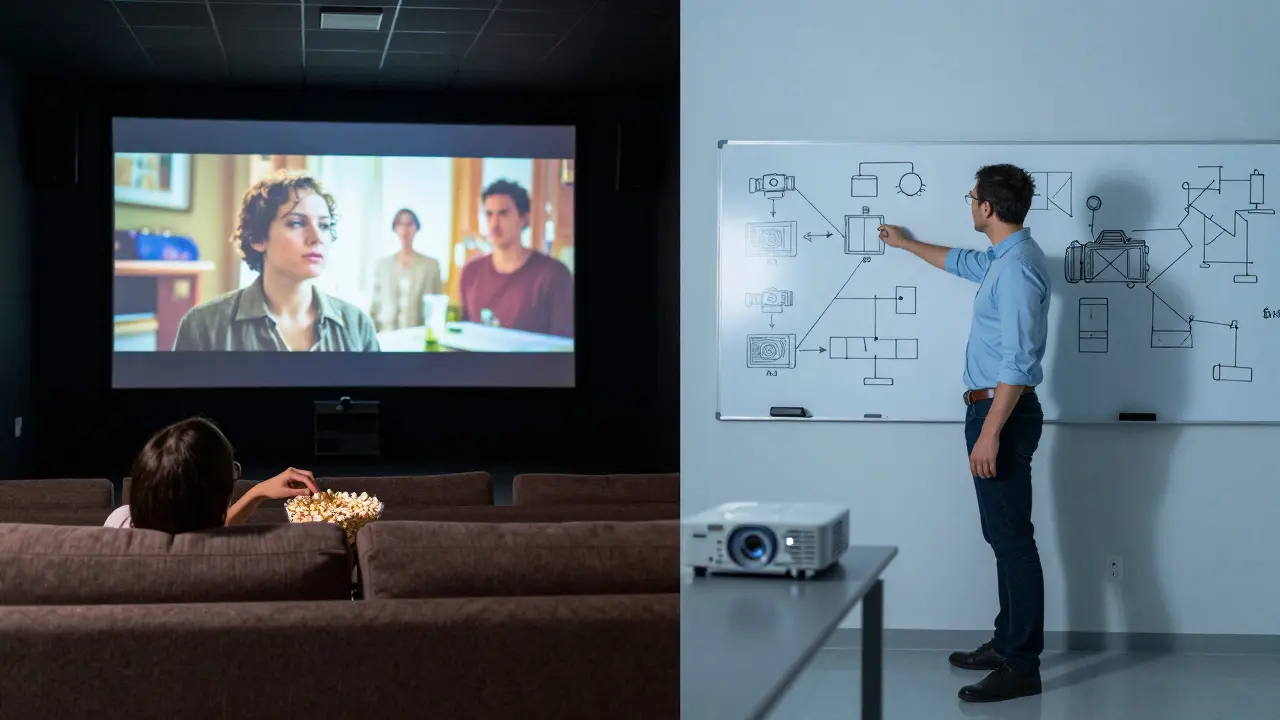
Most people judge a movie by how they felt in the theater. Did it make them cry? Did the plot twist land? But for scholars, a film is not just entertainment; it is a complex text packed with historical, political, and technical codes. Academic film criticism strips away the emotional reaction to look at the machinery of cinema itself. It asks not "was this good?" but "how does this work?" and "what does it mean in this specific context?" This approach transforms a two-hour runtime into a subject worthy of deep, rigorous study.
If you have ever read a journal article on a classic film and felt like you were decoding a secret language, you are experiencing the gap between consumer reviews and scholarly analysis. While a review might say a scene is "powerful," an academic critique will explain exactly why the camera angle, lighting, and editing rhythm create that power. It is less about taste and more about evidence.
The Core Difference: Evaluation vs. Interpretation
The fundamental divide lies in the goal. A consumer review is evaluative. It aims to persuade you to buy a ticket or stream the title. It relies on personal preference, genre expectations, and immediate emotional impact. If you love action movies, a slow-paced drama might get a low score simply because it doesn't fit your mood. That is valid for a viewer, but it is not useful for understanding cinema as an art form.
Academic criticism is interpretive. It seeks to uncover meaning. Scholars don't care if a film is "fun." They care about what the film says about society, gender, race, or technology. For example, a scholar analyzing a 1950s sci-fi film won't ask if the special effects hold up today. Instead, they will examine how the monster represents Cold War anxieties or nuclear fear. The value isn't in the enjoyment of the viewing experience, but in the insight gained from dissecting it.
Theoretical Lenses: How Scholars See Films
You cannot do academic film analysis without a framework. These are the "lenses" through which scholars view the screen. Each lens highlights different aspects of the film while ignoring others. Here are the most common ones you will encounter:
- Film Theory: This looks at the medium itself. How does montage create meaning? How does sound direct attention? Thinkers like Sergei Eisenstein argued that editing creates intellectual concepts, not just visual continuity. When a scholar uses this lens, they are analyzing the grammar of cinema.
- Feminist Film Theory: Pioneered by critics like Laura Mulvey, this approach examines how films represent women and how the "male gaze" structures the audience's perspective. It asks who is looking, who is being looked at, and what power dynamics are reinforced by the camera.
- Post-Colonial Studies: This lens analyzes how Western films depict non-Western cultures. It looks for stereotypes, exoticism, and narratives of rescue or domination. It is crucial for understanding global cinema and the politics of representation.
- Cognitive Film Theory: A newer field that borrows from psychology. It asks how viewers process information. Why do we understand a character's motivation before they state it? How do our brains fill in gaps during cross-cutting scenes?
These lenses aren't just jargon. They provide tools to see things you missed on your first watch. A feminist reading of a superhero movie might reveal how the female sidekick exists solely to motivate the male hero, a detail easily overlooked in a standard review focused on action sequences.
Methodology: Building an Argument
Writing an academic film critique follows a strict logical path. It is not a stream of consciousness. It is a structured argument supported by evidence. Here is how the process typically works:
- Thesis Statement: You must make a claim. Not "This film is sad," but "The use of desaturated color palettes in Act Two reinforces the protagonist's psychological isolation."
- Contextualization: Place the film in its historical and cultural moment. What was happening in the world when it was made? Who was the target audience? What were the studio constraints?
- Close Reading: This is the core. You break down specific shots, sounds, and edits. You describe them objectively (e.g., "a low-angle shot lasting four seconds") before interpreting them (e.g., "which visually diminishes the character's authority").
- Theoretical Application: Connect your observations to a theory. Does the low-angle shot align with theories of power dynamics? Cite the relevant scholar.
- Conclusion: Summarize how the evidence supports your thesis. Avoid new arguments here.
This method ensures objectivity. By grounding every interpretation in visible evidence and established theory, the critic moves away from "I think" to "the data suggests."

Consumer Reviews vs. Academic Criticism: A Comparison
To clarify the distinction, let's look at how both approaches handle the same film. Imagine a popular blockbuster with complex themes. The differences in focus are stark.
| Feature | Consumer Review | Academic Criticism |
|---|---|---|
| Primary Goal | Persuade purchase/viewing | Analyze meaning and technique |
| Basis of Judgment | Personal emotion, genre satisfaction | Theoretical framework, textual evidence |
| Tone | Conversational, subjective, enthusiastic | Formal, objective, analytical |
| Use of Jargon | Minimal; focuses on plot and acting | High; uses terms like mise-en-scène, diegetic sound |
| Timeframe | Immediate post-release | Often years later, allowing for cultural shift |
| Audience | General public, potential viewers | Students, scholars, specialized readers |
Notice that neither is "better." A consumer review helps you decide what to watch tonight. Academic criticism helps you understand why cinema matters culturally. They serve different masters: one serves the market, the other serves knowledge.
Why Academic Criticism Matters Today
In an age of streaming algorithms and endless content, academic film criticism provides a counter-narrative. Algorithms recommend what you already like. Academics challenge you to see differently. They highlight marginalized voices, deconstruct dominant ideologies, and preserve film history against forgetting.
For instance, when a classic film is re-evaluated decades later, it is often academic critics who lead the charge. They point out racial biases or gender assumptions that were invisible to original audiences. This ongoing dialogue keeps cinema alive and evolving. It turns static objects into dynamic subjects of debate.
Moreover, academic criticism bridges the gap between art and science. It uses rigorous methods similar to literary analysis or historical research. This gives film studies legitimacy in universities and beyond. It proves that watching a movie can be an intellectual act, not just a leisure activity.

How to Engage with Academic Film Criticism
You don't need a PhD to appreciate scholarly analysis. Here are practical ways to start:
- Read Journal Abstracts: Start with short summaries of articles in journals like Cinema Journal or Screen. They give you the core argument without the dense detail.
- Watch Lectures: Many professors upload film analysis videos. Watching someone break down a single shot is eye-opening. Look for lectures on directors like Alfred Hitchcock or Kiyoshi Kurosawa to see technique in action.
- Try Close Viewing: Pick a five-minute scene from a film you know well. Pause it. Describe the lighting, the position of actors, the sound mix. Then ask: what is the director trying to convey? Compare your notes to an academic analysis of that scene.
- Follow Film Theory Blogs: Some academics write accessible pieces online. They translate complex ideas into everyday language. This is a great bridge between the two worlds.
Engaging with academic criticism changes how you watch everything. You start noticing the cut, the shadow, the silence. You become a more active participant in the viewing experience, not just a passive consumer.
Common Misconceptions About Scholarly Analysis
Many people think academic film criticism is dry or elitist. They assume scholars only watch old, boring films. In reality, scholars analyze everything from Marvel blockbusters to viral short films. The difference is the depth, not the subject matter.
Another misconception is that academic critics hate fun. They don't. They just separate the fun from the analysis. You can enjoy a film's thrill and still analyze its structural mechanics. The two aren't mutually exclusive. In fact, understanding the mechanics often enhances the enjoyment. Knowing why a jump scare works makes it scarier.
Finally, some believe that only one interpretation is "correct." In academic criticism, multiple interpretations can be valid if supported by evidence. A film can be read as a political statement, a psychological drama, and a technical experiment simultaneously. The richness of cinema allows for this multiplicity.
Is academic film criticism only for university students?
No. While it is taught in universities, anyone with an interest in film can engage with it. There are many accessible books, podcasts, and online articles that introduce film theory to general audiences. The key is curiosity and willingness to look deeper than the surface plot.
What is the main difference between a film review and a film analysis?
A review evaluates quality and recommends the film based on personal taste. An analysis dissects the film's techniques and meanings using theoretical frameworks. Reviews answer "Should I watch this?" while analyses answer "How does this work and what does it mean?"
Do academic critics ignore modern blockbusters?
Not anymore. Early film studies focused heavily on European art cinema, but contemporary academia widely analyzes Hollywood blockbusters, anime, and digital media. Scholars study franchises like Star Wars or Marvel for their cultural impact, visual language, and narrative structures.
Which theory should I start with if I am new to film criticism?
Start with basic film grammar (shots, angles, editing) before moving to complex theories. Understanding how a close-up differs from a wide shot is foundational. Once comfortable with the visual language, explore Feminist Film Theory or Psychoanalysis, as these offer clear frameworks for interpreting character and audience relationships.
Can a film be academically significant even if it is poorly made?
Yes. Academic criticism often studies "bad" films to understand cultural anxieties, production constraints, or audience reception. A low-budget horror film might be technically flawed but highly significant in representing rural fears or religious tensions. Technical merit is not the only measure of academic value.