You just finished editing your feature. The festival circuit loved it. Now you are staring at a spreadsheet of potential buyers in Tokyo, Berlin, and Toronto, wondering who actually answers the phone. You might think you can email Netflix or A24 directly. In reality, that inbox is a black hole. This is where International Sales Agents enter the picture. They are the bridge between your creative vision and global revenue.
Think of them less as middlemen and more as specialized distributors with relationships. If you try to sell rights yourself, you need contacts in every territory. An agent already has those. They know which distributor in South Korea loves psychological thrillers and which one in France only buys comedies under $1 million. But how does this relationship actually work? And is it worth giving up a chunk of your profit?
The Core Function: What Do They Actually Do?
At its simplest, an international sales agent licenses your film’s rights to distributors in foreign territories. They do not make the movie; they sell it. Their job description covers three main areas: packaging, marketing, and negotiation.
Packaging starts before the film is even finished. If you have a script with a known actor attached, an agent can create a "sizzle reel"-a short video combining clips from similar films with your concept-to pitch to pre-sales buyers. This helps fund production. Once the film is done, they handle the marketing materials, like posters and trailers tailored for specific markets. Finally, they negotiate contracts. This is the heavy lifting. They ensure you get paid on time and that the distributor doesn't bury your film in a warehouse.
It is crucial to understand what they do not do. They usually do not handle domestic (US) distribution unless specified. That is typically handled by a US distributor or a different type of agent. They also rarely cover all territories simultaneously unless you sign an exclusive worldwide deal, which is risky for smaller indies.
Where the Deals Happen: The Market Circuit
If you want to meet these agents, you cannot just wait for an email. The industry runs on physical markets. For indie filmmakers, three events dominate the calendar. Knowing when and where to be present changes everything.
| Market Name | Location & Time | Best For | Typical Budget Range |
|---|---|---|---|
| European Film Market (EFM) | Berlin, Germany (February) | Art-house, drama, prestige projects | $500k - $5M |
| Cannes Marché du Film | Cannes, France (May) | High-prestige, star-driven, genre | $1M - $20M+ |
| American Film Market (AFM) | Santa Monica, USA (November) | Genre, horror, action, mid-budget | $100k - $3M |
Notice the pattern? Cannes is expensive and competitive. If you are making a micro-budget horror film, AFM is likely your better bet. EFM sits in the middle, great for character-driven stories. Your agent decides which market to target based on your film's profile. If they send a gritty urban drama to Cannes, they might miss the mark. If they send a high-concept sci-fi to AFM, they might undersell it. Choosing the right agency means choosing the right market strategy.
How to Find and Vet an Agent
Not all agents are created equal. Some represent 50 films a year; others take on five. For an indie filmmaker, volume matters. You want someone who will fight for your title, not treat it as filler content.
Start by looking at films similar to yours. Who sold them? Check the credits or press releases from recent festivals. If you liked The Florida Project or Everything Everywhere All At Once, look up their sales reps. Did they use a boutique firm or a major player like Wild Bunch or Bankside Films?
When you reach out, ask these questions:
- What is your track record for my genre? If they only sell rom-coms, they won't move your slasher.
- Do you require exclusivity? Exclusive deals give the agent total control. Non-exclusive lets you shop around but requires more coordination.
- What is your fee structure? Standard commissions range from 10% to 20% of gross receipts. Be wary of hidden costs for marketing materials.
- Who else is on their roster? If they represent ten other horror films launching next month, yours might get lost in the shuffle.
Be skeptical of agents who promise guaranteed sales. No one can guarantee a buyer. Anyone who says "We will definitely sell to Netflix" is guessing. Good agents talk about probabilities and strategies, not promises.

The Money Talk: Commissions and Costs
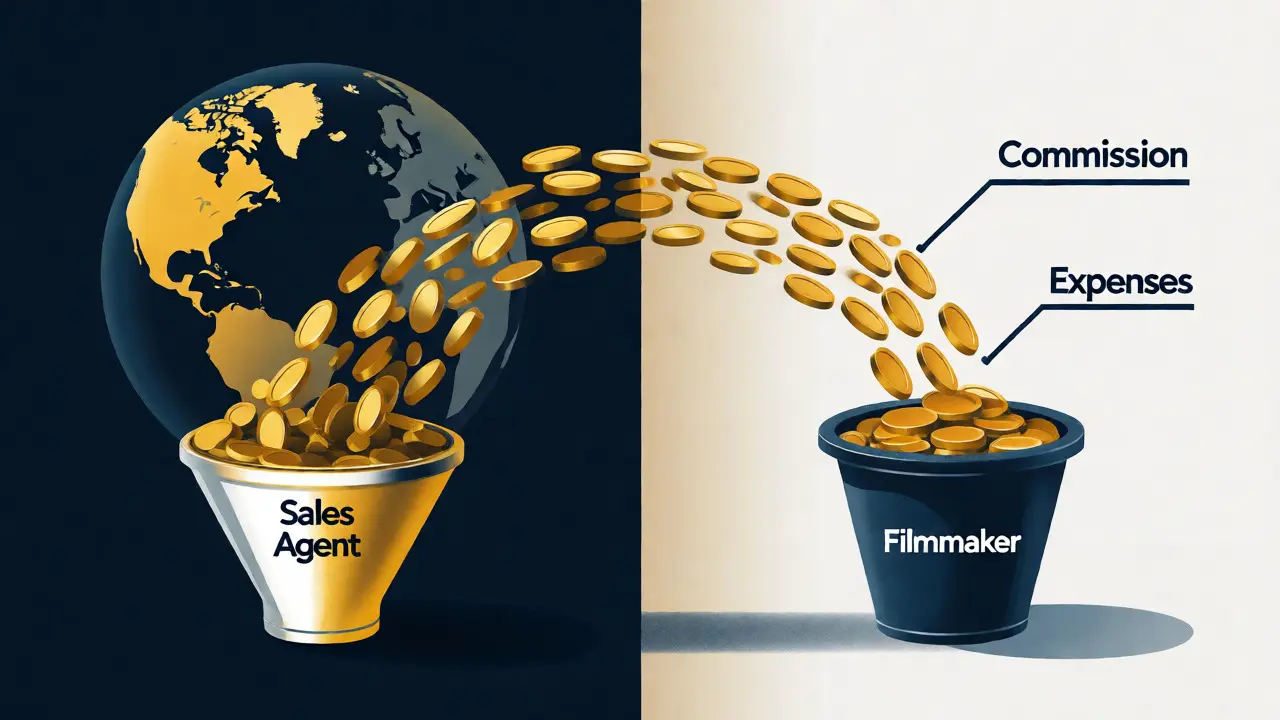
Let's break down the cash flow. Suppose you sell rights in Germany for $50,000. Here is how that money typically moves:
- The German distributor pays $50,000 to the sales agent.
- The agent deducts their commission (e.g., 15%). That is $7,500.
- The agent may deduct recoupable expenses (travel, booth fees, marketing). Let's say $2,500.
- The remaining $40,000 goes to you (or your production entity).
This model aligns incentives. If they don't sell, they don't earn much. However, some top-tier agencies charge a retainer or upfront fee. For a first-time indie director, avoid retainers if possible. Stick to commission-only models so the risk stays shared.
Also, watch out for "minimum guarantees" (MGs). Sometimes a distributor offers a small MG against future royalties. The agent handles the collection of these residuals. Make sure your contract specifies how often statements are sent. Quarterly is standard. Annual is too slow for cash-flow-strapped independents.
Common Pitfalls and Red Flags
Even with a good agent, things go wrong. The biggest issue is lack of communication. You might hear nothing for six months, then suddenly learn your film was sold to a low-quality platform in Brazil. Why? Because the agent didn't consult you on the deal terms.
To prevent this, insist on approval rights for key deals. You don't need to approve every minor transaction, but you should veto any deal that hurts your brand. For example, if a distributor wants to cut your film's ending to fit a TV slot, you need a say.
Another red flag is vague reporting. If an agent sends a one-line email saying "Sold UK," ask for the contract summary. Who is the distributor? What is the term length? What is the media format? Transparency builds trust. If they resist sharing details, walk away.
Finally, beware of agents who pressure you into signing quickly. Festival deadlines create urgency, but bad deals last forever. Take a week to review the contract. Have an entertainment lawyer read it. It is worth the few thousand dollars to avoid losing your rights for ten years.
DIY vs. Agency: When to Skip the Middleman
Is hiring an agent always necessary? Not always. With platforms like Premiere Screen or direct-to-streaming options, some filmmakers bypass traditional sales entirely.
Consider DIY if:
- Your budget is under $100,000.
- You have strong personal connections in specific territories.
- You are comfortable attending markets alone and negotiating basic contracts.
Hire an agent if:
- You want maximum exposure across multiple continents.
- You lack legal expertise in international copyright law.
- You need pre-sales to help finance post-production.
Hybrid models exist too. You might hire an agent for Europe and handle Asia yourself. This requires more work but saves commission fees. Test the waters. Start with a non-exclusive agreement. See how many leads they generate. If they bring zero interest after two markets, drop them.
Next Steps for Filmmakers
Representation is a partnership. Treat your sales agent like a co-producer. Share your data. Tell them about your social media following. Give them access to behind-the-scenes footage. The more they know about your audience, the better they can pitch your film.
Before you sign anything, map out your goals. Do you want fame? Revenue? Both? An agent focused on prestige awards might land you a tiny check but big reviews. An agent focused on volume might sell to streaming giants for quick cash but little buzz. Know what you are buying with that 15% commission.
The landscape is shifting. Streamers buy globally now, reducing the need for territorial splits. But human relationships still close deals. Algorithms don't attend AFM cocktail parties. People do. Build those bridges wisely.
Do I need an agent if I have a US distributor?
Yes, often. Most US distributors focus solely on North American release. They rarely have the infrastructure to sell rights in Japan, Germany, or Latin America. Unless your US distributor explicitly states they handle international sales, you likely need a separate agent for foreign territories.
How long does a typical sales agreement last?
Standard agreements run for 1-3 years. This gives the agent enough time to attend multiple markets and build relationships. Avoid contracts longer than 3 years for your first film. You want the option to switch agents if performance is poor. Always include a termination clause if no sales occur within 12 months.
Can I negotiate the commission rate?
Absolutely. While 10-20% is standard, rates vary. High-profile films with stars might command lower percentages because they are easier to sell. Micro-budget films might face higher fees due to the effort required to find niche buyers. Negotiate based on value, not just percentage. Ask what services are included in the fee.
What happens if my film doesn't sell internationally?
You receive no income from those territories. However, you keep the rights. Ensure your contract allows you to reclaim rights easily if unsold. Some agents might offer a "best efforts" clause, meaning they tried but failed. Others might hold rights hostage until you pay a penalty. Read the fine print carefully.
Are online film markets replacing physical ones?
Online platforms facilitate initial contact, but physical markets remain vital for closing deals. Buyers want to see the film in a theater setting and shake hands. Hybrid models are emerging, but face-to-face interaction still drives trust in high-stakes negotiations. Plan to attend at least one major market physically.