Walk into a modern multiplex and you might notice something odd: the walls aren't flat. They’re angled, textured, or covered in dark fabric panels. It’s not just aesthetics. Every curve and material is a calculated move to ensure that when a character whispers a secret in a quiet scene, you hear every syllable without straining your ears. This is the core of cinema acoustic design: engineering a space where human speech remains crisp, clear, and emotionally resonant, even when competing with low-frequency rumble from a blockbuster action sequence.
For dialogue-heavy films-think courtroom dramas, psychological thrillers, or intimate character studies-acoustic clarity isn’t a luxury; it’s the foundation of the viewing experience. If you miss a line of dialogue because the room sounded like a cave, the narrative breaks. Here’s how architects and audio engineers build auditoriums to keep words sharp and stories intact.
The Physics of Clear Speech in Large Rooms
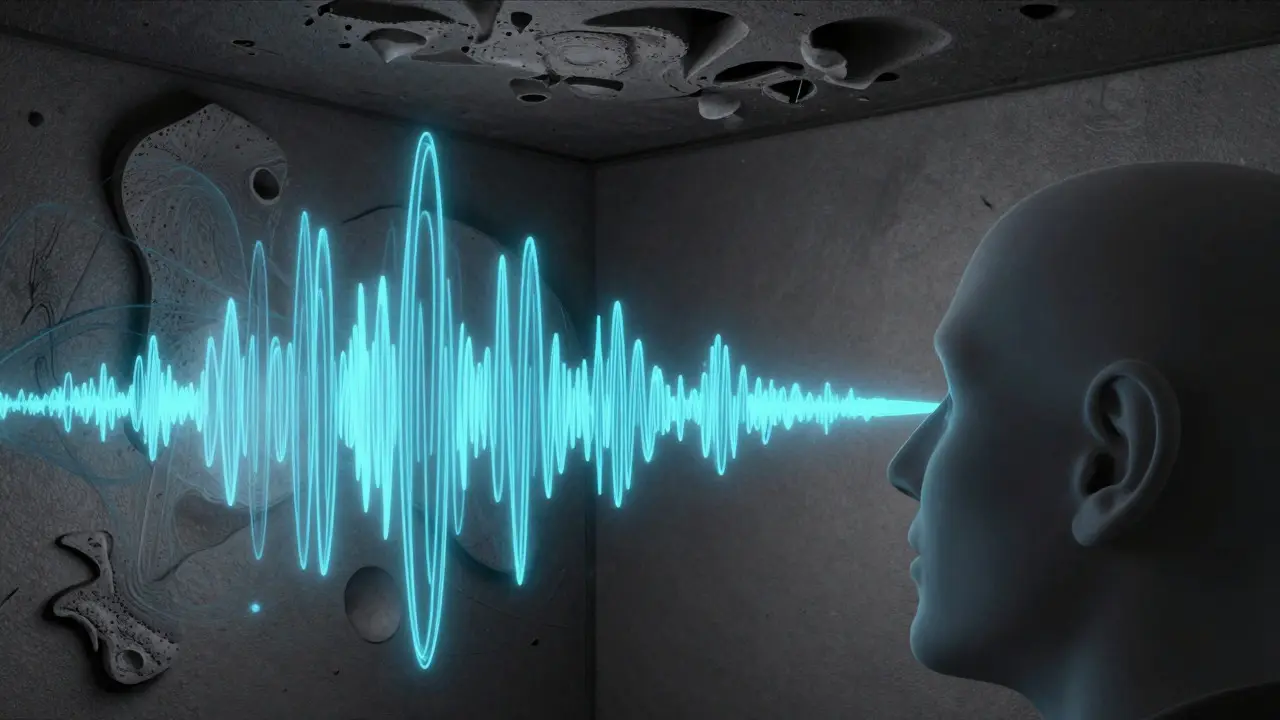
To understand why some cinemas sound muddy while others feel transparent, you have to look at how sound behaves in enclosed spaces. When a speaker talks, their voice travels directly to your ears (direct sound). But simultaneously, that sound hits the walls, ceiling, and floor, bouncing back as reflections. In a small room, these bounces are minimal. In a large cinema auditorium, they can pile up, creating a wash of noise known as reverberation.
Reverberation Time is the duration it takes for sound energy to decay by 60 decibels after the source stops. For speech intelligibility, this value is critical. If the reverberation time is too long, the tail end of one word overlaps with the beginning of the next, blurring consonants like 's', 't', and 'k'. If it’s too short, the room feels dead and dry, lacking the warmth that makes cinematic audio engaging.
Acoustic engineers aim for a specific sweet spot. In most commercial movie theaters, the target Reverberation Time (RT60) at mid-frequencies (around 500 Hz to 1 kHz, where most speech energy resides) typically falls between 0.8 and 1.2 seconds. This range ensures that direct sound dominates over late reflections, keeping dialogue distinct from background music or effects.
Controlling Reflections: The Role of Absorption and Diffusion
Achieving that 0.8-1.2 second window requires careful management of surface materials. Architects use two primary tools: absorption and diffusion.
- Absorption: Soft, porous materials like acoustic foam, heavy drapes, or specialized mineral wool panels trap sound waves, converting their energy into heat. These are often placed on side walls and ceilings to prevent early reflections from reaching the audience before the direct sound does.
- Diffusion: Hard, irregular surfaces scatter sound waves in multiple directions rather than reflecting them straight back. Diffusers break up strong echoes and create a more uniform sound field, preventing 'hot spots' where sound is louder and 'dead zones' where it’s quieter.
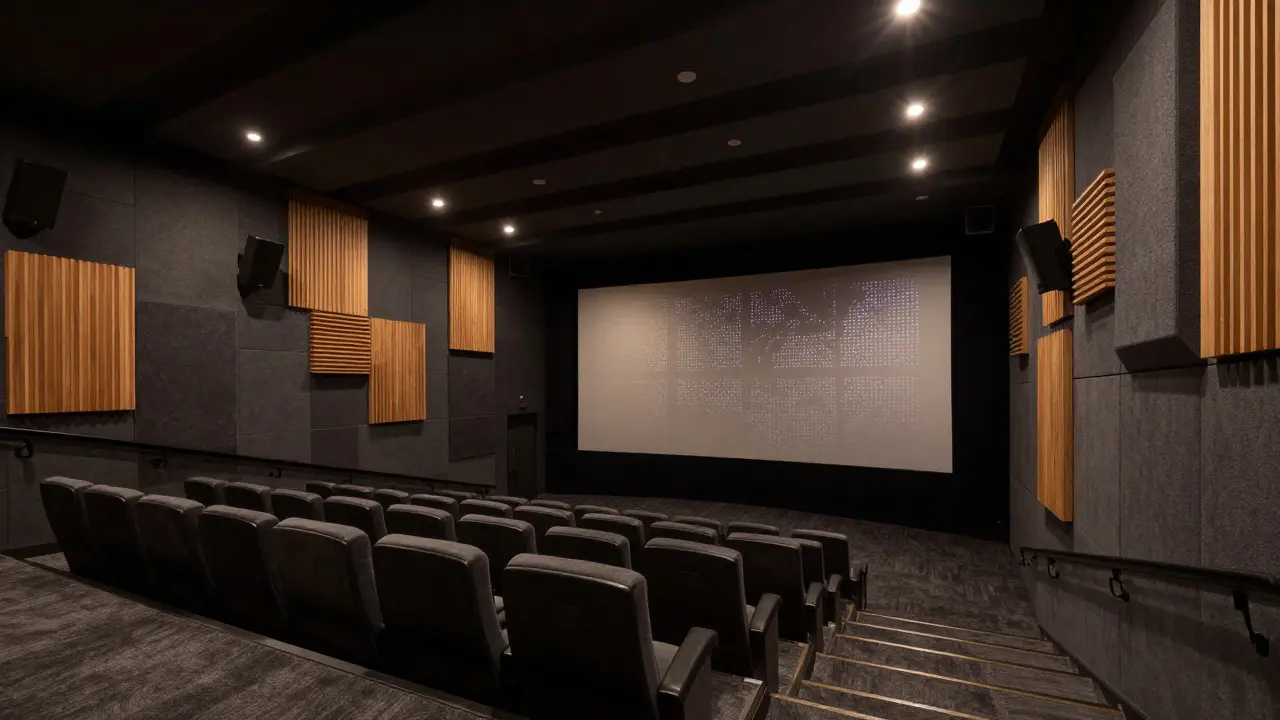
In a typical cinema layout, the front wall behind the screen is heavily treated with absorptive panels to stop sound from bouncing back onto the audience. The side walls often feature a mix of diffusive wood slats and absorptive fabric-wrapped panels. The ceiling might include angled baffles that direct sound downward toward the seating area while dissipating energy before it reflects off the floor.
The Screen: A Major Acoustic Hurdle
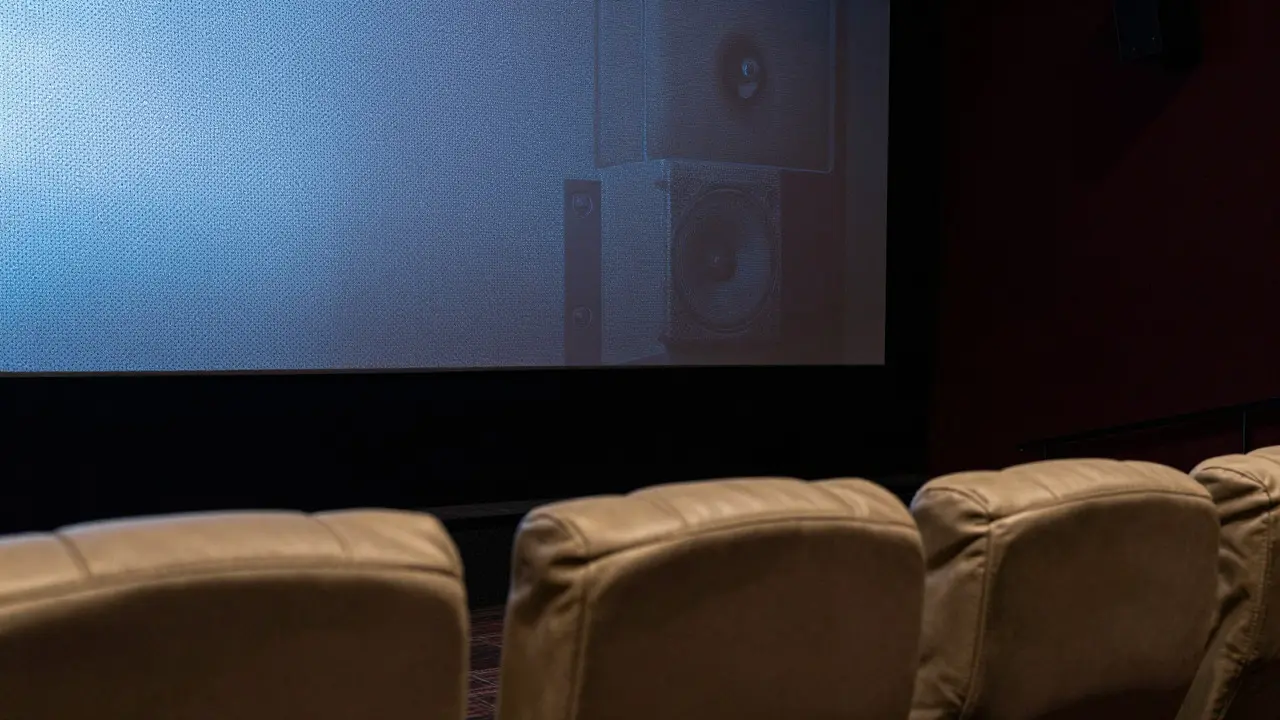
One of the biggest challenges in cinema design is the screen itself. Traditional white screens were highly reflective, causing severe flutter echo-a rapid series of echoes between the screen and the rear wall. Modern digital projection has changed the game, but the screen still presents issues.
Acoustic Transparency is the ability of a screen to allow sound to pass through it with minimal reflection or distortion. High-end theaters now use perforated screens or specialized acoustic fabrics that let sound from speakers mounted *behind* the screen pass through cleanly. This setup, often called 'through-screen' audio, allows engineers to place main left and right channels directly behind the display, aligning the visual source with the auditory source. This alignment dramatically improves the perception of speech coming from the characters’ mouths, enhancing immersion and clarity.
If a theater uses a standard non-acoustically transparent screen, speakers are usually placed in the corners of the room or on stands to the sides. While effective, this arrangement can sometimes cause slight localization errors, making dialogue feel slightly detached from the image. For dialogue-heavy films, this distinction matters.
Speaker Placement and Channel Configuration
Modern cinemas don’t just rely on three speakers. Most follow standards set by organizations like the SMPTE (Society of Motion Picture and Television Engineers) or Dolby Atmos specifications. These standards dictate precise angles and distances for speaker placement to ensure consistent coverage across all seats.
| Configuration | Dialogue Impact | Best For |
|---|---|---|
| Stereo (2.0) | Basic separation; limited spatial context | Budget theaters, older installations |
| 5.1 Surround | Improved center channel focus; better isolation of dialogue | Standard multiplexes |
| Dolby Atmos / Object-Based | Height channels add dimension; precise object panning keeps dialogue anchored | Premium experiences, high-budget productions |
The center channel is the hero here. In a 5.1 or 7.1 setup, the center speaker sits directly below or above the screen. Its sole job is to reproduce voices. By dedicating a specific driver to dialogue, engineers can boost clarity without raising the overall volume, which helps preserve dynamic range. In object-based systems like Dolby Atmos, dialogue is encoded as an 'object' that can be pinned precisely to the center of the stage, regardless of what other sounds are happening around it.
Seat Layout and Audience Interaction
It’s not just about the room; it’s about the people in it. Audiences are soft, irregular objects that absorb sound. An empty cinema sounds very different from a full one. Acoustic designers account for this by modeling the room with and without occupants. Typically, a full house adds significant absorption, lowering the reverberation time. If a room is designed to be perfect when empty, it might sound too dry when full.
Seat spacing and row depth also play a role. Wider aisles and staggered seating rows help reduce blockage of sound paths. If a person in the front row blocks the direct path to a speaker for someone in the back, the listener relies more on reflected sound, which can degrade clarity. Optimized sightlines and speaker heights ensure that direct sound reaches as many seats as possible.
Practical Tips for Choosing a Cinema for Dialogue-Heavy Films
As a viewer, you can assess a theater’s acoustic quality quickly. Look for these indicators:
- Wall Texture: Are the side walls flat and shiny? That’s a red flag for excessive reflections. Textured or fabric-covered walls suggest intentional acoustic treatment.
- Screen Type: If you can see perforations in the screen or if the speakers appear to be behind it, you’re likely in a facility optimized for through-screen audio.
- Seating Comfort: Reclining seats with good head support indicate a premium build, which often correlates with higher acoustic standards.
- Volume Consistency: During a preview or trailer, listen for muddiness. If you can clearly distinguish individual words in fast-paced dialogue without squinting your ears, the room is well-tuned.
For directors and sound mixers working on dialogue-heavy projects, understanding these architectural constraints is vital. Mixing for a room with a 1.0-second RT60 requires different EQ choices than mixing for a home theater with a 0.4-second RT60. Ensuring dialogue sits comfortably in the 300 Hz to 3 kHz frequency band helps maintain intelligibility across various playback environments.
What is the ideal reverberation time for a cinema?
The ideal reverberation time (RT60) for speech clarity in a cinema is typically between 0.8 and 1.2 seconds at mid-frequencies. This range balances naturalness with intelligibility, ensuring that dialogue remains distinct from background effects.
Why do some movies sound clearer in certain theaters?
Clarity varies based on the room's acoustic treatment, speaker placement, and screen type. Theaters with acoustically transparent screens and dedicated center channels provide better dialogue isolation. Additionally, proper calibration of the audio system to match the room's dimensions ensures consistent performance across all seats.
How does an empty vs. full cinema affect sound?
An empty cinema has less sound absorption, leading to longer reverberation times and potentially echoey sound. A full cinema absorbs more sound due to bodies and clothing, shortening the reverb time. Engineers calibrate systems to perform well in both states, often targeting a middle ground that works adequately for average occupancy levels.
What is the role of the center channel in dialogue clarity?
The center channel is specifically designed to reproduce voices from the center of the screen. By isolating dialogue in this channel, engineers can adjust its level and equalization independently from the left and right channels, ensuring that speech remains anchored to the visual source and doesn't get lost in surround effects.
Do acoustically transparent screens really make a difference?
Yes, they significantly improve the alignment of sound and image. By allowing speakers to be placed directly behind the screen, the auditory source matches the visual source, reducing localization errors. This is particularly beneficial for dialogue-heavy scenes where lip-sync accuracy enhances immersion.