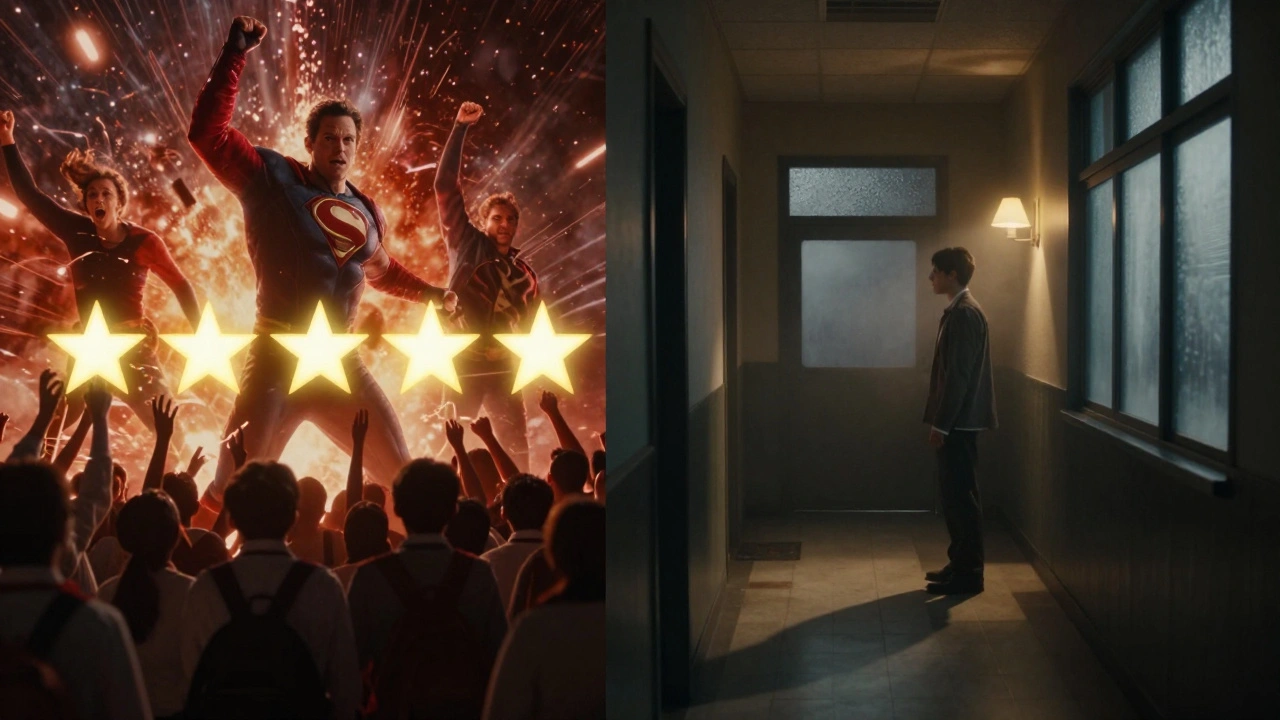
Ever scrolled through a movie page and seen a 9/10 rating from critics, then checked the audience score and found it at 5/10? You’re not alone. That disconnect isn’t a glitch-it’s a symptom of how we’ve simplified film evaluation into a single number. Star ratings promise clarity. But they also erase the messy, beautiful complexity of what makes a movie matter. Nuanced criticism doesn’t give you a quick answer. It gives you a reason to think.
Why Star Ratings Feel Necessary
Star ratings are fast. They’re easy. After a long day, you don’t want to read a 2,000-word essay before deciding whether to watch a movie. You want to know: is this worth my time? A 4-star rating on Rotten Tomatoes or a 5/5 on IMDb gives you that in under a second.
Platforms built on star ratings thrive because they tap into human psychology. We’re wired for simplicity. A five-star system reduces choice overload. It turns subjective taste into something that looks objective. When 87% of users give a film 4 stars or higher, it feels like consensus. Like proof.
But here’s the catch: that consensus is often manufactured. A blockbuster with a big marketing budget will flood social media with 5-star reviews from fans who just wanted to see their favorite actor in a superhero suit. Meanwhile, a quiet indie film with layered themes might get 3-star reviews from viewers who didn’t know what to do with silence or ambiguity. The stars don’t tell you why. They just tell you whether you liked it-or didn’t.
The Hidden Cost of Simplification
When you reduce a film to a star rating, you lose the story behind it. Did the director use long takes to build tension? Was the sound design intentionally jarring to mirror the protagonist’s anxiety? Did the script subvert genre tropes to make a point about class? None of that shows up in a rating.
Think about how music reviews work. You don’t see someone saying, "This jazz album gets 3 stars because it’s too slow." You read about how the drummer’s use of polyrhythms challenges traditional time signatures, or how the bassline echoes a 1970s soul record in a way that feels both nostalgic and revolutionary. That’s criticism. That’s depth.
Film criticism has been slowly stripped of that depth. Streaming platforms now prioritize "watchability" over meaning. Algorithms push movies that match your past behavior, not ones that stretch your perspective. Star ratings feed that loop. They reward predictability. They punish complexity.
Worse, studios now treat critic ratings like KPIs. A movie that opens with a 7/10 on Metacritic gets greenlit for a sequel. One with a 6/10 gets shelved. But what if that 6/10 came from critics who didn’t understand the film’s intent? What if it was a deliberate experiment in discomfort-like "The Lighthouse" or "The Green Knight"-and audiences just weren’t ready for it?
What Nuanced Criticism Actually Offers
Nuanced criticism doesn’t tell you whether to watch a movie. It tells you what you’ll get if you do. It’s not about scoring films. It’s about mapping them.
Take the 2023 film "The Holdovers." A star rating might say: "Heartwarming comedy-drama. Good acting. 4 stars." But a nuanced review might say: "The film uses the confined setting of a boarding school over Christmas to explore grief disguised as institutional control. The lead actor’s performance-quiet, brittle, and rarely smiling-mirrors the emotional architecture of American education: rigid, underfunded, and deeply lonely. The humor isn’t there to lighten the mood. It’s the sound of a man learning how to breathe again."
That kind of writing doesn’t make a quick decision easier. But it makes the experience richer if you choose to watch. It turns a movie from entertainment into an encounter.
Nuanced criticism also acknowledges context. A film like "Oppenheimer" isn’t just about nuclear physics. It’s about guilt, legacy, and the moral collapse of scientific ambition in the Cold War. A star rating can’t capture that. But a critic who connects the film to historical archives, Oppenheimer’s real-life letters, and the rise of AI ethics today? That’s insight.
And it’s not just for arthouse films. Even action movies benefit from this approach. "John Wick: Chapter 4" isn’t just about gun choreography. It’s about the myth of the lone wolf in capitalist society-how violence becomes a currency, and how even escape is commodified. That’s not obvious from a 5-star rating. But it’s there if you look.

When Star Ratings Actually Help
Let’s be fair: star ratings aren’t useless. They have real value in specific situations.
- If you’re looking for a reliable date night movie and want something guaranteed to be light, funny, and not emotionally draining, a high audience score is a solid filter.
- If you’re watching with kids and need to avoid graphic content, user reviews often flag inappropriate scenes better than official ratings.
- If you’re trying to find a movie your friend loved and you trust their taste, their 5-star rating can be a shortcut to something you’ll enjoy.
But these are narrow use cases. They’re about convenience, not discovery. They’re about avoiding bad experiences, not having meaningful ones.
Star ratings work best as a gatekeeper, not a guide. They can keep you out of a bad movie. But they can’t lead you to a great one.
The Rise of the Anti-Rating Movement
More critics are pushing back. Film festivals now feature panels titled "Beyond the Star System." Independent review sites like Letterboxd are seeing a surge in users who write long-form thoughts instead of just slapping on stars. Some critics are even abandoning ratings entirely.
One of the most influential voices in this shift is the critic Jonathan Rosenbaum, who once wrote: "A film is not a product. It’s an event. You don’t rate an event. You remember it, or you don’t."
Platforms like MUBI have experimented with removing star ratings from their main listings. Instead, they feature curated essays and personal recommendations. Their user engagement? Higher than ever. People aren’t just watching more-they’re talking more.
Even YouTube critics are moving away from "10/10" endings. Channels like "The Take" and "NerdWriter" focus on analysis, not scores. Their most popular videos often have no rating at all. Just deep dives into symbolism, editing choices, or cultural context.
How to Balance Both
You don’t have to choose one over the other. You can use both-but with intention.
- Use star ratings to filter out the obvious duds. If a movie has a 3/10 from critics and a 2/10 from users, it’s probably not worth your time.
- When you find something with mixed ratings-say, 7/10 from critics but 4/10 from audiences-that’s your signal to dig deeper.
- Read one or two detailed reviews. Look for critics who explain why they felt something, not just that they felt it.
- Ask yourself: What am I looking for? Do I want comfort? Or do I want to be challenged?
- After watching, write your own note. Not a star. A sentence. What stayed with you? Why?
This isn’t about becoming a film scholar. It’s about reclaiming your relationship with movies. You don’t need to agree with every critic. You just need to know why you felt what you felt.
The Real Risk of Abandoning Nuance
If we keep letting star ratings replace thoughtful criticism, we risk turning cinema into background noise. Movies become products to consume, not experiences to sit with. We stop asking questions like: "What did this try to say?" and start asking: "Was it entertaining?"
That’s not just bad for art. It’s bad for us. Films are one of the few places left where we can safely confront difficult truths-about power, grief, identity, and justice. If we reduce them to a score, we lose the chance to grow.
There’s a reason people still talk about "2001: A Space Odyssey" decades later. Not because it got 5 stars. But because it made them feel small. And then, somehow, less alone.
Don’t let the stars decide what you see. Let your curiosity do it.
Are star ratings still useful for finding good movies?
Star ratings can help you avoid bad movies, especially when there’s broad agreement among critics and audiences. But they’re terrible at helping you find films that challenge or change you. A movie with a 6/10 might be the most meaningful thing you watch all year-if you’re willing to look beyond the number.
Why do critics sometimes give high ratings to movies audiences hate?
Critics often value ambition, originality, or technical mastery over immediate entertainment. A film like "The Lighthouse" or "The Power of the Dog" might feel slow or uncomfortable to casual viewers, but critics recognize the craft behind it-lighting, sound design, layered performances. Audiences often respond to emotional accessibility; critics respond to artistic intent. The gap isn’t a mistake. It’s a difference in priorities.
Can a movie be great even if it gets low ratings?
Absolutely. Many now-classic films were panned on release. "Blade Runner," "The Shining," and "Eternal Sunshine of the Spotless Mind" all had divisive early reactions. Time, context, and deeper analysis changed how people saw them. Ratings are snapshots. Legacy is the full film.
Should I trust audience reviews more than professional critics?
Neither is inherently more trustworthy. Audience reviews reflect personal taste and mood-they’re great for gauging whether a movie is fun or annoying. Critics bring context, history, and technical knowledge. The best approach is to read both, then decide what matters to you. Do you want to be entertained? Or do you want to be moved?
Is there a way to rate films without using stars?
Yes. Many critics use descriptive categories like "Recommended," "Watch if you’re in the mood for...," or "Not for everyone." Others use thematic tags-"Grief," "Isolation," "Satire," "Hope." Some platforms let you write a single-sentence takeaway. These methods capture nuance better than numbers. The goal isn’t to score a film. It’s to describe the experience it creates.





Comments(8)