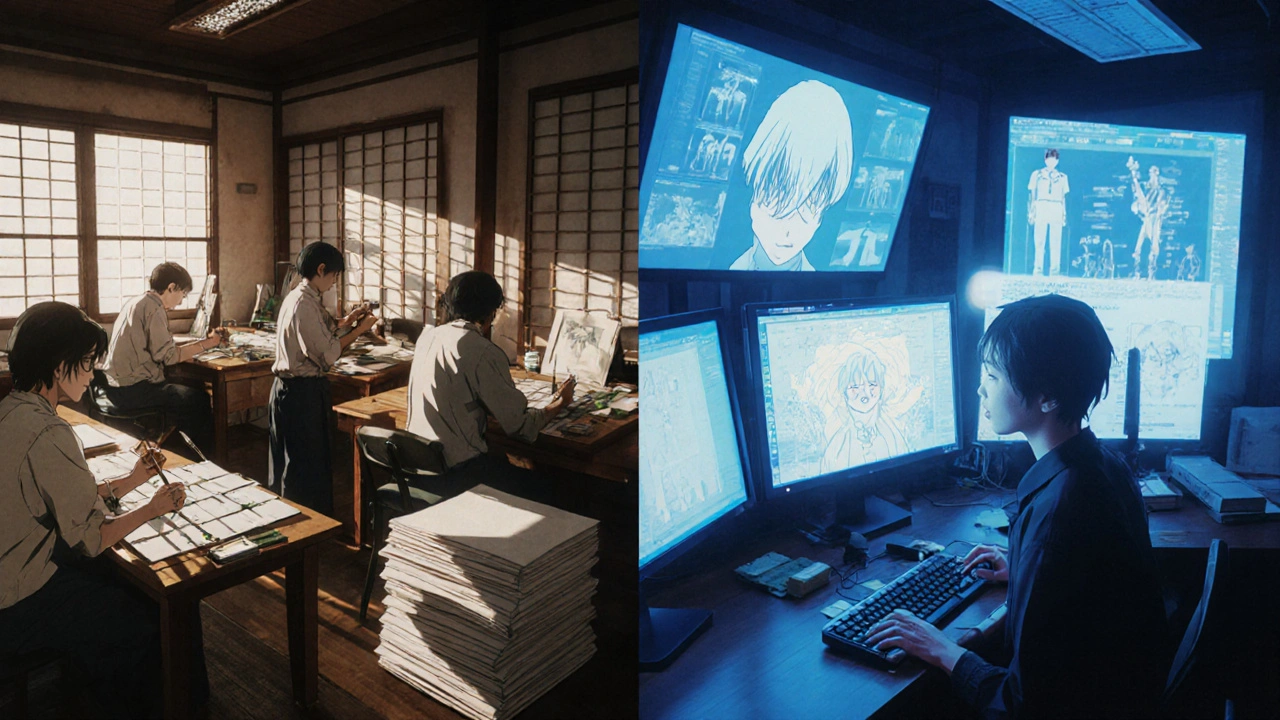
CGI Anime: How Digital Animation Is Redefining Animated Films
When you think of CGI anime, a style of animation that uses computer-generated imagery to create moving characters and environments in the Japanese anime tradition. Also known as 3D anime, it blends the emotional depth of hand-drawn storytelling with the precision and scale of digital tools. Unlike traditional 2D anime, which relies on thousands of hand-drawn frames, CGI anime builds characters and worlds in 3D space—letting cameras move freely, lighting react naturally, and action unfold with physics-based realism. This isn’t just a visual upgrade. It’s changing how stories are told, who makes them, and how audiences experience them.
CGI anime doesn’t exist in a vacuum. It’s shaped by tools like real-time rendering, technology that lets animators see final-quality visuals as they work, using engines like Unreal Engine or Unity, and techniques borrowed from virtual production, a filmmaking method that uses LED walls and live camera tracking to blend digital backgrounds with live actors. Studios like Polygon Pictures, Trigger, and even Studio Ghibli have experimented with these methods—not to replace hand-drawn art, but to expand what’s possible. Some films, like Promare or Blue Exorcist: The Movie, use CGI for large-scale battles and complex environments, while keeping 2D-style faces and expressions to preserve emotional connection. Others, like Beastars Season 2, lean fully into 3D to make animal anatomy feel alive and weighty. The result? A hybrid form that’s neither fully 2D nor fully 3D, but something new.
What’s driving this shift? Budgets, speed, and audience expectations. Producing a 12-episode season of 2D anime can take over a year and require hundreds of artists. With CGI, one animator can reuse assets, tweak movements digitally, and iterate faster. Streaming platforms need content quickly—and CGI helps meet that demand without sacrificing visual ambition. But it’s not just about efficiency. Audiences now expect cinematic quality, even on small screens. That’s why even smaller studios are investing in VFX pipelines, motion capture, and lighting simulations that once belonged only to Hollywood blockbusters.
There’s still debate. Some fans miss the handcrafted feel of traditional animation. Others say CGI anime feels cold or lifeless when done poorly. But when it works—when the movement flows, the lighting feels real, and the emotion still lands—it’s undeniable. The best CGI anime doesn’t try to hide its digital roots. It uses them to amplify the story. Think of a character’s tear catching the light just right, or a crowd of thousands moving with individual rhythm. That’s not magic. That’s code, skill, and vision working together.
Below, you’ll find real-world examples of how studios are pushing CGI anime forward—from production tricks that save time, to how directors balance digital tools with artistic intent. Whether you’re a fan, an animator, or just curious about where animation is headed, these stories show the quiet revolution happening frame by frame.